
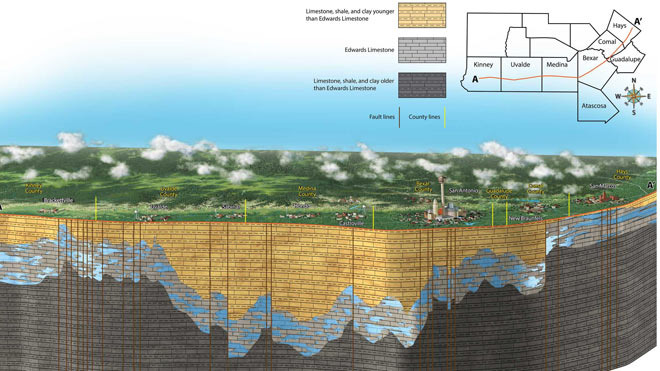
One of the biggest surprises for people moving to San Antonio is the fact that the seventh largest city in the U.S., with a population of over 1.6 million, relies much more on groundwater than on rivers or lakes.
Most of the tap water consumed by San Antonio residents comes from the Edwards Aquifer, which flows beneath the city.
An aquifer is essentially a massive natural water tank located underground.
It refers to the space where rainwater seeps into layers of permeable rock, like limestone, over time.
Although it is not visible like rivers or lakes, this water can be drawn up through wells for drinking or agricultural use.
However, the aquifer must be replenished by rainwater; if droughts last too long or usage is too high, the water level can drop, leading to shortages.
So when it rains heavily, the aquifer's water level rises quickly, but conversely, during prolonged droughts, the level drops rapidly.
Many people think, "Since it's groundwater, can't we just keep pumping it out?" but that's not the case.
The aquifer needs rainwater to be maintained. If there is little rain for several months, the amount of water used exceeds the recharge rate, causing the water level to drop.
Therefore, in San Antonio, water usage restrictions (Stage 1-5) are issued based on the Edwards Aquifer's water level.
This is why there are restrictions on the days and times for watering lawns when the level falls below a certain point.
San Antonio is naturally a city prone to drought. The average annual rainfall is about 30 inches, but it does not come evenly; it often falls in concentrated bursts.
Some years experience flooding from heavy rains, while others see almost no rain for months.
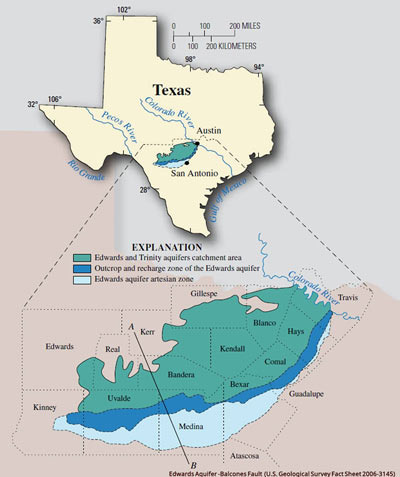
Interestingly, San Antonio is a city that worries about both floods and droughts. It's a bit funny, isn't it?
There can be tremendous downpours that flood the roads, but that rain doesn't necessarily fill the aquifer.
If it rains too hard, the water just runs off. Conversely, slow, steady rain can often be more beneficial for recharging groundwater.
Thus, San Antonio has been proactive in water conservation policies for a long time.
They encourage the use of low-flow toilets and showerheads, and promote 'xeriscaping' with drought-resistant native plants instead of water-intensive lawns.
The many homes with brown lawns in the summer are often related to water usage restrictions.
The good news is that San Antonio is consistently preparing to not rely solely on the Edwards Aquifer.
In addition to groundwater, they are expanding the use of reclaimed water and operating facilities to desalinate saline groundwater.
They are implementing long-term plans to ensure a stable water supply even as the population continues to grow.
Ultimately, the water in San Antonio is a resource created by both the sky and the earth.
To understand San Antonio, it seems necessary to recognize the vast, invisible aquifer underground and the efforts to protect that water. QuantumLove
 GlowLaundry








 Coding Elf |
 Dragon Lee |
 gravity |
 Agenda Center |
 Texas Migration Story |
 solvix18 |
 action blog 101 |
 Hajiwon Blog Hair Salon |
 TEXAS Fishing Boat |
  Omelet Rice for Strength |
  Vermont Capt |
  Softy |
  solid90 |
  waltz |
  Ohio Ohayoung Hello |
  parlon |
  Shoot Me |
  Michigan Enthusiast |
  festive |
  You Turn Me On |
  Supplemental Security Income (SSI) Information |
  Sams Market |
  ansdal |
  VVV 80 |
  BIODOCTOR NEWS |
  Gold Bar |
  Tamfa Fan |
  Jenny's Mom blog |
  Karina's Blog |