
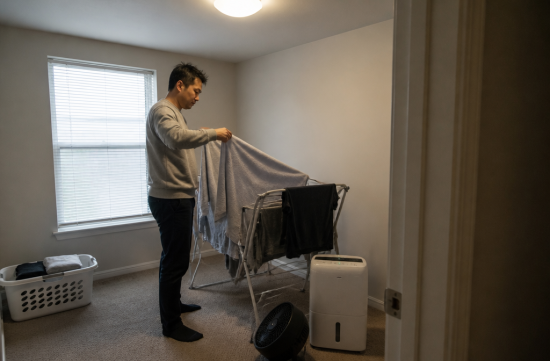
Last weekend, I hung towels on the drying rack in the living room and waited for two days. The outside was dry, but when I got close, I could smell that musty odor.
In the end, I washed them again. I used detergent, water, and time. It's quite annoying to go through this cycle several times every winter.
So this time, I did some proper research. I figured that understanding why the smell occurs would help me avoid unnecessary effort.
The culprit turned out to be bacteria rather than mold. A Japanese study published in the 2012 journal Applied and Environmental Microbiology identified a bacterium called Moraxella osloensis as the main cause of laundry odors.
This bacterium produces a substance called 4-methyl-3-hexenoic acid, which is responsible for that rag-like smell. Just the name alone makes it sound like it would smell bad.
The tricky part is that this bacterium can withstand drying quite well. The longer the laundry stays damp, the more time it has to reactivate.
So the key is simple: dry quickly. Before changing detergents, you need to reduce the time the laundry stays wet.
However, winter indoors can be surprisingly tricky. Windows are closed, the heater blows air from one side of the room, and the moisture from the wet laundry has nowhere to go.
The EPA recommends keeping indoor humidity below 60%, ideally between 30% and 50%. This range makes it difficult for mold to grow.
If humidity is high, it's not just the laundry that dries slowly. Water droplets form on window frames, and black spots start appearing behind closets or in the corners of bathroom ceilings.
I placed a small digital hygrometer, and after about an hour of hanging laundry, I could see the numbers rising sharply. Seeing it visually definitely raises awareness.
The first tip starts with the washing machine. Running an extra spin cycle significantly reduces moisture before hanging. Just avoid clothes that stretch, like knits.
The second tip is spacing. If you hang clothes too closely on the drying rack, the areas where they touch won't dry completely. Leave enough space for a fist to fit between them.
The third tip is airflow. Using a fan or circulator to blow air from below the laundry upwards greatly speeds up drying. The moist air escapes upwards and doesn't linger between the clothes.
The fourth tip is to avoid placing clothes against walls. Hanging them near cold exterior walls can cause moisture to condense on the wall, making it easier for mold to grow later.
The fifth tip is my personal favorite. Place the laundry and a dehumidifier in a small closed room. The smaller the space, the better the dehumidifier works.
The bathroom is also a good option. If you keep the exhaust fan on and the door closed, moisture won't spread throughout the house.
However, avoid the bathroom right after a shower when it's filled with steam. Run the exhaust fan for about 30 minutes first to dry the walls and floor, then hang the laundry for much quicker drying.
Avoid placing laundry directly on heater vents or radiators. While it may seem like it would dry quickly, it can damage the fabric and strain the appliance.
In fact, sometimes you should suspect the washing machine before the laundry itself. Researchers from the University of Pforzheim in Germany reported finding this bacterium in the rubber seals of household washing machines.
So after washing, leave the door open and occasionally clean the inside of the rubber seals. I run a cleaning cycle for the drum once a month. It may seem like a hassle, but it only takes ten minutes.
It's also important to develop the habit of taking laundry out immediately after it's done. Laundry left sitting in the drum for hours is already preparing to smell before you even hang it up.
Many suggest washing towels separately and reducing fabric softener. The reason is that softeners coat the fibers, reducing absorbency and drying speed. For towels that smell particularly bad, washing them separately in hot water is also a good idea.
If you use a dryer at home, there's one more task. According to a report from the U.S. Fire Administration (USFA), there are an average of 2,900 residential dryer fires each year, with the highest number occurring in January.
The data is from 2008 to 2010, so it's a bit outdated. However, the warning that dryer fires peak in winter is still repeated by fire departments every year. With more laundry in the winter, it's something to be more cautious about.
The most common cause was not cleaning the lint trap. The USFA recommends emptying the lint filter every time before and after running the dryer.
On snowy days, make sure to check that the outside vent cover isn't blocked by snow or ice. If the vent is blocked, drying won't happen, and the risk increases. There are likely many homes that haven't checked this at all throughout the winter.
In summary, it's simple: one more spin, wide spacing, airflow from below, a dehumidifier in a small room, and keep the washing machine door wide open.
After making these changes, my towels dry fluffy in just one day. It's just a matter of following the steps like keeping time with music.
Personally, I believe a dehumidifier is much better than an expensive deodorizing spray. Covering up odors just adds another layer of smell on top of the existing one.
I hope this winter will be a season without the need to wash again. Just one fluffy towel can make a cold morning feel a little lighter.
 Have4Vibes
 Bridge79



 tredolo |

 Anjollinya Blog |

 Kitchen Ideas |

 Spaghetti Flying Religion |

 Giant Squid and Sweet Potato Soup |

 sugarotter |

 frostpup |


 Good Karma |

 milkbear |
 Colorado Lee |
 kiwiii |
 foxtrot83 |
 stiff |
 namico |
 Caribbean |
 dynamico |
 Elastico |
 United States Army |
 Moving Waterfall |
 travelo |
 BOOM BOOM BOOM |
 blues town |
 glenview 89 |
 Mr Oh |
 skiny joe |
 envora21 |
 silverfox |
 nameone |
 bayaa |