
Last month, I opened my electricity bill and was momentarily stunned. I hardly used the air conditioner, yet the numbers were higher than this time last year.
So this time, I really dug in to find out how much Idaho's electricity rates have actually increased and what this winter's heating costs will look like.
First, let's address the claim circulating online that rates have gone up by "11% in a year." To cut to the chase, official data hasn't confirmed exactly an 11% increase.
Different rate comparison sites report varying figures, like 4% or 12%, making it hard to trust any single source. Therefore, let's stick to the numbers confirmed by official announcements and take it step by step.
The biggest change is the increase effective January 1st. The Idaho Public Utilities Commission (IPUC) approved a rate increase agreement for Idaho Power, with an overall average increase of 7.48%.
According to Idaho Power, a typical household using 900 kWh per month will see an additional $12.13 on their bill. The basic service fee of $15 remains unchanged. Over a year, that adds up to $145.56.
Additionally, in April, there was another application for the annual Power Cost Adjustment (PCA). When combined with fixed cost adjustments, the proposal indicated a monthly increase of 3.15%, or $3.64, for households using 900 kWh.
This application aimed for implementation on June 1st, but I haven't been able to confirm the final approved amount. You can find the exact details on the IPUC website under case number IPC-E-26-10.
Why are rates increasing? According to Idaho Power, the main reason is water scarcity.
This company relies on hydropower, which is the cheapest electricity, but ongoing drought conditions have reduced the amount they can generate. They have to purchase more expensive electricity from the market, and those costs ultimately show up on our bills.
However, amidst the frustration, there's one comforting number. According to the U.S. Energy Information Administration (EIA), the average residential rate in Idaho was 12.35 cents per kWh in May this year.
In comparison, the national average was 18.44 cents as of August, so we are still on the lower end. Data from the Idaho Department of Labor indicates that the average for 2025 is projected to be 11.52 cents, making it the second lowest in the nation.
But just because it's cheaper doesn't mean I can celebrate. My bank balance isn't just low; it's at rock bottom.
Now, let's talk about winter. Idaho Power's residential rates are divided into summer rates from June to September and non-summer rates from October to May.
The non-summer rate is lower than the summer rate, but as usage increases, the rates go up in tiers. If you run an electric heater all day, you'll quickly surpass those tiers.
Let's do a simple calculation. If you use 1,500 kWh in a month during winter and multiply it by the EIA average rate of 12.35 cents, you'll end up with $185.25.
Of course, the actual bill will differ due to tiered rates and service fees, but this gives a good sense of the scale.
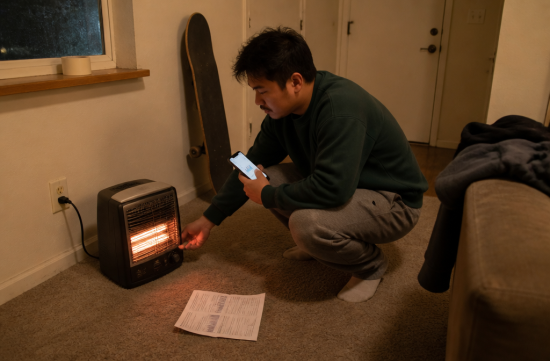
Those of us relying on a single electric heater need to be especially cautious. I still vividly remember waking up in shock after seeing my bill last winter when I had fallen asleep with the heater on.
Homes using gas for heating have a different situation. Intermountain Gas filed an application in August to lower prices starting October 1st.
This proposal aims to reduce annual revenue by $11.06 million, and the company indicated that most customers would see a decrease in their rates. They attributed this to last winter being warmer, which led to a drop in both gas prices and demand.
However, it's best to check the final approval status and the rates applicable to your home directly on the IPUC case number INT-G-26-04.
So what can we do? I've compiled a list of things I plan to try this winter.
First, if your household uses more than 800 kWh a month, consider comparing Idaho Power's time-of-use rates. The company's FAQ suggests that this may be suitable for homes with high usage and flexible timing.
Second, run your laundry or dishwasher during off-peak hours. This is the easiest change since it doesn't cost anything—just a shift in habit. If I can overcome my laziness, that is.
Third, apply weather stripping tape around windows and doors. You can buy it cheaply at a local hardware store, and the difference is more significant than you'd expect. Lowering the heater temperature by a degree or two can make it feel less cold.
Fourth, check your monthly usage graph on your Idaho Power account. If you see a spike in a particular month, you can quickly identify whether the culprit is the heater or the hairdryer. For me, it was my gaming computer.
And here's one more piece of good news. Idaho Power has stated that they will not file for a general rate increase in 2026, so there won't be any increases from that side next year.
Personally, it's a bit disheartening to see climate issues like water scarcity reflected in our rates. Investing in renewable energy and storage facilities seems like a way to ultimately protect our wallets.
This winter, I plan to start by comparing rates and using a timer for my heater. Let's all stay warm and avoid any surprises when the bills arrive.
 WhaleJamBand
 OneCupDream

 Carolina border |
 juicylol |
 Mr Song Song |
 Way to easy |
 holy cow |
 new noah |

 A landlocked state |

 Idaho's Sumi's House |

 Korean Boo |


 foxtree |
 Colorado Lee |
 kiwiii |
 foxtrot83 |
 stiff |
 namico |
 Caribbean |
 dynamico |
 Elastico |
 United States Army |
 Moving Waterfall |
 travelo |
 BOOM BOOM BOOM |
 blues town |
 glenview 89 |
 Mr Oh |
 skiny joe |
 envora21 |
 silverfox |
 nameone |
 bayaa |