
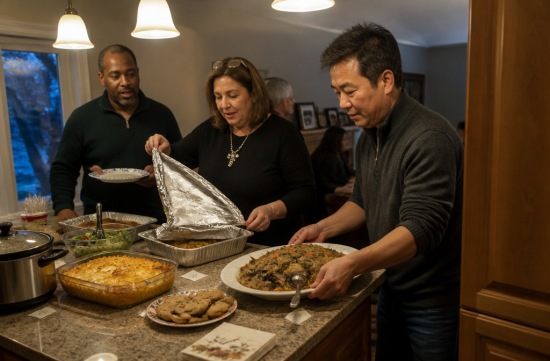
When I first immigrated, I was invited to a neighbor's dinner and spent a long time pondering what to bring. I decided to bring a box of fruit in the Korean style, but the host looked grateful yet slightly awkward.
It turned out that it was a potluck. While everyone else brought a dish, I was the only one standing there with a box of fruit. In the end, the fruit was left untouched on the dessert table.
Since then, I've paid close attention to what Americans say when inviting others. Even for the same dinner invitation, what you bring can vary completely depending on whether it's a dinner party or a potluck.
The term "potluck" is interesting when you look at its origins. The earliest recorded use in English dates back to 1592, attributed to the British writer Thomas Nashe.
Its meaning back then was different from today. It referred to a meal where food was served directly from the pot without any prior preparation for unexpected guests, literally leaving it to luck.
There's also frequent mention that it comes from the potlatch, a sharing feast among Native Americans. However, since the British records from the 1590s came first, I find the interpretation of it as a combination of pot and luck more convincing.
The practice of everyone bringing a dish to share became widespread during the Great Depression in the 1930s. The idea was to share the burden instead of one household preparing everything.
Especially in the Midwest, church fellowship gatherings and potlucks often went hand in hand. Different regions have different names for them.
In the East, they are often called covered dish suppers, while in Indiana, the term "pitch-in" is used. People in Minnesota associate such gatherings with a casserole dish called hotdish.
Ultimately, the essence of potluck is practicality. Instead of one host preparing dozens of servings, the burden is shared, allowing everyone to taste a variety of foods. For guests, having just one dish to bring makes it easier, and it opens up conversations about food with neighbors they may not know well.
Understanding this structure helps answer what to bring. At a potluck, the correct choice is a dish that can be shared and eaten right away.
However, a dinner party is different. Bringing food to a gathering where the host has already planned the menu can be seen as rude.
The Emily Post Institute, which has long been recognized for its authority in etiquette, explains that dinner party guests typically bring a small gift. Close friends who often eat together may be an exception.
Interestingly, Lizzie Post, co-president of the institute, has clearly stated that bringing a gift for the host is not mandatory. This means that arriving empty-handed is not considered rude.
It's also worth remembering the explanation regarding wine. Wine brought to a dinner party is considered a gift rather than part of the menu, so the host shouldn't feel upset if it isn't opened that day.
If bringing flowers, it's recommended to bring them already arranged in a vase. This consideration helps the busy host avoid the hassle of finding a vase and filling it with water.
From my experiences, there are a few unwritten rules for potlucks. First, it's important to ask in advance what to bring.
Often, the hosts will divide the dishes into categories like salad, main course, and dessert. I once saw a situation where five dishes of dessert showed up because no one asked.
Second, bring your dish ready to serve. If you plan to use someone else's oven or stovetop to heat it up, the kitchen can quickly become crowded.
Third, remember to bring serving spoons for your dish. Surprisingly, many people forget this, leaving the host rummaging through kitchen drawers.
Fourth, label your dish. After the gathering, if there are about ten similar glass containers stacked up, no one will know whose is whose.
Nowadays, many people are mindful of allergies or dietary restrictions, so it's becoming more common to attach a small note indicating whether there are nuts or meat in the dish. Though it may seem trivial, such consideration leaves a good impression.
From a Korean perspective, there's often a dilemma about whether to bring Korean food. In my experience, dishes like japchae or kimbap, which are not spicy and taste good even when cold, tend to be well-received.
On the other hand, it's better to avoid strong-smelling stews or dishes that require a lot of preparation. The more unfamiliar the food, the easier it should be to eat.
With Thanksgiving season approaching, there will likely be more invitations. I recommend checking if the invitation text includes the phrase "bring a dish."
If it does, it's a potluck; if not, it's likely a gathering where the host will prepare everything. If it's unclear, asking what would be appropriate to bring is the safest bet.
The Emily Post Institute also advises sending a thank-you note after the gathering. If a handwritten note feels too burdensome, sending a short text the next day is a good idea.
Looking back, that box of fruit wasn't a wrong choice. I just didn't know the rules of the potluck game.
If it were me, I would bring wine or flowers in a vase for a dinner party, and for a potluck, I would prepare a dish of japchae along with a serving spoon. In American invitation culture, the key is to help lighten the host's load.
 TiusMom
 CommuteHell



 xylora |

 Tan Zoo |

 hot chocolate |

 Chichiki Chicago Train |

 Noodle Noodle |

 Far East Movement |

 moo moo |




 Epoca News |
 Colorado Lee |
 kiwiii |
 foxtrot83 |
 stiff |
 namico |
 Caribbean |
 dynamico |
 Elastico |
 United States Army |
 Moving Waterfall |
 travelo |
 BOOM BOOM BOOM |
 blues town |
 glenview 89 |
 Mr Oh |
 skiny joe |
 envora21 |
 silverfox |
 nameone |
 bayaa |