

Living in San Antonio, one item that is almost a staple in Southern homes is the ceiling fan.
They are typically installed in the master bedroom and are common in living rooms, other bedrooms, and even back patio areas.
You can find them not only in Texas but also in Florida, Georgia, and Louisiana.
However, there is a surprisingly unknown feature of these ceiling fans.
Specifically, you need to change their rotation direction according to the season.
At first, I thought it was just a ceiling-mounted fan.
But it turns out that in summer, it helps with cooling, and in winter, it enhances heating efficiency.
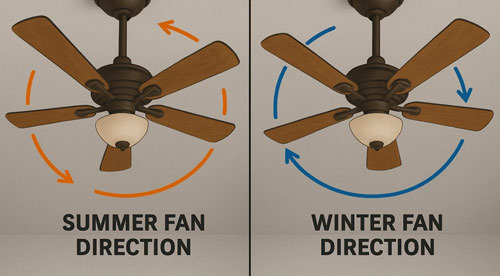
Counterclockwise in Summer, Clockwise in Winter
In summer, it's best to set the fan to rotate counterclockwise.
This rotation pushes air downwards.
As the air hits your skin, it helps sweat evaporate faster, making you feel cooler than the actual indoor temperature.
According to the U.S. Department of Energy, using ceiling fans properly can allow you to raise your air conditioning setting by about 4°F (2.2°C) while still maintaining comfort.
For example, if you usually set your air conditioning to 74°F, you can raise it to 78°F while using the ceiling fan and still feel similarly cool.
Conversely, in winter, it's common to switch to a clockwise rotation and run it at a low speed.
Since warm air rises, heating can cause hot air to accumulate near the ceiling.
By slowly rotating the ceiling fan clockwise, it pulls air up towards the ceiling and circulates warm air down along the walls.
This air circulation can particularly help improve heating efficiency in homes with high ceilings in the U.S.
However, since the blade structure can vary by product, it's best to check where the actual airflow is directed rather than just relying on the rotation direction.
How to Change the Rotation Direction?
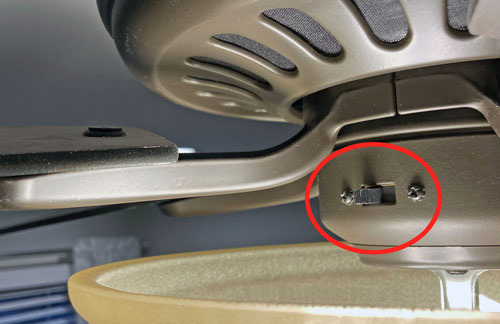
Older ceiling fans usually have a small switch on the side or top of the motor housing.
This switch typically moves up and down or side to side, and changing it to the opposite position will alter the rotation direction.
Recent models may have a Reverse button on the remote control or allow changes via a smartphone app.
It's important to ensure that the fan is completely stopped before changing the direction.
For products installed on high ceilings, it's advisable to use a safe ladder or hire a professional instead of attempting to climb up yourself.
Maintaining your ceiling fan is also crucial, with dust cleaning being the most important task.
Dust can accumulate more than you might expect on the top of the blades. Cleaning them once every month or two is recommended.
Most modern ceiling fans use motors that do not require separate oiling, so unless the manual specifies otherwise, there's no need to add lubricant.
Additionally, it's good to know that ceiling fans should be turned off in rooms without people during the summer.
Ceiling fans do not cool the air like air conditioners; they simply circulate air to lower the perceived temperature for people.
Ultimately, a ceiling fan is not just a decorative item. It is a practical device that creates a cool breeze in summer and circulates warm air collected at the ceiling in winter.
Now that mid-October has passed, cooler weather is gradually arriving in San Antonio.
If you start using heating soon, be sure to check the rotation direction of your ceiling fan.
Counterclockwise in summer, clockwise in winter.
If you didn't know this feature while living in the U.S., make sure to learn it this time.
 YoungsTown
 RamenSparta







 prixon74 |

 Balancework |

 Make My Day |

 viroma |

 eatontown blog |

 Helpful Life Stories |

 History Repeats Itself |
 Kitchen Ideas |
 Diana Blues |
 Agenda Center |
 Community Cross |
 journey |
 heeve |
 leman |
 corner kick |
 treasure |
 strawberry |
 Augusta Univ |
 B.I.G. Victor |
 Victory 1988 |
 Swift Falcon |
 venture |
 SPAM 101 |
 choi family |
 zoryan |