
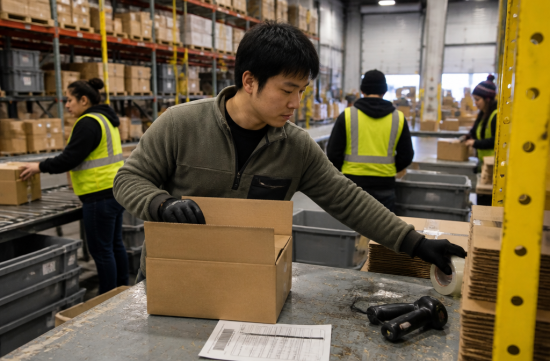
Last week, a friend of mine reached out to see if I wanted to work at an Amazon warehouse during the year-end season. They heard that seasonal workers would get health insurance starting from day one, and they asked me if that was true.
Curious, I looked up Amazon's official announcement. To sum it up, part of it is correct, and part of it is a bit different.
On October 20, Amazon announced that it would hire over 300,000 people across its logistics network in the U.S. for this year's holiday season. This number includes seasonal, part-time, and full-time positions.
According to a Reuters report, Amazon has hired 250,000 people each holiday season for the past three years. So, this marks the first increase in scale in three years, with a 20% rise.
The National Retail Federation (NRF) predicts that total seasonal hiring in retail this year will be between 325,000 and 375,000. Since this is about the same level as last year, it shows how significant Amazon's role is in the overall industry.
NRF forecasts that retail sales in November and December will increase by 4.2% compared to last year, reaching $1.13 trillion. When more products are sold, there will ultimately be a need for people to transport and deliver those boxes.
Now, regarding the health insurance that my friend was most curious about. Amazon stated that it would provide health insurance to seasonal workers who work over 30 hours a week starting from their first day.
However, this policy will begin on January 1, 2027. The key point is that it does not apply immediately.
The announcement specifies that seasonal workers hired before January 1 will be able to use the insurance starting from January 1, not from their hire date. So, if someone starts in November and finishes in December, they essentially won't receive the benefits.
On the other hand, if someone continues working after January or starts next year, the situation changes. The plan starts at $5 per week, and the copay is also listed as starting at $5.
Honestly, the $5 per week figure surprised me. Anyone who has purchased insurance individually would know how low that amount is.
I also checked the pay rates. The average hourly wage for seasonal workers is $20, and full-time logistics positions start at a minimum wage of $20.
The average hourly wage for all logistics personnel is reported to be just under $24. Amazon stated that the average total compensation for full-time employees, including benefits, exceeds $32 per hour.
However, this is a national average, so actual hourly wages may vary by region. Be sure to check the hourly rates listed in each job posting before applying.
There are also quite a few other benefits. Employees receive a 10% discount on groceries and essentials from Amazon.com and Whole Foods online, and a 20% discount in Whole Foods stores.
Existing benefits include free Prime membership, 401(k) company matching, and paid parental leave. The Career Choice program, which supports tuition, reportedly pays up to $5,250 per year in advance.
A new low-cost banking service in partnership with First Tech Credit Union will also be rolled out. It will gradually open starting at the end of this year and will be fully available by 2027.
Of course, whether all benefits apply equally to seasonal workers may vary depending on the type of employment. It's best to ask the hiring manager directly for clarification.
Applications can be submitted at amazon.com/localjobs. You can also text NEWJOB to 31432 to receive alerts for new job postings.
Job postings will not all go up at once; they will be released weekly from October to December. So, there's no need to give up immediately if you don't see your preferred time slot.
We should also discuss the reality of the situation. Warehouse jobs often require standing or walking all day, and during the holiday peak season, overtime is common.
If you don't have the stamina, you might jump in just looking at the hourly wage and end up quitting after a week. It's wise to consider whether it's night shifts and how far the commute is beforehand.
Still, there are clear advantages. The company has stated that there is a pathway for seasonal workers to transition to full-time positions.
For first-generation immigrants, the fact that this job can be started even without fluent English is significant. I've seen many people use it as a stepping stone to gain their first job experience in the U.S.
On the other hand, there were reports that this hiring announcement came shortly after news of small layoffs in Amazon's retail division last month. It creates a bit of a mixed feeling to see one side reducing while the other side is ramping up.
Ultimately, I told my friend this: If they plan to finish in December, they shouldn't expect insurance and should just evaluate based on the hourly wage and discount benefits.
Conversely, if they plan to work longer into next year, it would be better to start now since insurance will apply from January 1 if they meet the 30-hour requirement.
If it were me, I would first look for a position that consistently offers over 30 hours a week. Since the insurance condition is tied to 30 hours, the working hours are essentially the most important number.
If you're considering a year-end job, don't just trust the "insurance from day one" claim; make sure to check the start date as well. Even for the same seasonal position, the benefits can vary significantly depending on how long you work.
 SunnyBridge92
 EndureRL








 Casa Mia |

 CA Real Estate |
 Eldorado 88 |

 limestone |

 loran |

 Helpful Life Stories |

 velaro29 |

 cortiva6 |

 Coco Chanel |

 havero70 |
 Colorado Lee |
 kiwiii |
 foxtrot83 |
 stiff |
 namico |
 Caribbean |
 dynamico |
 Elastico |
 United States Army |
 Moving Waterfall |
 travelo |
 BOOM BOOM BOOM |
 blues town |
 glenview 89 |
 Mr Oh |
 skiny joe |
 envora21 |
 silverfox |
 nameone |
 bayaa |