
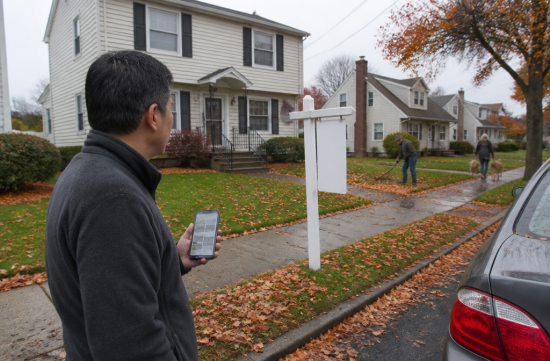
In summary, the Syracuse real estate market in October saw a decrease in transactions while prices remained stable. However, the official statistics for the entire month of October have not yet been released.
This report is based on the most recent data available. I will include sources and reference points for each figure.
First, let's look at the transaction volume. According to a report by This Is CNY, citing data from CNY Information Service, which is affiliated with the Greater Syracuse Association of Realtors, there were 2,771 housing transactions in Onondaga County by October 20.
This is 261 fewer than the same time last year. It's important to note that this decline is not a sudden drop in the fall but rather a continuation of a trend observed throughout the year.
The decrease is even more pronounced within the city of Syracuse. By September 8, there were 447 transactions in the city, down 11% from 505 during the same period last year.
The report views this as part of a nationwide trend of declining transactions. The National Association of Realtors (NAR) also confirmed this slowdown in transactions.
So, what about prices? While one might expect prices to drop with fewer transactions, recent market trends suggest otherwise.
The average sale price in Syracuse was $200,300 as of June 30, surpassing $200,000 for the first time. This represents a 9.6% increase from $182,700 a year ago.
It's important to note that this figure is an average, not a median. A few high-value transactions can significantly affect the average.
Nonetheless, the fact that the average price has risen while transactions have decreased signals that there are fewer listings available in the market. When there are more buyers than homes for sale, prices are less likely to drop.
Some suburban towns have seen even larger increases. As of early September, Manlius saw a 13% rise in prices and an 8% increase in transactions.
During the same period, Cicero and Lysander experienced a 13% increase in transactions. While transactions in the city are declining, some towns are seeing an uptick.
Notably, the latest data from the end of October highlights Clay. During the week ending October 20, 21 homes were sold in Clay, making it the most active area in the county.
However, Clay's cumulative transactions this year are down by 26 compared to last year. Yet, the average sale price has risen by 4.7% to $326,400.
Clay is located near the Micron semiconductor plant site, which continues to drive demand in the area. However, it should be noted that this report does not directly link Micron to the price changes.
Now, let's move on to rentals. The rental market is much quieter than the sales market, and the numbers vary across different sources.
According to data updated by RentCafe on September 30, the average rent in Syracuse is $1,699, down 0.28% from $1,704 a year ago.
In the same report, one-bedroom apartments are listed at $1,384, and two-bedroom apartments at $1,658. Studios are priced at $1,380, which is nearly the same as one-bedroom apartments.
RentHop's October data lists one-bedroom apartments at $1,100, indicating a 1.15% increase from $1,088 a year ago.
The significant difference in numbers between the two sites is due to their differing data collection methods. RentCafe focuses more on large management complexes, while RentHop emphasizes individual listings, so relying on just one source can be misleading.
However, there is a commonality: both sources show that the year-over-year changes are below 1%, indicating that rents are essentially stagnant.
If sale prices are rising while rents remain flat, the calculations for those buying homes to rent them out become tighter. I will revisit this point later.
There is also an issue worth noting from the tenant's perspective. On February 23 of this year, the Syracuse City Council voted on a good cause eviction ordinance, but it failed to pass with a tie vote of 4 to 4.
This ordinance would have prevented landlords from evicting tenants or refusing lease renewals without just cause and allowed tenants to contest significant rent increases. Small landlords with fewer than ten units were exempt from this ordinance.
According to Spectrum News, to pursue this again, a new proposal must be submitted to the city council. Since this matter has not been resolved, tenants should keep an eye on the city council's schedule.
In summary, Syracuse is a market where inventory is scarce, leading to fewer transactions but prices that are not easily swayed. The rental market appears to be in a stagnation phase based on average figures.
If you are looking to buy a home now, it may be better to look at transaction records in your desired town rather than relying solely on the overall city average. Trends can vary significantly by town, and even within the same county, there are areas where transactions have increased and others where they have decreased.
If your goal is investment, you should conservatively calculate returns in the current structure where purchase prices are rising faster than rents. Personally, I would assume minimal rent increases and adjust the numbers accordingly.
Official statistics for the month of October will be released sequentially in the coming weeks. When new data comes out, I plan to check whether the decline in transactions and the rise in prices continue through the end of the year and how rents behave during the winter off-season.
If the numbers change, our assessments should also change. I believe that is the most realistic approach to navigating this market.
 midnightroadwalker1949
 silvervalleytraveler1902





 Choco Choco Star |
 gentle |
 neapolis |

 moo moo |

 ultron78 |

 dynamic |

 Delicious Food Finder |

 namico |


 Vasila's Newlywed Blog |
 Colorado Lee |
 kiwiii |
 foxtrot83 |
 stiff |
 Caribbean |
 dynamico |
 Elastico |
 United States Army |
 Moving Waterfall |
 travelo |
 BOOM BOOM BOOM |
 blues town |
 glenview 89 |
 Mr Oh |
 skiny joe |
 envora21 |
 silverfox |
 nameone |
 bayaa |