

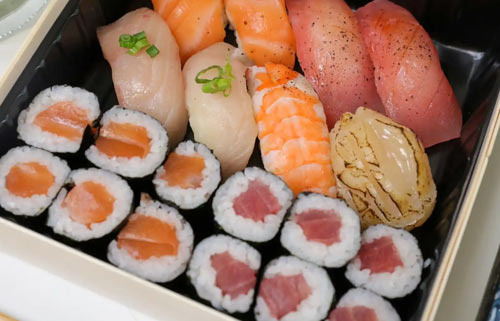
I won't disclose the name or exact location of the restaurant, as I think those who know the area will recognize it quickly.
I'll just say that I've been running a Japanese restaurant in Agoura Hills for the past 10 years.
It's a small establishment that does decent dinner business, mainly serving regular customers through delivery and takeout.
However, I recently encountered a truly unbelievable customer.
This was a first-time customer who ordered a combo menu that included sushi and rolls for delivery.
After receiving the food, they ate all the sushi and rolls but left the salmon roll, claiming there wasn't enough salmon and demanded a refund over the phone.
At first, I thought they only wanted a refund for the salmon roll. But no, they wanted a full refund for the entire combo.
How does that make sense? They ate everything and now want a full refund just because they left one roll behind. Is that reasonable?
In my 10 years of business, I've encountered all kinds of customers, but this situation is truly maddening.
If the food was spoiled or the order was wrong, I would naturally take responsibility.
But demanding a refund for food that was eaten just because the salmon was less than expected? I can't understand that mentality.
Moreover, this was a first-time customer, not even a regular.
With such a start, I worry about what demands they might make if they order again.
Honestly, running a restaurant in California these days is incredibly tough.
Compared to five years ago, the cost of ingredients has completely changed.
Salmon, tuna, shrimp, sushi rice, seaweed, avocado, cream cheese—there's no ingredient that hasn't gone up in price.
Especially items like seaweed or fish roe may seem trivial to customers, but they are a significant burden for us.
Ingredients like ikura (salmon roe), tobiko (fish roe), and masago fluctuate in wholesale prices based on import costs and exchange rates.
Fish must be transported in refrigerated conditions, so if transportation and fuel costs rise, that burden ultimately falls on the restaurant.
Packaging containers, soy sauce, wasabi, pickled ginger, chopsticks, and sauce cups all cost money.
Delivery-focused restaurants use a lot of packaging, so those costs can't be ignored.
Labor costs are even more serious. In 2021, California's minimum wage for small businesses was $13 per hour, but by 2026, it will be $16.90.
That's a 30% increase in just five years.
If you hire one employee for 8 hours a day for 22 days a month, the minimum wage alone is about $2,974.
On top of that, you have to add the payroll taxes and workers' compensation insurance that the employer pays. I'm currently employing three staff members, and I'm considering whether I need to reduce that number.
This area also has high electricity costs. Refrigerators and freezers for fish must run 24/7, and rice cookers and kitchen equipment continuously use electricity.
Rent is a constant worry every time the lease is renewed, and insurance premiums and various maintenance costs keep rising.
And what about the delivery app fees?
When orders come through DoorDash or Uber Eats, a commission of about 20-30% is deducted according to the contract.
If I sell a roll for $20 and the commission is 30%, that means I lose $6 and only have $14 left. After deducting ingredient costs, packaging, employee wages, and rent, how much is left?
But I can't just raise the prices of the food at will. Even a $2 increase on a roll makes me worry that orders will drop because customers will think it's too expensive.
So, the news about restaurants in the LA area closing down one after another doesn't feel distant at all.
I read in the LA Times that over 100 famous restaurants closed in 2024 and 2025.
Restaurants that have been in business for decades are shutting down, and even those that seemed busy have eviction notices posted when you visit.
In the past, if a restaurant closed, I would think it was because the food was bad or the business was poor, but now I realize that's not always the case.
If sales come in but there's no profit, eventually, you have no choice but to close.
These days, I often think about wanting to close my restaurant.
After 10 years of running the place, I haven't had a proper weekend off, and I've worked hard to take one more order while others are out enjoying their holidays.
I've managed to hold on, but now it seems like hard work doesn't guarantee any profit.
And then to have a customer who finishes the entire sushi combo and demands a full refund for just one salmon roll left is truly disheartening.
If I refund them, it feels unfair, but if I refuse, I worry about a negative review on the delivery app.
Honestly, it's not about the few dozen dollars.
It's upsetting that the food I put so much effort into is treated this way.
I even considered just refunding them as a way to avoid conflict.
But if I give in this time, what will they demand next time?
And fighting with customers only tires me out.
I know there are many good customers out there.
Thanks to those who order quietly, enjoy the food, and come back to order again next week, I've managed to stay afloat.
But in a situation where ingredient and labor costs are skyrocketing and restaurants are closing one by one, the stress from one difficult customer feels different than before.
What I used to brush off with a smile now lingers in my mind even after I get home.
I'm even tempted to smoke again, something I quit a long time ago, just to cope with the stress.
How many more years do I have to endure this struggle?
Would it be better to close the restaurant and do something else?
It's hard to let go of a business I've run for 10 years, but I also wonder if just holding on is the right answer.
I understand the saying that the customer is king. But the people running the business are human too, and they work to make a living.
If I have to accommodate a customer who finishes the entire sushi combo and demands a full refund for just one salmon roll left, how much longer do I have to endure?
Tomorrow, I'll wake up early to cook rice, prepare fish, and roll sushi again, but these days, I can't help but sigh.
After 10 years in business, I'm seriously considering closing down for the first time.
Honestly, running a restaurant in California is becoming increasingly unbearable.
 MorningSun
 SunnyStone90







 limestone |

 loran |

 DeArizona Blog |

 Swift Falcon |
 Tonky |

 Weekend Movie Blog |

 Superman Cat Blog |

 Valley Hong |

 My Town My Way Blog |
 Awesome Blog |
 Key spots |
 berrypup |
 Yo Lock Me Up |
 Oh my Julia |
 bibigoo |
 silents |
 Team Korea Psychoanalysis Research |
 North Dakota Ragdoll Cat Owner |
 El Dorado |
 Cap Com |
 Trot King News |
 Blondee |
 some fame |
 rapidfire |
 walnutbo |
 Shinbaram Dr. Blog |
 breaddough |
 Michigan Enthusiast |
 Only Dentalbay |
 postcard |