
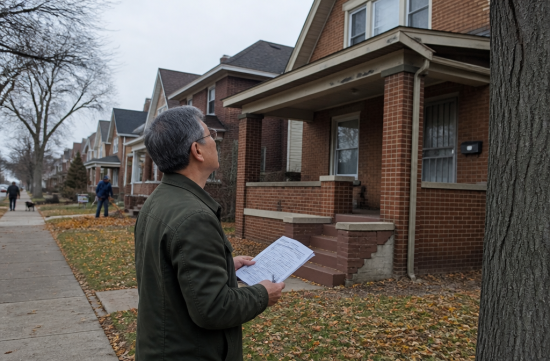
I'm reminded of a tenant who received a rent renewal notice. They mentioned that their monthly rent has increased slightly, even though it's the same house as last year. Is it true that rents in Detroit are really rising again?
To put it simply, rents have rebounded while home prices remain stagnant. I've been observing this market for a long time, and it's rare to see these two indicators diverging like this. Let's verify each one with numbers.
First, let's look at rents. Apartment List's November rent report reflects the movements from October.
According to this data, the median rent for the city of Detroit is $1,076, which is a 1.3% increase over the month of October.
Compared to a year ago, this is a 3.8% rise. During the same period, the average in Michigan was 3.5%, and the national average was just 0.1%.
This means that while the nation has essentially stalled, Detroit has seen a slight increase above the state average. This difference is not something to overlook.
When broken down by the number of bedrooms, the median for a one-bedroom is $778, while a two-bedroom is $1,042. Compared to other major cities, these figures are still relatively low. However, just because they are low doesn't mean they won't rise.
We also need to consider the trend. According to data from Apartment List cited by Axios, the median rent in March of this year was $1,038, which was down 2.3% compared to the previous year.
This indicates that while rents were declining in the spring, they have turned upward in the fall. The increase reflected in the renewal notices aligns with this trend.
Now, let's discuss home sales. The statistics for October sales have not yet been released. The most recent available data is from August.
The September report from Real Estate One, based on Realcomp MLS data, covers the performance from August. This figure specifically tracks single-family homes in Detroit.
In August, there were 361 single-family home transactions, which is a 13% decrease from July. The number of new listings in the same month was 968, which is similar to the previous month.
The average sale price is around $123,000, which is 11% lower than the previous month. The price per square foot is $94.
Since monthly figures can be erratic, it's better to look at the annual totals. From January to August, there were 3,023 transactions, which is 8% less than the 3,279 transactions during the same period last year.
During the same timeframe, the average sale price was $124,088, which is nearly the same as last year's $124,574. This indicates a market where transactions are decreasing while prices are holding steady.
In this situation, sellers are not lowering their prices, and buyers are not rushing to purchase. This is a common sight in a market where buyers have limited purchasing power, so it's not particularly surprising.
The situation is different for condos. According to the same report, the cumulative average price for Detroit condos and lofts is $299,976, which is 16% higher than last year.
However, the number of condo transactions is relatively low. A few expensive sales can significantly skew the average, so caution is advised in interpretation.
We also cannot overlook the tax situation. The city announced earlier this year that residential property values have risen for 11 consecutive years, with an average increase of 10%.
However, this does not mean that taxes will increase by 10%. If there is no change in ownership, the increase in taxable value is capped by state law, and this year it is 2.7%.
Conversely, those who purchased homes this year will have their values reassessed without the cap. It's important not to rely solely on the previous owner's tax amount when making a judgment. It's safer to inquire with the city assessor's office about the expected tax amount in advance.
There are also two notable local issues that emerged in October. The city hall summarized and released key announcements on October 8.
The first is the strengthening of code compliance for rental housing with one to two units. This is part of a five-point plan introduced by the Sheffield mayor, aimed at ensuring small rental properties meet safety standards.
Tenants can report serious housing issues on the Tenant Support page of the city website. The registration status of homes can also be checked on the city's rent compliance map.
The second issue is the alley sewer repair program. The city plans to spend $184 million to repair 9,000 private sewer connections at no cost to homeowners.
No application is necessary, and notifications will be sent block by block before the work begins. This is welcome news for neighborhoods with many older homes.
The city has also signed an administrative directive prioritizing housing repairs and appointed a senior advisor for housing repairs. Specific budget figures have not yet been released.
In summary, tenants should compare the increase in their renewal notices with the surrounding market rates. If it's significantly higher than 3.8%, there may be room for negotiation.
Investors should first calculate repair costs and code compliance expenses rather than focusing solely on home prices. For homes priced around $100,000, repair costs often determine profitability more than the purchase price.
If I were buying for rental purposes, I would choose a property that can pass inspections over a cheaper option. In a tightening regulatory environment, that ultimately proves to be the better investment.
Once the October sales statistics are released, I will check again to see if this trend continues. Numbers should always be viewed in context with the reference point.
 SeaMedia
 Snowman






 Choco Choco Star |
 gentle |
 neapolis |

 moo moo |

 ultron78 |

 oflare |

 So is multiplied by So, So Ji-sub |

 Michigan Enthusiast |

 U.S. Weather Bureau News |

 juniper |
 Colorado Lee |
 kiwiii |
 foxtrot83 |
 stiff |
 namico |
 Caribbean |
 dynamico |
 Elastico |
 United States Army |
 Moving Waterfall |
 travelo |
 BOOM BOOM BOOM |
 blues town |
 glenview 89 |
 Mr Oh |
 skiny joe |
 envora21 |
 silverfox |
 nameone |
 bayaa |