
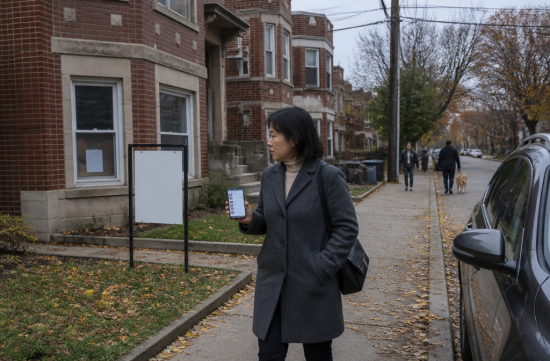
To summarize the Chicago real estate market in October, rents are stabilizing while the sales market still faces a shortage of listings. The two markets within the same city are moving at quite different temperatures.
First, let's look at rents. Since the October figures are already available, it's easier to make comparisons in this area.
According to Apartment List's November rent report, the overall median rent in Chicago dropped by 1.1% during October, bringing it to $1,858. This report reflects the movements of the month of October.
When divided by the number of bedrooms, the median for one-bedroom apartments is $1,723, while for two-bedroom apartments, it's $1,875. It's noticeable that the price difference between the two isn't as large as one might expect.
While a one-month decline may seem like good news, it's still 3.4% higher compared to a year ago. The slight drop in rents during the fall is part of a seasonal pattern that occurs every year.
Widening the comparison makes Chicago's position clearer. In the same report, the average increase in Illinois was 2.9%, while the national average was just 0.1%.
While national rents are nearly stagnant, Chicago continues to see an increase in the 3% range. From a tenant's perspective, this yearly trend should weigh more heavily than a one-month decline.
Now, let's turn to the sales market. Since the October sales statistics have not yet been released, we'll refer to the most recent official figures from September.
According to the Illinois Realtors Association's September report, as of October 7, the median sale price in Chicago was $389,900, which is an 8.3% increase from $360,000 a year ago.
When broken down by housing type, the median price for single-family homes is $375,000, up 8.7%, while condos are at $400,000, up 6.7%.
It's not uncommon for the median price of condos in Chicago to exceed that of single-family homes, likely due to the significant proportion of transactions involving downtown and lakeside high-rise condos.
Although prices have risen, the number of transactions has decreased. In September, there were 1,681 transactions, which is 7.2% fewer than the previous year, with single-family homes down 9.7% and condos down 5.7%.
The most noteworthy figure is the inventory. At the end of September, there were 3,788 homes on the market, down 20.9% from 4,789 a year ago.
This means that one in five listings has disappeared, which explains why prices are holding steady despite the drop in transactions. With fewer sellers, buyers are competing among themselves.
The speed of sales has also increased. The time it takes for listings to go under contract is now 27 days, which is four days shorter than the 31 days in September of last year.
Looking at the cumulative data from the beginning of the year through September, the median price has risen to $403,000, an increase of 6.9%. This indicates a trend that has continued throughout the year, rather than a temporary spike.
When you factor in interest rates, the situation becomes even more complex. According to Freddie Mac, the average 30-year fixed mortgage rate was 7.24% as of October 29.
This is slightly down from 7.32% the previous week, but over 1 percentage point higher than 6.17% a year ago. Even for the same house, the monthly principal and interest burden has definitely increased compared to last year.
High interest rates discourage existing homeowners from selling their homes, as they are reluctant to give up lower rates. This is one reason why the inventory shortage is not easily resolved.
Currently, the biggest local issue in Chicago real estate is the tenant protection ordinance. Mayor Johnson's Protecting Renters Ordinance is in contention with the FAIR ordinance proposed by Alderman Viegas.
The market passed the housing committee in September with a vote of 12 to 9, but during that process, provisions to prevent unjust evictions and relocation assistance were removed. The FAIR proposal passed the zoning committee with a vote of 12 to 6.
Both proposals include a rental registration requirement and a dedicated tenant protection department. The FAIR proposal also includes a provision to cap security deposits at one and a half months' rent.
The vote in the full council on September 23 was postponed to allow for further negotiations. As far as I can confirm, there has been no final passage news from the full council yet, so it would be best to check the official city council records or local media for updates.
Regardless of how the ordinance is finalized, it is likely that landlords will face new registration requirements. If you are a Korean landlord with a two-flat or small multi-family property, it would be practical to review your lease agreements and security deposit management methods now.
So, is it better to buy now or continue renting? When you lay out both options side by side, the answer becomes a bit clearer.
Renting is entering the winter off-season, which is a time when there may be room for negotiation. If your lease renewal is approaching, it might be worth asking for a smaller increase based on current market rates.
When it comes to buying, rather than waiting for prices to drop, the more important criterion is whether you have the capacity to refinance when interest rates go down. Given the current low inventory, expecting home prices to fall seems less substantiated.
Personally, I would take my time looking at listings during the winter off-season when competition is lower, focusing only on homes where the monthly payments are manageable even at a 7% interest rate. Once the October sales statistics are released, I will reassess whether this trend continues.
 NoodleDrone
 SleepyJolie








 Choco Choco Star |

 gentle |
 neapolis |

 moo moo |

 ultron78 |

 Illinois Mom |

 Rice Shop Uncle BLOG |

 blues town |


 Colorado Lee |
 kiwiii |
 foxtrot83 |
 stiff |
 namico |
 Caribbean |
 dynamico |
 Elastico |
 United States Army |
 Moving Waterfall |
 travelo |
 BOOM BOOM BOOM |
 glenview 89 |
 Mr Oh |
 skiny joe |
 envora21 |
 silverfox |
 nameone |
 bayaa |