
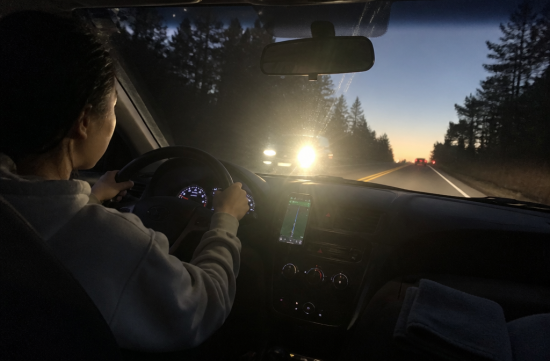
Isn't it really surprising when you come out of class and the sky is already dark? In November, the atmosphere for driving home or after school changes dramatically.
The reason is simple. Daylight saving time ended on Sunday, November 1, 2026, and the clock was set back one hour.
So now in Georgia, the sun sets before 6 PM. The earliest sunset this year will be around December 3, at about 5:35 PM.
As a result, the 5 PM to 6 PM rush hour is transitioning into twilight or night. Our bodies are still in summer mode, but the roads are already dark, so some adjustment is needed.
These days, the most common complaint I hear is that the headlights from oncoming cars are too dazzling. I thought I was the only one, but it turns out I'm not. Whenever this topic comes up in my friends' group chat, everyone resonates with it.
According to a survey released by AAA in March 2026, 6 out of 10 American drivers reported that glare at night is a problem. Nearly three-quarters of them felt it has worsened over the past decade.
Among those experiencing glare, 92% identified headlights from oncoming lanes as the main cause. Wow, that's almost everyone.
Of those who wear glasses, 70% reported experiencing glare, while 56% of non-wearers did. Female respondents reported 70%, while male respondents were at 57%, showing a significant difference.
AAA pointed to new headlight technologies and increasingly elevated vehicle designs as the causes. It turns out that the bright lights from large SUVs or pickup trucks hitting my eye level isn't just in my head.
For reference, this survey was conducted with 1,092 American adults aged 18 and older, with a margin of error of plus or minus 4 percentage points. So, it seems quite a few people share the same concerns.
So what does the law say? Georgia law (O.C.G.A. 40-8-20) requires drivers to turn on their headlights from 30 minutes after sunset until 30 minutes before sunrise.
You must also turn them on when it's raining. The same goes for when visibility is poor enough that you can't see a person or vehicle 500 feet ahead.
There are also regulations regarding high beams. When an oncoming vehicle is within 500 feet, you must switch from high beams to low beams to avoid shining light directly into the other driver's eyes (O.C.G.A. 40-8-31).
Honestly, it feels a bit unfair when you encounter a car coming toward you with high beams on a country road. Still, I believe it's best to follow the rules myself.
Now, here are some methods I've personally tried and found effective. The first is cleaning the inside of your windshield.
The outside gets cleaned by the wipers, but the haze on the inside remains. This haze spreads the light from headlights, increasing glare significantly. Keeping a dry microfiber cloth in the glove box makes it easy to wipe while waiting at a signal.
The second is managing your gaze. When bright lights from oncoming vehicles come into view, don't look directly at them; instead, slightly lower your eyes toward the white line on the right lane.
Follow the lane while maintaining your direction, and once the car passes, you can look ahead again. This is something I learned while studying for my driver's license, and surprisingly, it really helps.
The third is using the night mode on your rearview mirror. If the lights from the car behind you are blinding, tilt the small lever under the mirror or check if the automatic dimming feature is activated. Adjusting the side mirrors slightly outward can also help prevent the light from hitting your eyes directly.
The fourth is checking the condition of your car's headlights. If the lenses are yellowed, the light scatters, making it harder to see ahead and dazzling others more. If the angle of your headlights is tilted upward, it directly blinds oncoming drivers, so you can ask a mechanic to check it for you.
Many people drive without realizing one of their bulbs is out. I found out about mine when someone at the gas station pointed it out to me.
The fifth is lowering the brightness of your dashboard. If the instrument panel or large touchscreen is too bright, your eyes can't adjust to the darkness. Switching your phone's navigation to dark mode also helps reduce fatigue.
And remember to reduce your speed a bit. At night, it's essential to drive at a speed where you can stop within the distance illuminated by your headlights.
Pedestrians also require more attention. People wearing dark clothing can sometimes only be seen right when they're in front of you.
Driving on rainy nights adds another layer of difficulty. The light reflects off the wet pavement, making it hard to see the lanes, so if your wiper blades are worn out, it's a good idea to replace them now.
Drowsiness can also be a subtle issue. The week right after the time change can be tough as your body is still adjusting, so if you feel tired, it's best to pull over in a safe spot and take a short break.
If you notice a halo around lights at night or if your vision has noticeably worsened, don't ignore it; get your eyes checked by an eye doctor.
Even a slight change in your glasses prescription or worn-out lens coating can significantly affect your vision. It's best to consult with a doctor for accurate advice.
Personally, I believe the standards for headlight brightness need to be revised. While technological advancements are great, I hope there will be a gradual shift towards considering the eyes of other drivers as well.
Until then, just focusing on cleaning your windshield, managing your gaze, and practicing high beam etiquette will make a big difference. Seriously, try it today!
When do you find it most challenging to drive at night? If you have your own tips, please share them in the comments!
 RedSteed
 SavingsMyth


 tredolo |

 Anjollinya Blog |

 Kitchen Ideas |

 Spaghetti Flying Religion |

 Giant Squid and Sweet Potato Soup |

 City builder |

 Good Hotels |

 Korea Tiger News |



 Colorado Lee |
 kiwiii |
 foxtrot83 |
 stiff |
 namico |
 Caribbean |
 dynamico |
 Elastico |
 United States Army |
 Moving Waterfall |
 travelo |
 BOOM BOOM BOOM |
 blues town |
 glenview 89 |
 Mr Oh |
 skiny joe |
 envora21 |
 silverfox |
 nameone |
 bayaa |