


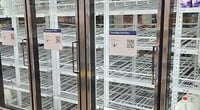
Last week in the evening, as soon as the weather app showed a snow forecast, I went to the grocery store. I was only planning to buy a gallon of milk, but the area in front of the milk fridge was strangely empty.
The bread shelf was even worse. Only a couple of whole wheat loaves were left, and the egg section was lined with empty cardboard boxes.
Meanwhile, canned soups and rice were stacked neatly. In that moment, I felt a familiar urge from my days of searching for a thesis topic. This is a research subject, I thought.
Those who have lived in America for a long time will know this phenomenon. When snow is in the forecast, bread, milk, and eggs disappear first.
People in the Boston area have even turned this into a joke. There's a system called the French Toast Alert System created by a local news site, Universal Hub.
According to a report by WGBH, this indicator started around 2007. The operator, Adam Gaffin, created it based on jokes from online forums, parodying the color-coded terror alerts from the Department of Homeland Security at the time.
The levels are indicated by the number of French toast slices. One slice represents the lowest risk, while five slices indicate the most serious level.
Why French toast, you ask? Because if you buy bread, milk, and eggs, that's ultimately what you can make. It's a clever way to summarize the entire phenomenon with just one name, and I honestly found it impressive.
So where did this habit come from? The weather information company AccuWeather believes that the massive snowstorm that hit New England in 1978 contributed to this tradition at least in part.
However, this is merely a plausible explanation. There are no definitive records proving its origin. In academic terms, it's still at the hypothesis stage.
This phenomenon became a nationwide meme much later. Fox-affiliated local broadcasters report that a video posted by comedian Vic Dibitetto in 2013 significantly amplified its popularity.
The psychological explanations are even more interesting. Public health professor Kimberly Schaff noted that these items are basic ingredients in the American diet.
The second reason is a simple logistics issue. Grocery stores have limited capacity for fresh foods, so they run out much faster than canned goods.
The third reason is crowd psychology. Seeing empty shelves makes people feel they should have arrived earlier, prompting them to rush next time. Professor Schaff referred to this as a kind of mob mentality.
Duke University behavioral economist Dan Ariely offers a similar explanation. The more people see others buying something, the more desirable that item appears.
I felt a bit guilty at this point. I went to buy just a gallon of milk, but seeing the empty egg section made me grab the last remaining carton of eggs.
Clinical psychologists have a different interpretation. The act of buying perishable items itself is a ritual that reassures oneself that this crisis will end soon.
This interpretation resonates with me the most. Someone who is prepared to be stuck for a week would buy rice and canned goods. A person buying milk believes that the roads will be clear in three days.
However, practically speaking, this is a misguided choice. The CDC recommends non-perishable foods for emergency supplies, and while bread fits this category, milk and eggs can spoil quickly if the power goes out.
So, in preparing for a snowstorm, you end up buying the items most vulnerable to power outages. If I were a thesis reviewer, I would have told them to redesign their study from the start.
Our area is a bit different. According to airport observation data, the average annual snowfall from 1991 to 2020 is 57.4 inches.
Data from the local weather office shows that from the winter of 2017 to the spring of 2018, the seasonal snowfall reached a record 106.1 inches. The previous record was 103.5 inches during the 2013-14 season.
So for people here, snow is more of a seasonal greeting than news. It's common for households to keep shovels and blankets in their car trunks.
This is a place where snow is part of everyday life. Yet, it's interesting that even when a forecast comes out, the milk section still empties out. It seems that habits are stronger than climate.
From my perspective growing up in Korea, it's even more fascinating. I have memories of stocking up on ramen and bottled water when a typhoon was forecast, but I've never rushed out to buy milk and eggs.
Ultimately, the foods people reach for in emergencies reflect what home-cooked meals mean in that society. For Americans, bread, milk, and eggs are the essence of breakfast.
So I don't intend to mock this phenomenon. The desire to toast bread as usual even during a snowbound morning—that's the core of it, I think.
However, if it were me, I would change the order. I would prioritize flashlight batteries, canned goods, and water first, and only buy milk if it was still available.
That night, the snowfall ended up being much less than forecasted. The next morning, I made French toast with the eggs I had bought for no reason. The research remains unfinished, but breakfast turned out quite well.
 MisoRadio
 mintforestwalker1991


 fantastic |
 Yo Lock Me Up |
 Rice Shop Uncle BLOG |
 My Town My Way Blog |
 Arizona AZ Cowboy |
 Childbirth Drabble Blog |


 tarvion |
 velion |

 ssome |
 skykong |
 Shining Our Own World |
 gardener 007 |
 golfmaster |
 Nanana Nanana Nanana |
 Who's watching? |
 endone |
 RockStar |
 Casa Mia |
 You Only Live Once |
 Hardworking CPA |
 Joyce 77 |
 Runner Kim |
 My Miami Stories |
 Entip |
 Tony Park |
 Jean Claude Bundang Blog |
 DJ DC BLOG |