
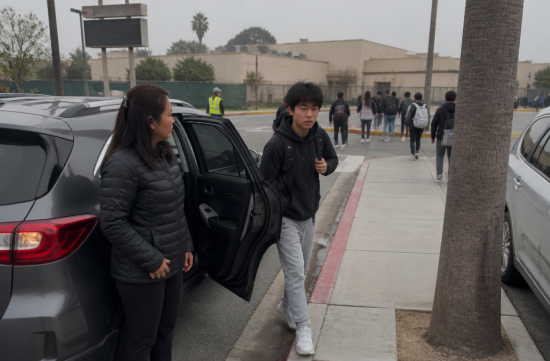
At 7:30 AM, waking up a high school student who hasn't gotten out of bed yet is probably similar in every household. However, in California, this scene has changed a bit over the past few years.
This change is due to SB 328, commonly referred to as the "school start time law." Governor Gavin Newsom signed it in 2019, and it officially took effect on July 1, 2022.
The content is simple. High schools cannot start regular classes before 8:30 AM, and middle schools cannot start before 8:00 AM.
It's also worth noting that California is the first state to enforce such regulations statewide. This is why other states are still observing the results.
There are exceptions. Rural school districts are exempt from this law, but there was initial confusion because the law does not define "rural."
Many parents are also confused about the zero period. Elective classes that occur before the first period are still allowed, and these do not count as regular class time.
This means that if our child takes a zero period class, they can still leave home around 7 AM. The law hasn't made every household's morning equally relaxed.
So, if you look at the current California high school schedules, you'll often find that first periods are clustered around 8:30 AM. They are set right at the minimum required by the law.
So, have kids really been getting more sleep? In May of this year, a research paper addressing this question was published by the National Bureau of Economic Research (NBER).
The researchers compared five sets of data before and after the law was implemented. The result showed that the percentage of students sleeping more than 8 hours a day increased by 13%.
The reason 8 hours is the benchmark is that the CDC recommends 8 to 10 hours of sleep for adolescents aged 13 to 18. This means more kids are exceeding the minimum recommendation.
There are also academic results. 8th-grade math and English scores increased by about 0.08 to 0.10 standard deviations, with the most significant effects observed among Hispanic and low-income students. There were also signs of a slight decrease in high school dropout rates.
While the numbers may seem small, achieving this level of change in education policy without costly programs is not a trivial accomplishment.
Mental health results should be read with caution. The overall average effect was not statistically significant, but there was a meaningful reduction in feelings of sadness and despair among male students.
Interestingly, there was no change in chronic absenteeism. This suggests that students are not attending school more frequently and that the increase in sleep is the main effect.
However, this paper is still a working paper that has not yet undergone peer review. Therefore, the numbers should be considered tentative.
Not everything is positive. According to EdSource, some families reported issues with parents' commuting times being disrupted and dissatisfaction with sports and after-school activity schedules.
There were also criticisms that as school times were pushed later, bedtimes were simply pushed back as well. This is certainly possible for teens who have their phones in hand.
From the school district's perspective, there were reactions that transitioning was too difficult and expensive due to school bus routes and labor costs. It seems that not many schools received help from dedicated consultants.
So, what about Torrance? Unfortunately, I couldn't find any public data specifically investigating sleep changes in the Torrance Unified School District (TUSD).
The authors of the paper also stated that the state government needs to systematically collect student sleep data. There is currently no adequate way to verify the effects by region.
While there are many stories shared in school newspapers or parent meetings, those are merely individual experiences. No one can yet say with numbers whether all the kids in our neighborhood are sleeping more.
Therefore, I would like to suggest a way for parents to check directly. First, open your child's school website and look for this year's bell schedule.
The start time for the first period, whether there is a zero period, and the block schedule for each day are all listed. Even within the same district, there can be slight differences between schools.
Next, write down your child's actual bedtime for just one week. If the school start time has been pushed back but their bedtime has also been pushed back, then the effect is essentially nullified.
If your child is involved in sports, you should also check early morning practices or late game schedules. While the school start time is set by law, practice times are determined by coaches.
Personally, I generally support this law. Initially, I thought it was excessive for the state government to dictate school schedules, but as data has emerged, my perspective has shifted.
However, a one-size-fits-all regulation cannot suit every family. The realities of morning situations for dual-income households and the budget burdens on school districts need to be addressed.
Ultimately, the law has only created an additional 30 minutes, and it's up to families to convert that 30 minutes into sleep. If it were me, I would prioritize setting a time to turn off phones before the school start time.
This week, try asking your child over dinner. What time do you go to bed these days? That answer might be the real report card for this law.
 RichNextYear







 Texas Migration Story |
 seadoll |

 Round and Round Children's Song Kingdom |

 new sugar |

 Way to easy |

 Nuchuhan Exploration BLOG |

 Good Neighborhood, Wealthy District Information |

 US Home Buying Information Home Insurance |

 Gongs Blog |
 MacMorningBlog |
 Encyclopedia of New York and Surrounding Areas |
 romeo JU |
 Folding Instructions |
 See It |
 memorabilia |
 H Leader |
 Carolina border |
 xylora |
 linex |
 Victory 1988 |
 washington mom |
 Deep South Mississippi |
 moomoon |
 hexora |
 jammybear |
 chiobase |
 jondol |
 US Regional Information Blog |
 tredolo |