
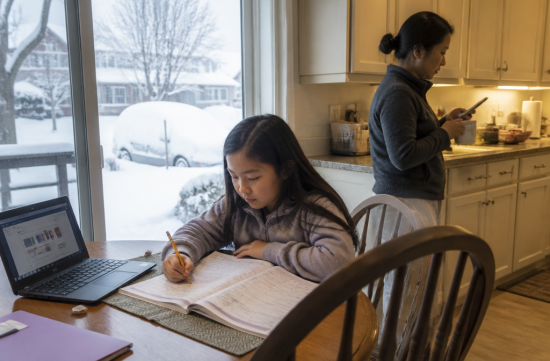
Many of us remember eagerly waiting for school closure announcements on snowy mornings when we were kids. For American children, snow days have long been a special treat.
However, the atmosphere in Maine schools has changed significantly lately. More schools are turning snow days into remote learning days instead of just a day off.
By November, it's not unusual for Maine to experience its first snowfall. Therefore, I've compiled some information that parents might find helpful as winter approaches.
First, let's look at the basic rules. Maine law requires school calendars to have a minimum of 180 days, with at least 175 of those being instructional days.
If schools close due to snow, they must make up those days in June. This is why summer vacations start later.
Interestingly, the state education department did not initially welcome remote learning. In the winter of 2018, one school district proposed having students complete assignments at home on snow days, but the state government did not recognize this as an instructional day.
Then, in the 2019-20 school year, it was tentatively allowed for qualifying districts, and the situation changed dramatically during the pandemic. With laptops and internet access in every home, the idea that "we can have classes on snow days" became a natural conclusion.
According to local news reports, several conditions must be met for remote learning days to count toward the 175 days. There must be at least three hours of instruction, and lunch must be provided to students on that day.
The lunch requirement makes sense when you consider that school lunch is often the most substantial meal of the day for many kids.
So, how is the Augusta school district handling this? Augusta is known for actively using remote days in Maine.
The superintendent has a flexible approach, allowing for remote learning days to be declared before a storm hits. According to district communications, decisions are announced by 1 PM the day before via the website, social media, and notification systems.
If a decision isn't made by 1 PM the day before, it defaults to a traditional snow day. In fact, January 7 was a remote learning day, while Monday, January 26, was a snow day due to a storm.
The approach varies by grade level. For kindergarten through sixth grade, teachers send home a paper learning packet called "Remote Roadmap" in advance.
It's unrealistic to expect young children to sit in front of a screen all day, so this seems like a practical choice. If there's a power outage on a snow day, paper is the most reliable option.
Attendance policies are also important to note. Attendance for remote learning days is counted when assignments are completed that day.
If students cannot finish due to power outages or internet issues, they have up to three days to submit their work. However, if assignments are not submitted within three days, that day is marked as an absence.
Some may think, "Come on, it's a snow day, can't we be lenient?" But I believe this is fair. If it's to be counted as an instructional day, there should be some responsibility involved.
Of course, not all schools are adopting this approach. As of 2024 reports, Scarborough has two snow days, while Portland has three, after which any additional snow days will be remote learning days.
Conversely, some districts, like Lewiston, do not use remote learning at all and make up all snow days in June. Even within Maine, districts vary widely in their approaches.
Parental reactions are mixed. In a letter from the Augusta superintendent in June 2025, there were requests for more structured assignments and online classes from home.
Some parents also requested decisions to be made on the morning of the snow day rather than the day before, indicating that scheduling can be challenging for working families. This is completely understandable.
So, what should we prepare at home? First, check your child's school website to see if the criteria for snow days and remote days have changed this year.
Make sure you're properly registered for district notification texts or emails before winter. Announcements are made the day before, and missing them can lead to a chaotic morning.
If your child is in higher grades, it's a good idea to have their school laptop charger and login information ready. For younger kids, remember where you put the paper packets.
Having a backup battery prepared for power outages is essential during Maine winters. It's also helpful to discuss with your child that they have up to three days to submit assignments if they can't finish them on the snow day.
Honestly, it's a bit disappointing that the romance of snow days spent having snowball fights and sledding is diminishing. However, I believe it's better than having summer plans disrupted by attending school until the end of June.
Ultimately, the key is choice and responsibility. Families that know the rules set by their district and prepare in advance will be less flustered on snow days.
 PizzaBot
 GoldenPath73







 Texas Migration Story |

 seadoll |

 Round and Round Children's Song Kingdom |

 new sugar |

 Way to easy |
 cookiefox |

 cheesepup |

 US Regional Information Blog |


 See It |
 memorabilia |
 H Leader |
 Carolina border |
 xylora |
 linex |
 Victory 1988 |
 washington mom |
 Deep South Mississippi |
 moomoon |
 hexora |
 jammybear |
 chiobase |
 jondol |
 tredolo |
 panda express |
 luido |
 norazoo |
 Oz's Wow Company |