
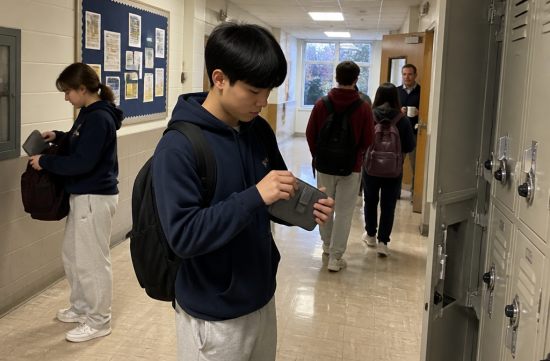
At around seven-thirty in the morning, I saw kids waiting for the school bus on my way back from a walk by the lake. Unlike before, when they would all be looking down at their screens, that day they were joking around and laughing with each other.
Like ripples spreading across a calm surface, their laughter strangely resonated towards the bus stop. Then it suddenly hit me: the New York State school cell phone ban has already entered its second year.
The Distraction-Free Schools law in New York State was implemented starting in the 2025-26 school year. The core principle is the so-called bell-to-bell rule, meaning students are not allowed to use smartphones from the first bell to the last bell.
This rule applies not only during class time but also during lunch, in the hallways, and during breaks, which is the biggest difference from previous classroom rules. It affects all K-12 public schools.
Each school district has the discretion to decide how to store the devices. The state has allocated $13.5 million to assist schools that need to purchase storage equipment like pouches or lockers.
However, there are conditions that must be met. Schools must provide a way for parents to contact their children during the day, and they must consider the opinions of teachers, parents, and students when creating the policy.
There are exceptions as well. Students who need devices for medical reasons, those whose IEP includes device usage, and those using devices for educational purposes are allowed to do so.
For example, in the Albany City School District, according to last year's district guidelines, students in grades 6 through 12 are required to place their phones in locked pouches in the morning and retrieve them at dismissal.
It doesn't matter if the pouches are kept in lockers or carried around. Elementary students are required to turn off their devices for the entire day and keep them out of sight, with specific procedures varying slightly by school.
Interestingly, the range of devices covered includes smartwatches, tablets, and wireless earbuds and headphones. Urgent messages are relayed through school offices by staff.
So, how has it been after a year? In June of this year, the governor's office released the results of a survey of educators, with 585 responses received.
About 80% of respondents reported positive effects in schools. 76% noted improvements in class focus, student participation, and attitudes towards each other.
80% said that relationships among students have become stronger, and 60% reported a decrease in bullying both inside and outside of school. Honestly, I was a bit surprised by the bullying statistics.
In a previous announcement last December, over 350 school administrators responded, with 92% stating that the transition went smoothly. 75% of teachers reported being able to teach more effectively without interruptions.
On the surface, the numbers look promising. However, there are a few concerns that make it difficult to accept these findings at face value.
First, this survey was a self-reported study conducted directly by the governor's office. Nearly half of the respondents were from New York City, which may differ from the atmosphere in upstate schools.
The impact on academic performance is still unknown. Governor Hochul herself indicated that it's difficult to say that test scores improved based solely on the first year.
In the second year, a new requirement has been introduced. Each school district must post an implementation report on their website by September 1 each year, with this year marking the first deadline.
The report must include de-identified demographic data of students who received disciplinary actions and an analysis of disparities among groups. If statistically significant disparities are found, a separate improvement plan must be submitted.
I read through several of the reports that were submitted. The Williamsville school district near Buffalo reported that 810 students received disciplinary actions, with a total of 1,618 recorded incidents.
The Jamestown school district report included a table showing that the violation rates for some groups were higher than their enrollment rates. Conversely, some districts concluded that there were no disparities, and I also saw reports filled entirely with zeros.
This indicates that even though it's the same law, the way districts record data can vary significantly. This seems to be the first challenge that needs to be addressed in the second year.
The law also includes a provision stating that students cannot be suspended solely for violating the cell phone policy. The emphasis is on changing habits rather than punishment, which I believe is the right approach.
The superintendent of the Central Square school district described the first year as a time to test how the rules work not only in classrooms but also during lunch and in hallways. The improvement noted was students talking during study time and playing card games during lunch.
From a parent's perspective, the remaining concern is ultimately about communication. While the principle is to go through the office, it would be good to hear directly from schools whether this method is sufficient in emergency situations.
You can find your child's school policy at ny.gov/phonefree. Policies from over 1,000 school districts, charter schools, and BOCES are available.
If I were you, I would open both the original school policy and the implementation report posted in September. What matters more is not just how the rules are written but how they are actually enforced.
Only when the waves have calmed can we see what lies beneath the surface. I hope that year two will provide a clearer picture of what fills the space left by the absence of notification sounds in children's daily lives.
 TeacherAemin


 Round and Round Children's Song Kingdom |
 new sugar |

 Way to easy |

 Magic Cabbage School of Martial Arts |

 Vacation on Hawaii |

 Tennis City |

 Vivid Information US News |
 Dolly |

 Day by day |


 daddyyo |
 neapolis |
 seadoll |
 ansdal |
 Vivid U.S. Regional Information |
 Vasila's Newlywed Blog |
 Arizona Cowboy |
 merry merry |
 Hoorah Ooorah |
 Fragile Me |
 Rowland Mama |
 foxtree |
 bayaa |
 loveyom |
 Coastal city |
 Spaghetti Flying Religion |
 My Town My Way Blog |
 holy cow |
 endone |
 starline |