
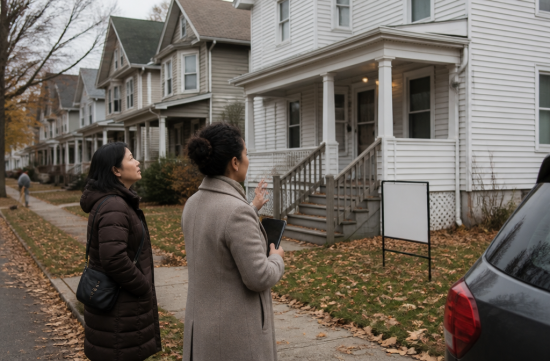
Buffalo home prices have not significantly dropped this fall. However, the sharp increase seen in spring is not present, and the rate of increase has become more gradual.
First, let me clarify the reference point. As of early November, the official data for the month of October has not yet been released.
Therefore, this article is based on the latest available data, specifically the figures from August and September. I have not filled in the October numbers based on estimates.
According to Redfin, the median sale price in Buffalo for the three months up to September was around $233,000. This is a 1.7% increase compared to the same period last year.
In the same Redfin report, there were 579 transactions in September, an increase from 524 in September of last year. Typically, it took about 15 days for homes to sell.
According to the Zillow index, the average home value in Buffalo as of August was $248,828. This represents a 0.4% increase from the previous month and a 2.9% increase from a year ago.
Let's also address why these two figures differ. Redfin reports the median price of homes that have actually sold, while Zillow provides an estimated value for all homes in the market.
Thus, it is better to look at each figure separately rather than mixing them. Both sources agree that the rate of increase is in the low single digits.
When compared to the first half of the year, the differences become clearer. Redfin reported that the average median sale price for Buffalo Metro from January to June was $264,184, which is a 4.8% increase from the previous year.
This figure includes the suburbs, not just the city, so direct comparisons cannot be made. However, it is evident that the annual growth rate has decreased from the 4% range to the 1-2% range.
Looking at the recent market, properties still sell quickly when they come on the market, but the atmosphere of endlessly increasing prices seems to have cooled down a bit. From my perspective, having observed this market for a long time, this is actually a healthy sign. After experiencing several cycles, markets often endure longer after such a breather.
Zillow has ranked Buffalo as the hottest housing market in 2024 and 2025, and second in 2026, citing low supply and steady demand as the reasons.
On the rental side, public data is released later. The figures for October and even September have not been verified by reliable sources.
According to PadMapper's data from the end of July, the median rent for a one-bedroom was stable at $1,275. The two-bedroom was $1,400, and the three-bedroom was $1,500.
The studio rent was $1,068, which is a 1.57% decrease. While this is not a significant drop, it indicates that smaller units are starting to take a breather.
Fall is typically a season when moving demand decreases, so I believe rents are unlikely to rise significantly until the end of the year. If you are approaching a lease renewal, it may be worth exploring negotiation options during this time. Checking the recent vacancy prices in the same complex can make discussions much easier.
There are two local issues to watch during this period. One is the redevelopment of Marine Drive public housing.
New York State announced on July 20 that the first phase of redevelopment for the 70-year-old Marine Drive apartments has begun. The first phase budget is $250 million, which will construct 254 new units across four buildings.
The overall plan is to replace the existing 616 units with approximately 730 new apartments. Existing residents will not have to leave their homes during the construction period, and the goal for completing the first phase is summer 2028.
This project could change the atmosphere around the downtown waterfront, so those interested in surrounding property values should keep an eye on its progress.
The other issue is Buffalo Ready Homes. This initiative involves the city and the UB Regional Institute creating pre-approved housing designs for vacant land.
The aim is to reduce the permitting period and increase new supply, but the announcement regarding the final design has not yet been confirmed. The actual effects may take more time to materialize.
If you are considering rental investments, you should also check the city's rental registration system. According to the city's website, the application fee for new registrations is $100.
The annual fee is $50 for a single-family unit and $100 for a two-family building. Registered rental properties will be subject to city inspections, so it's advisable to ensure their condition is maintained.
For those currently looking for a home, here's a checklist to follow. First, check the recent three-month sales prices in the neighborhood you are considering.
Next, verify how many days it takes for properties to sell. The average is around 15 days, so if a property has been on the market for over a month, it may indicate room for price negotiation.
Finally, decide whether to focus on the city or the suburbs. There is a significant difference between the metro average and the city average. If you prioritize school districts, you should check the price ranges in the suburbs separately.
In summary, Buffalo is still somewhat favorable for sellers, but the time of having to pay a premium is passing. Personally, I would take my time comparing properties during the winter off-season rather than rushing.
Once the official October figures are released, I will check again to see if this trend continues.
 HamsterShire






 Choco Choco Star |
 gentle |
 neapolis |

 moo moo |

 ultron78 |

 Darnignac |

 Holy Cow |

 Delicious Food Finder |

 See It |

 memorabilia |
 H Leader |
 Carolina border |
 xylora |
 linex |
 Victory 1988 |
 washington mom |
 Deep South Mississippi |
 moomoon |
 hexora |
 jammybear |
 chiobase |
 jondol |
 US Regional Information Blog |
 tredolo |
 panda express |
 luido |
 norazoo |
 Oz's Wow Company |