
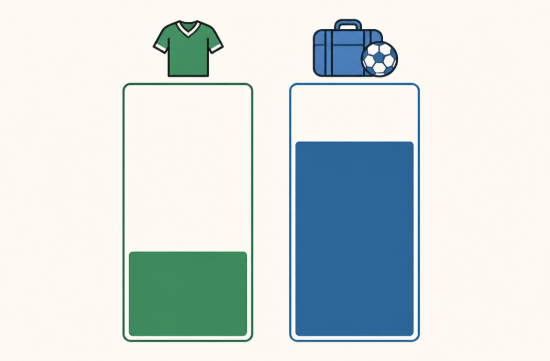
Recently, I asked a parent from the same soccer team how much the registration fee was for this season, and I had to double-check the number. I thought that was the total, but when I added in the uniform and travel expenses for away games, I realized a significant amount was already spent for the season.
Curious about the actual costs of youth sports in the U.S., I looked up some data.
According to a 2025 survey by the Aspen Institute, American families spent an average of $1,016 on their child's primary sport in 2024. This is a 46 percent increase compared to 2019, which is much steeper than the rate of inflation.
However, out of that $1,016, only $197 is for pure registration fees, while a significant portion goes towards travel and accommodation costs for away games, which is $278. It's ironic that the cost of travel is greater than the cost of skill development.
There are also considerable differences by sport. Soccer was the highest at $1,188, followed by basketball at $1,002, baseball at $714, and tackle football at around $581.
The increase in costs is also influenced by private lessons and summer camps. In the past, team training was sufficient, but nowadays, more families are signing up for individual lessons or camps to enhance skills, which adds to the overall expenses.
Ice hockey was notably mentioned separately in this survey, with annual costs often exceeding $2,500.
Additionally, many kids participate in more than one sport, leading to an average of $475 in extra expenses, which brings the total to nearly $1,500 per year for one child.
However, this is just the level of community leagues; moving up to club or travel teams opens up a completely different world.
Club team registration fees range from $2,400 to $4,500, which is just the entry fee, and depending on the sport, the total annual costs for travel teams can rise to between $7,000 and $13,000.
For ice hockey travel teams, it's not uncommon for costs to exceed $10,000 a year. The reason for such differences is primarily due to travel tournaments.
When you add in accommodation, travel, and food expenses, each away game can cost between $300 and $600, and if you go four or five times a season, that adds up to $1,200 to $3,600.
It's like spending the money for a family vacation on your child's away games, which can be quite a burden for many families.
At this point, the level of sports a child can continue to pursue often depends on the family's financial situation, which is a bit disappointing as it places money as a barrier rather than skill.
So, I've compiled some alternatives that parents are actually using these days.
The first is to join recreational leagues run by local community centers or park districts, where registration fees range from $35 to $100 per season, a fraction of club fees.
Including uniforms, equipment, and gas, the total annual cost can be around $500 to $900, so I recommend starting here.
The second option is to utilize second-hand equipment. Stores like Play It Again Sports offer gear at about 50 percent less than new prices.
You can also sell unused equipment to such stores for cash or store credit, making this a great option during the time when kids frequently outgrow their gear.
The third option is to reduce the number of away games. By checking the schedule before the season starts and choosing leagues with fewer away games, you can significantly cut travel costs.
The fourth option is to limit participation to one or two sports instead of multiple, as the additional cost of $475 for multiple sports can be avoided by reducing the number of sports.
The fifth option is to share costs with other parents, such as carpooling and group purchases for discounts.
The sixth option is to set a budget for your child's sports expenses before the season starts. By determining how much you will spend in advance, you can make more informed decisions when additional camp or private lesson offers come up.
Lastly, don't overlook financial aid programs. Many youth sports organizations and local agencies offer reduced or waived registration fees based on income, so be sure to inquire before registering.
Personally, I believe there's no need to put kids in travel teams from a young age. Starting in recreational leagues and moving up only if the child truly enjoys it and shows talent is perfectly fine.
Money should be spent on keeping kids interested in sports, not just increasing the burden on parents, as that won't last long.
 KTVWave








 Silent Sea |
 Pointy |
 Idaho's Sumi's House |
 holy cheese |
 Michigan Enthusiast |
 Anna Life |
 Spaghetti Flying Religion |
 Sugar Cream Door Bulletproof Noodles |
 My Love DS |
  Round and Round Children's Song Kingdom |
  Augusta Univ |
  butter 90 |
  Lando Mao |
  Washington Denzel DJ |
  LIZ Legal Information Blog |
  vegas mom |
  Sandiego Auntie |
  Premium Gas Camp |
  Things to know |
  TEXAS Fishing Boat |
  AUTO OK |
  aaoaa |
  Florida King |
  Encyclopedia of New York and Surrounding Areas |
  Study Abroad Life Know-How Tips |
  Conflite Teacher |
  Montgomery Mom |
  Franco Family |