
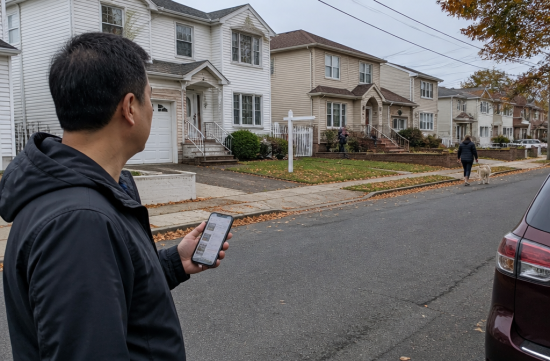
To summarize the Staten Island market in one line: transactions have decreased, but prices are holding steady, and interest rates have risen back to the 7% range.
Since the October figures are not fully available yet, this briefing is based on the latest published data. Each number includes its source and reference point, so please keep that in mind.
First, let's look at the sale prices. According to PropertyShark, the median sale price for Staten Island homes in September was $767,450.
In the same month last year, it was $705,000, which means it has increased by 8.9%. Considering the current interest rate levels, this was a higher increase than expected.
However, it's premature to judge based on just one month's figures. Monthly medians can fluctuate significantly depending on which homes were sold that month.
Therefore, we should also look at quarterly numbers. From the same data, the median sale price for the third quarter was $760,000, up 4.1% from $730,000 in the same quarter last year.
The price per square foot follows a similar trend. As of September, it was $481, which is 3.9% higher than a year ago.
One noteworthy point is the transaction volume. The number of sales in the third quarter was 685, down 27.4% from 944 in the same quarter last year.
The transaction count for September appears to be incomplete, so I won't cite it here. Preliminary figures often get revised later.
In summary, with fewer listings and buyers, prices are being maintained at a high level. This is advantageous for sellers, but it also means that the entry barrier remains high for first-time homebuyers.
Now, let's move on to rentals. The data for October is available.
According to Zumper's update at the end of October, the average rent in Staten Island was $2,977.
By bedroom count, the average for a one-bedroom is $1,850, and for a two-bedroom, it's $2,745. Compared to Manhattan or Brooklyn, these prices still offer some breathing room.
However, these figures are based on currently listed properties. Since different platforms have varying aggregation methods, it's common to see differences of several hundred dollars between sites, so it's best to compare listings in the neighborhood before finalizing any contracts.
We should also touch on interest rates. According to Freddie Mac's weekly survey, as of October 29, the average rate for a 30-year fixed mortgage was 7.24%.
The 15-year fixed rate was 6.60%. Compared to the same time last year when the 30-year fixed rate was 6.17%, this represents an increase of over 1 percentage point.
For someone purchasing a $760,000 home with a mortgage, the monthly payment burden has definitely increased compared to last year. I believe this is the main reason for the decrease in transaction volume.
The biggest local issue this month is the city's Affordable Housing Fast Track. The city government announced 12 target community districts in October, which include Staten Island's Mid-Island (CD 2) and South Shore (CD 3).
This program is based on a charter amendment passed by resident vote last November and will take effect on January 1, 2027. Housing projects that build a certain percentage of units as permanently affordable will be decided by a vote of the City Planning Commission without review by the City Council.
The review period will also be reduced from the previous ULURP's 6-7 months to within 90 days. Community board and borough president reviews, as well as environmental assessments, will remain unchanged.
The local response has been chilly. Borough President Vito Fossella has reportedly expressed strong opposition to this program and is considering legal action.
Local council members have also voiced concerns that this could diminish neighborhood voices. There is an underlying worry that the character of low-density residential areas could change.
There is also some background to consider. In August, the city's Department of Housing Preservation and Development released a draft that aims to add 17,675 new housing units in Staten Island over the next five years, which corresponds to 9.5% of the existing housing stock.
This issue has valid points on both sides. Increasing supply could alleviate rent and home price burdens in the long term, but if infrastructure like roads, schools, and parking does not keep pace, the satisfaction of existing residents could decline.
If you are currently looking for a home, there are a few things to check. It's advisable to see if your area falls within the Fast Track target districts and whether there are large development sites nearby.
When it comes to loans, be sure to compare estimates from various banks and consider the fixed-rate period carefully. It's safer to judge sale prices based on quarterly trends rather than just one month's figures.
If you're entering the rental market, it's also good to check whether the building is subject to rent stabilization before signing a lease. You can verify this through the New York State Homes and Community Renewal (HCR).
In my opinion, unless interest rates drop significantly from their current levels, there isn't much reason to rush. However, there are still no clear signals that prices will drop noticeably, so if you're looking to buy for personal use, I would recommend acting when a suitable property comes up.
Once the final sales statistics for October are released, I will provide an update in next month's briefing.
 MozzaShelter








 Choco Choco Star |

 gentle |
 neapolis |

 moo moo |

 ultron78 |

 lavender |

 rosed |



 sweetee |
 See It |
 memorabilia |
 H Leader |
 Carolina border |
 xylora |
 linex |
 Victory 1988 |
 washington mom |
 Deep South Mississippi |
 moomoon |
 hexora |
 jammybear |
 chiobase |
 jondol |
 US Regional Information Blog |
 tredolo |
 panda express |
 luido |
 norazoo |
 Oz's Wow Company |