

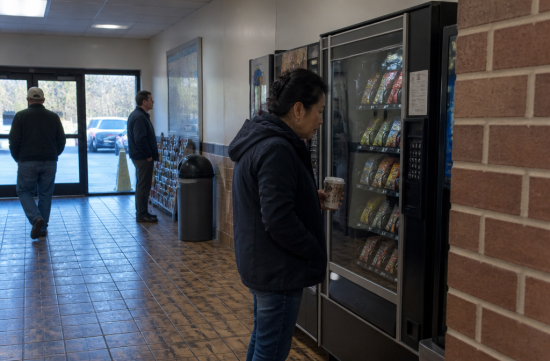
I once drove for several hours on the interstate with guests from Korea. When I saw a rest area sign, I suggested, "Let's stop for a bowl of udon here," but when we entered, there were only restrooms and vending machines.
I still remember the look on my guest's face. "Why don't they sell food here?" I couldn't give a proper answer to that question.
It's natural to find it even stranger when you think of Korean highway rest areas. They are like a travel destination in themselves, offering walnut cakes, hot bars, and rice soup.
So, I decided to look into it this time. The answer turned out to be surprisingly simple. Federal law was blocking it.
The key provision is found in Title 23, Section 111 of the U.S. Code (23 U.S.C. 111). It states that commercial facilities are not permitted on interstate highway land.
In simple terms, this means that within federally funded interstate rest areas, gas stations, restaurants, and souvenir shops cannot operate. This regulation is tied to federal funding, making it difficult for state governments to change.
So what was the original purpose of rest areas? Their official purpose is safety and convenience. They are spaces for sleepy drivers to take a short break, use the restroom, and regain their focus before continuing their journey.
As someone who often hears about drowsy driving accidents, I honestly agree with this purpose. If rest areas become commercialized, their original intent could be blurred.
However, there is an exception. Facilities owned by state governments that existed before January 1, 1960, are allowed to continue operating.
So, if you drive on toll roads in the eastern U.S., the scenery is completely different. On toll roads like the Pennsylvania Turnpike, which opened in 1940, service plazas with fast food restaurants and gas stations exist, having been established before the interstate system.
Even though it's the same country, the reason some roads resemble Korean rest areas while others only have vending machines is due to this one date.
How did vending machines come to be? The Surface Transportation Assistance Act of 1982 changed the regulations to allow vending machines at interstate rest areas.
This is where I was most surprised. The law stipulates that when permitting vending machines, priority must be given to those operated by state government agencies under the Randolph-Sheppard Act.
The Randolph-Sheppard Act, established in 1936, is a system that prioritizes business opportunities for visually impaired individuals within federal facilities. This means that many vending machines at rest areas are tied to the livelihoods of visually impaired entrepreneurs.
The National Federation of the Blind stated in a 2016 opinion that state government agencies operate vending machines at 1,098 interstate rest areas. The opposing argument is that if restaurants were to open at rest areas, it could jeopardize jobs for these individuals.
There are also those who oppose this. Companies that have set up truck stops and gas stations right before interchanges, like NATSO, have consistently opposed the commercialization of rest areas.
I understand their logic as well. They invested under the assumption that the commercial area at highway exits would not lose customers to rest areas.
On the other hand, there are strong voices advocating for commercialization. Organizations like OOIDA, representing long-haul truck drivers, have supported the commercialization of rest areas for a long time.
Organizations like the Reason Foundation argue that since state governments struggle with rest area maintenance costs, privatizing them would improve services and generate revenue. In fact, some states have closed rest areas due to budget issues.
The law does have small loopholes. Limited activities like travel information or advertising displays are allowed, and the revenue generated from these must be used for rest area operating costs.
So, this isn't simply a matter of "that's just how it is in America." It's a complex issue involving safety, employment for disabled individuals, local businesses, and state budgets.
Those who have traveled south on Georgia's I-75 will know. The rest areas are packed with cars, but the only food available is vending machine snacks, so everyone ends up exiting at the next exit.
For reference, the Georgia Department of Transportation (GDOT) has a separate list of temporarily closed rest areas on its website. It's a good idea to check 511ga.org before embarking on a long drive.
Ultimately, my guest had a late lunch at a Waffle House right off the exit. They smiled, saying it was tastier than expected, but I felt a bit conflicted.
To share my thoughts, I'm cautious about making significant changes to the current system. Keeping rest areas as quiet places to rest has clear benefits for driver health.
However, the issues of restroom maintenance and operating budgets genuinely need solutions. Finding a realistic middle ground that protects visually impaired entrepreneurs while securing operating funds seems necessary.
The next time you grab a cup of coffee from a vending machine at a rest area, I hope you'll think about the story behind it.
Now, when I go on long trips, I always pack kimbap and a thermos of coffee. Knowing that American rest areas are not places to fill your stomach but rather places to catch your breath makes me feel more at ease.
 WhyStopJjang


 Thoroughly Prepared Pioneer Spirit |
 Shinbaram Dr. Blog |
 Good World Good Thoughts |

 celtics |

 candytip |

 vivavida |

 Park M.Y. |
 H Leader |

 Macon Boy |

 See It |
 memorabilia |
 Carolina border |
 xylora |
 linex |
 Victory 1988 |
 washington mom |
 Deep South Mississippi |
 moomoon |
 hexora |
 jammybear |
 chiobase |
 jondol |
 US Regional Information Blog |
 tredolo |
 panda express |
 luido |
 norazoo |
 Oz's Wow Company |