
On the morning of the first snowfall, seeing the Wasatch Range covered in white makes you feel great. But that excitement turns into a bit of tension the moment you grab the car keys.
While you can see the snow-covered roads and drive cautiously, the real danger lies in the thin layer of ice that looks fine, known as black ice.
Despite its name, black ice isn't actually black. It's very thin and transparent, allowing the color of the asphalt underneath to show through, making it feel like just a wet road.
It typically forms when melted snow or rain freezes overnight as temperatures drop below freezing. The tricky part is that it can also form on days when it doesn't snow.
So, during the first snow season, I mentally review the slippery spots before driving. Just knowing where they are gives you a significant advantage.
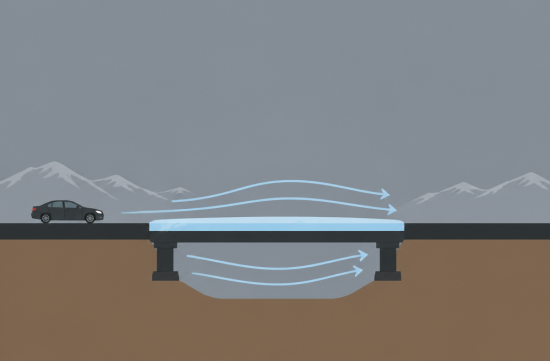
The first spot is bridges and overpasses. The Utah Highway Patrol and the Department of Transportation repeatedly warn that bridges freeze first every winter.
The reason is quite simple. Regular roads have ground underneath that retains some heat, while bridges are exposed to cold air above and below, causing them to cool down much faster.
So, just because the road leading up to the bridge looks fine, don't assume the bridge itself is safe. The same caution applies to highway entrance and exit ramps.
According to a report from local station KUTV, there were over 1,600 accidents on Utah's bridges and overpasses from 2021 to 2025. There were also hundreds of injuries and several fatalities, which was surprising to see in the numbers.
However, not all of these incidents were due to black ice. The same report indicated that many were related to speeding.
The second spot is shaded areas. Curvy roads that are long in the shadow of mountains, next to buildings or sound barriers, and densely wooded paths tend to retain ice even when the sun is out.
This is especially true for canyon roads. During ski season, the route to the resorts often has sections that don't get much sunlight, so the road can remain slick even in the afternoon.
The third spot is less-traveled areas. When many cars pass, their tires break up the ice and generate some heat, but in quiet neighborhoods or parking lot entrances, that doesn't happen, allowing ice to linger.
The time of day is also important. The public safety department advises that black ice forms most frequently at night and early in the morning.
Surprisingly, the day after a snowfall can be particularly dangerous. The patrol has even warned not to let your guard down after a storm passes.
The sky may be clear and the roads may look dry, but there can be patches of ice that have frozen overnight.
So, what should you do if you start to skid? The patrol advises to take your foot off the gas pedal immediately.
Slamming on the brakes or sharply turning the steering wheel is the most dangerous thing you can do. The common advice from the traffic department and patrol is to gently steer in the direction you want to go.
Black ice usually forms in patches rather than extending continuously. If you stay calm, you'll soon find a section where traction returns.
In fact, the best approach is to avoid situations that could lead to skidding. If you see a bridge or shaded area, reduce your speed before entering, and maintain a greater distance from the car in front of you than usual.
Be cautious about relying too much on four-wheel drive or AWD vehicles. They may struggle less at the start, but stopping and turning on ice is not much different from other vehicles.
The traffic department's motto is "Ice and snow, take it slow." At first, I thought it was a bit cheesy, but after a few winters, I realized it's a perfect summary.
It's also a good habit to check the UDOT Traffic app before you head out. You can see road conditions, alerts, and canyon travel conditions all in one place.
If you're planning to ski in the canyon, you should also be aware of the traction law. Since last season, on days when the traction law is in effect in Big Cottonwood and Little Cottonwood Canyons, your tire tread depth must be at least 5/32 inches.
At the entrance to Little Cottonwood, they conduct vehicle checks on the enforcement days, and if you don't meet the standards, you won't be allowed to go up. It's a good idea to check your tire condition before the first snow falls.
During winter, I usually keep windshield washer fluid, an ice scraper, and a blanket in my trunk. It may seem trivial, but when you need them, you'll be glad you have them.
Enjoying the snowy mountains and sparkling lake views is one of the great pleasures of winter in this area. To fully enjoy that pleasure, it seems that driving with a relaxed mindset is the key.
Bridges, shaded areas, quiet roads, and the early morning and the day after snow. Just remembering these five things will make driving in the first snow much less intimidating.
If it were me, I would leave 10 minutes earlier the morning after the first snow and drive slowly. It's much better to arrive safely, even if it means being a little late.
 HappyToo213
 StrawbMilk


 Anjollinya Blog |

 Kitchen Ideas |

 Spaghetti Flying Religion |

 Giant Squid and Sweet Potato Soup |

 choi family |
 loran |


 KGOMIO Blog |
 arion9 |

 xelora72 |
 See It |
 memorabilia |
 H Leader |
 Carolina border |
 xylora |
 linex |
 Victory 1988 |
 washington mom |
 Deep South Mississippi |
 moomoon |
 hexora |
 jammybear |
 chiobase |
 jondol |
 US Regional Information Blog |
 tredolo |
 panda express |
 luido |
 norazoo |
 Oz's Wow Company |