
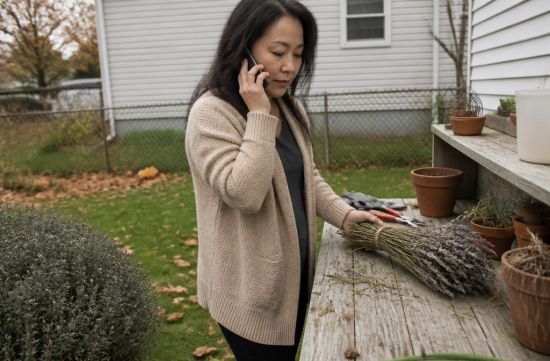
It was an afternoon when I was cutting and drying the lavender in my backyard for the last time. The scent still lingered on my fingertips when I received a text from my sister, who I garden with.
I got a call that sounded like my son's voice, saying he had an accident and was crying. Thankfully, I hung up and called my son directly to confirm he was fine and working at his company.
What my sister said stuck with me the most. She mentioned that the breathing sounded so similar that for the first few seconds, she had no doubts at all.
In the past, when I received a call claiming to be my son, I could quickly tell it was off because the voice sounded strange. Now, that last line of defense, which was based on recognizing voices, has quietly crumbled.
AI voice replication can mimic a person's speech patterns with just a short audio sample. This means that a brief video posted on social media could serve as material for such scams.
It's not just the voice that's an issue. The tone of crying, the urgency in speech patterns can be convincingly replicated, leaving the listener with no time to think.
The FBI issued a public warning on December 3, 2024, about scams exploiting generative AI, citing emergency calls impersonating loved ones as a prime example.
One of the recommended methods in that warning is to establish a secret word or phrase known only to family members. If an urgent call comes in, they should ask for that word first.
The FTC consumer guidance echoes this advice. It suggests creating a family code in advance and asking for it before taking any action.
Given the scale of the issue, it's not something to take lightly. According to FTC data, the reported losses from impersonation scams in 2025 amounted to $3.5 billion.
Impersonation scams accounted for nearly one in three reported fraud cases. Just seeing those numbers made my hands feel cold.
Of course, this amount doesn't all come from family impersonations. It includes cases where banks, government agencies, and companies were impersonated as well.
Still, a family member's voice is the sound that most quickly undermines rational thinking. That's why I decided to create a code for my family this weekend.
I set three criteria for choosing the code: it should be something that others can't guess, it should never have been posted online, and it should come to mind quickly in an emergency.
Avoid using pet names, birthdays, or school names. Such information can easily be found with just a few scrolls through social media.
Instead, I prefer quirky memories known only to us. For example, the name of a burnt dish from a camping trip when we were kids or a nickname my grandmother used to call me.
I'm considering using the name of an herb I once grew and then let wilt. That failure story is something only my family knows about because I overwatered it and the roots rotted.
Some families create an additional code. This is a signal word established for use in extremely dangerous situations when one might not be able to speak properly.
It's best not to write the code down in texts or group chats. It's safest to discuss it face-to-face around the dinner table and have everyone memorize it.
With my parents, I need to explain it slowly and multiple times. If they are hard of hearing or startled, they might not even think to ask for the code. Make sure to tell them not to let their guard down just because they are familiar with the language, especially since calls can come in Korean.
Having a predetermined order for answering calls can also help reduce panic. First, ask for the code, and if they can't answer or hesitate, hang up.
Then, I call that family member directly using the number I already know. If I can't reach them, the FTC advises checking with other family members or friends.
If the caller insists that you don't hang up or tell anyone, that's a red flag. A real family member wouldn't have a reason to prevent you from verifying.
Be cautious about how money is requested. If they ask for gift card numbers and PINs, or request money transfers or cryptocurrency, the FTC warns that it's likely a scam.
The FBI also advised reducing the scope of sharing voices and photos online. I'm trying to cut back on the habit of including my voice in garden videos.
Simply making accounts private reduces the amount of material shared. Setting children's videos to be viewable only by close friends also brings peace of mind.
If you've already received such a call, you can report it at ReportFraud.ftc.gov. If you've sent money, it's important to contact your bank or card issuer immediately.
Deciding on a code isn't the end of it. It's good to check in with family every few months to see if everyone remembers it, and if there's any concern that someone might have leaked it, change it right away.
In fact, creating the code turned out to be more heartwarming than I expected. As we reminisced about old stories, we ended up laughing for quite a while.
No matter how much technology can mimic voices, it can't steal the memories that only we share. That realization oddly brought me comfort.
As I hung a bundle of dried lavender by the window, I thought that tonight at the dinner table, it would be nice for you all to establish a little code of your own with your family.
 TwoKidsMom







 Spaghetti Flying Religion |

 Giant Squid and Sweet Potato Soup |

 choi family |

 What can make money? |

 road98 |

 rosed |

 crystalo |
 linex |


 dermoon |
 mariashin |
 lavender |
 Bridgo |
 Tamfa Fan |
 Sunny Sunday |
 mini hometown |
 torvia |
 Chichiki Chicago Train |
 Univ Student |
 See It |
 Con Cheese |
 softmoony |
 Breaking Bad Drama |
 New York Queens Native Blog |
 Shinbaram Dr. Blog |
 vivavida |
 Way to easy |
 limestone |
 oster |
 daddyyo |