
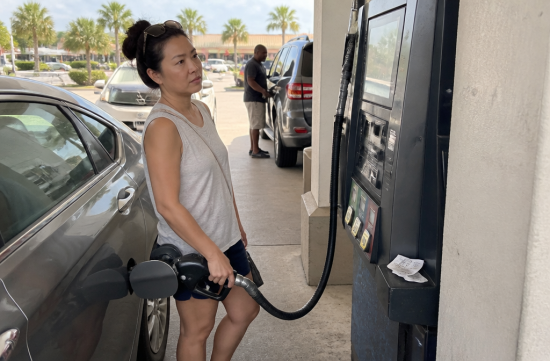
Last weekend morning, I stopped at a gas station near Dale Mabry and paused when I saw the numbers on the screen. Filling up my half-empty tank was already over $40.
The man at the pump next to me shook his head and muttered that it wasn't like this at this time last year. That comment stuck with me, so I looked up the numbers when I got home.
According to AAA's weekly report, as of Sunday, October 18, the average price for regular gasoline in Florida was $4.11 per gallon. That's an increase of $1.19 compared to the same time last year.
Considering that the average price in Florida was around $2.92 last October, doesn't that hit home? It's over a 40 percent increase in just one year.
On the same Thursday, the state average rose to $4.23 before dropping slightly over the weekend. Earlier in October, it had fallen to $4.06, so the fluctuations have been quite significant.
I was curious about why prices have risen so much. Reports indicated that due to increased tensions in the Middle East last September, U.S. crude oil prices jumped from $83 to over $100 per barrel in just over two weeks.
Since more than half of the consumer price for gasoline is based on crude oil prices, international news eventually impacts our local gas station screens. It feels disheartening when events happening far away directly affect my wallet.
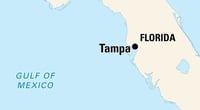
Fortunately, the situation in Tampa is somewhat better. According to AAA data, as of October 20, the average price in the Tampa-St. Petersburg-Clearwater area was $3.99.
This is 5 cents cheaper than the Florida average of $4.04 and lower than the national average of $4.28. Still, being close to the $4 mark doesn't provide much comfort.
So, I calculated how much more I'm spending each month. To keep the comparison consistent, I used only the Florida state average numbers.
Let's say I fill up a 15-gallon tank. At last year's price of $2.92, it would cost $43.80, but now at $4.11, it comes to $61.65.
That's an extra $17.85, almost $18 more each time I fill up. AAA also explains that it costs about $18 more based on a 15-gallon tank compared to last year.
Now, let's consider a monthly driving distance. If I drive 1,000 miles a month for commuting, shopping, and picking up kids, and my car gets 25 miles per gallon, I would use 40 gallons a month.
Multiplying 40 gallons by the $1.19 increase means an additional $47.60 a month. Over a year, that adds up to $571.20, which is about the cost of a plane ticket disappearing into fuel costs.
If I drive an SUV or minivan that gets 20 miles per gallon, I would use 50 gallons for the same distance. That would mean an extra $59.50 a month, totaling $714 a year.
I enjoy taking short trips to the suburbs every weekend, so these numbers hit hard. Just a round trip to St. Pete Beach or Sarasota makes me reach for the calculator again.
But I can't just stay home. So, I've organized a few habits I've changed recently.
First, I compare gas prices using an app before I go. Even within the same neighborhood, gas prices can vary significantly from station to station, so checking before I leave makes a difference.
Second, I use gas stations at membership stores like Costco or Sam's Club. In July, the regular price at the Costco on Linbaugh Avenue in Tampa was $3.599, which was lower than the local average at that time.
However, there are often long lines, so if I have to wait 20 minutes just to fill up, that's also a time cost. I've decided to fill up only when I go grocery shopping.
Third, I try to combine errands into one trip. By grouping grocery shopping, post office visits, and dry cleaning into one day, I definitely use less gas.
Fourth, I check my tire pressure and organize my trunk. Everyone knows that low tire pressure or carrying heavy loads decreases fuel efficiency, right?
If you're putting premium fuel in a car that only requires regular, check your vehicle manual. If it doesn't require it, there's no reason to spend extra on premium fuel.
When I talk to my family in Korea, we often discuss prices per liter. I used to think gas prices in Korea were always high, but the real burden in the U.S. is that public transportation is weak, making it hard to reduce driving.
In Seoul, you can at least take the subway, but here, it's not easy to go to the store without a car. So, I've realized that how many gallons I use each month is more important than the price per gallon.
Experts believe that as the weather cools down and we switch to winter gasoline, prices may gradually decrease. However, it's wise to keep in mind that they could rise again depending on international circumstances.
If it were me, I would fill up when prices drop a bit and plan weekend outings to combine trips. I think it's better to travel smart rather than give up on traveling altogether.
How much are you spending on gas each month these days? If you calculate based on your car's fuel efficiency and monthly mileage, it will become much clearer where you can save.
 TofuGymKing



 Way to easy |
 holy cow |

 Soy Angelino |
 SKy Face |

 gleeful |

 Living in Florida |

 Tamfa Fan |

 FLORIDA Acus |

 lavender |
 Bridgo |
 Sunny Sunday |
 mini hometown |
 torvia |
 Chichiki Chicago Train |
 Univ Student |
 See It |
 Con Cheese |
 softmoony |
 Breaking Bad Drama |
 New York Queens Native Blog |
 Shinbaram Dr. Blog |
 vivavida |
 limestone |
 oster |
 daddyyo |
 neapolis |