
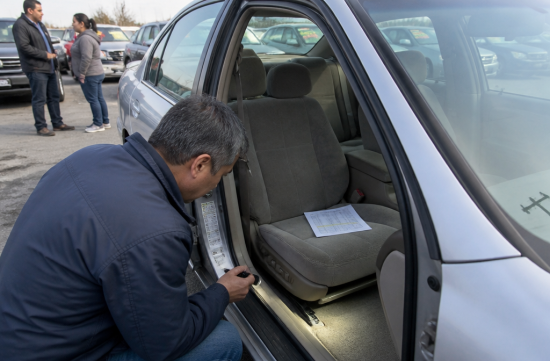
When looking at used cars, there are often vehicles that look fine in pictures and have a good price, but something just feels off. The first thing to do in such cases is not to take a test drive, but to check the VIN.
The VIN is a unique 17-digit number assigned to each vehicle. You can find it under the windshield on the driver's side dashboard or on the door frame sticker when you open the driver's door.
I don't just trust the number sent by the seller; I take a photo of it directly in front of the car. If the numbers on the dashboard, door frame, and title documents don't match, it's best to stop the transaction right there.
The first step is to use NICB's VINCheck. This is a free service operated by the National Insurance Crime Bureau (NICB), which shows whether the vehicle has been reported stolen and not recovered, or if it has been processed as salvage by an insurance company.
NICB states that participating insurance companies account for over 92% of the market. However, records from non-participating insurers or police records will not appear.
You can only check five times per IP address within 24 hours. If you're comparing multiple vehicles, it's better to narrow down your candidates first.
NICB itself advises that this result is not a comprehensive history report, so don't rely solely on this for your purchase. It means it's too early to feel reassured just because it came back clean.
The second step is the NMVTIS, or vehiclehistory.gov, which is operated by the federal government. This database requires insurance companies, salvage auctions, junkyards, and rental car companies to report total loss vehicles within 30 days.
Consumers receive reports through government-approved private companies. For example, Auto Data Direct sells a title check for $9.98 without a subscription, so be sure to compare prices among different companies.
Interestingly, well-known reports like Carfax or AutoCheck do not contain NMVTIS data directly. Therefore, I recommend looking at one commercial report alongside an NMVTIS report.
Carfax is strong on maintenance records, accident reports, and the number of owners. NMVTIS is strong on title brands and total loss status. This structure helps fill in each other's gaps.
The third step is to check for recalls on the NHTSA website. By entering the VIN at nhtsa.gov/recalls, you can see any safety recalls from the past 15 years that have not yet been repaired.
Recall repairs are done for free at official dealers. If there are no results, it simply means there are no repairs needed at this time.
Now, let's talk about flood-damaged vehicles. After hurricanes or major floods, cars that were submerged often reappear for sale in other states after some time.
The problem is title washing. This is a method where vehicles are moved to states with looser title regulations, allowing the flood or salvage designation to be erased during re-registration.
So when reviewing documents, check for words like flood, salvage, junk, rebuilt, or reconstructed on the title. If the car has recently come from another state, it's worth looking into its history again.
There may be delays in report updates. According to state attorney general guidance, it can take over 30 days for flood history to appear on consumer reports.
Therefore, the final judgment ultimately comes down to your own senses. Check if there's a musty smell of mold when you open the door, or conversely, if an old car has an unusually strong scent of air fresheners or cleaners.
Use a flashlight to check for mud or fine sand inside the glove compartment, under the seats, or in the spare tire area of the trunk. If there's rust on the bolts under the seat rails or pedals, that's a pretty strong signal.
Also, check for moisture or water droplets inside the headlights, taillights, and dashboard. In the engine compartment, look for water marks on the radiator or engine block.
You can get a sense of accident history from the gaps between panels and differences in paint color. If you look at the side of the car at an angle in sunlight, you might notice repainted areas surprisingly well.
Still, I always get a pre-purchase inspection (PPI) before buying. It incurs a separate cost, but compared to the money lost from buying a flood-damaged car, it's worth it.
The key is to have the inspection done at a shop I choose, not one designated by the seller. If a seller refuses this, that alone is a clear answer.
If you're buying from a dealer in California, it's good to know the new regulations. Under the CARS Act, effective October 1 of this year, used cars under $50,000 can be canceled within three days without reason.
However, you must not exceed 400 miles driven, and the dealer can charge a restocking fee of 1.5% of the car price, with a minimum of $200 and a maximum of $600. There are no such provisions for private transactions, so prior checks are even more important.
In summary, the steps are simple. Verify the VIN yourself, run the NICB VINCheck, review the NMVTIS report along with a commercial report, check for NHTSA recalls, and finally, have my mechanic take a look.
Honestly, some might wonder if it's really necessary to go this far. However, in a market where information is heavily skewed toward sellers, the only weapons buyers have are these public data sources, and the fact that NICB and NHTSA checks are free is a pretty good system.
Personally, I would check one step further for cars that are significantly cheaper than the market price. There's usually a reason why they're priced low.
 ShrimpPower








 Spaghetti Flying Religion |

 Giant Squid and Sweet Potato Soup |

 choi family |

 What can make money? |

 road98 |

 ollege Mom |

 Sunny Fullerton |

 Until the Day It Gets Better |
 Noodle Zin |

 Baguette Blog |
 See It |
 Con Cheese |
 softmoony |
 Breaking Bad Drama |
 New York Queens Native Blog |
 Shinbaram Dr. Blog |
 vivavida |
 Way to easy |
 limestone |
 oster |
 daddyyo |
 neapolis |
 seadoll |
 ansdal |
 Vivid U.S. Regional Information |
 Vasila's Newlywed Blog |
 Arizona Cowboy |
 merry merry |
 Hoorah Ooorah |
 Fragile Me |