
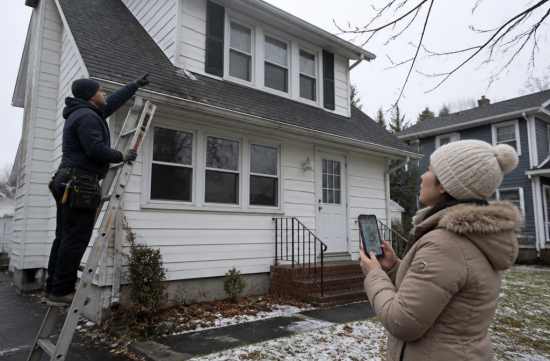
When the home insurance renewal documents arrive, most people first look at the premium amount. However, these days, there's one line that should be checked before that number: how the roof will be compensated.
Recent market trends show that insurance companies are paying much closer attention to roof age than before. Even for the same house, the age of the roof can significantly affect both the premium and the compensation terms.
This issue is particularly relevant in areas like Western New York, where snow accumulates and ice forms every winter. Therefore, let's outline the key items to check before renewal in order.
First, let's clarify the terminology. Roof compensation is generally divided into two methods: Replacement Cost and Actual Cash Value, abbreviated as ACV.
The Replacement Cost method compensates for the cost of a new roof minus the deductible. In contrast, the ACV method deducts depreciation based on the roof's age and material in addition to the deductible.
The older the roof, the greater the depreciation, meaning that even for the same damage, the amount you receive can be significantly lower. Depreciation is assessed by the adjuster based on the roof's condition and remaining lifespan.
Many insurance companies are switching roofs over a certain age to ACV. Whether that threshold is 10 years or 15 years varies by company, so you'll need to ask your insurer directly.
Some companies apply age-based payment tables only for wind and hail damage, while compensating other incidents like fire based on Replacement Cost. Therefore, knowing the exact name of the roof endorsement on your policy is the starting point.
Next, here are the regulations in New York State. According to the New York Department of Financial Services (DFS), if an insurer intends to deny renewal, they must send a written notice between 45 and 60 days before expiration.
Conditional renewals that reduce coverage or change limits must also be communicated in writing within the same timeframe, along with specific reasons. This is based on New York Insurance Law Section 3425.
Just because an agent discussed the roof over the phone does not mean that renewal can be denied based solely on that. The DFS legal opinion also states that verbal notifications are not effective.
However, merely increasing the premium does not trigger the obligation for conditional renewal notification. This means that premiums can simply rise, so not receiving a notice does not guarantee peace of mind.
There is some debate in the industry about whether changing roof compensation to ACV constitutes a reduction in coverage. If such a change is noted in the notification, it's advisable to confirm the reasons and effective date in writing.
In New York State, there is also a protective measure that prevents arbitrary cancellation or denial of renewal for three years after the first 60 days of the contract. However, if the condition of the building changes and it becomes difficult for the insurer to underwrite, this is an exception.
Roof aging can serve as a basis for that exception. Ultimately, managing the condition of the roof is linked to maintaining the insurance contract.
A common issue in this area is ice dams. When ice blocks the eaves, melted water can seep into the roof, wetting the ceiling and walls.
According to the consumer group United Policyholders, ice dam damage is generally compensable if reported promptly and if it is not solely due to known roof defects. Conversely, if there is a record of roof aging, disputes are more likely to arise.
In practice, common points of contention in such claims include ACV payments, existing damage, and the scope of repairs. The older the roof, the more disadvantageous it can be in all three areas.
So, what should you do before renewal? First, check the roof compensation method and endorsement name on the front page of your policy.
Second, gather documents that prove the year of roof replacement. Having the construction contract, receipts, or building permit records can prevent the insurer from estimating the age of the roof.
Third, if you have a mortgage, check the bank's requirements. Some lenders require Replacement Cost coverage, which could conflict with an ACV endorsement.
Fourth, verify the deductible structure. The DFS opinion has indicated that raising the deductible for wind damage also falls under conditional renewal, so it's worth checking if there was a notification if the numbers have changed.
Fifth, take dated photos of the roof before winter arrives. This will serve as the most reliable evidence in disputes over existing damage if issues arise later.
If damage occurs, report it immediately and keep receipts after only making emergency repairs before permanent fixes. If everything is repaired before the insurer inspects the site, it becomes difficult to prove the scope of compensation.
If you are considering a replacement, it's advisable to calculate it in line with the renewal date. Comparing estimates to see if compensation terms improve with a new roof and how much the premium changes is the next step.
If you receive a notice of renewal denial, check the market assistance program and the New York Property Insurance Underwriting Association (NYPIUA) information noted in the notice. If you believe it is unjust, you can file a complaint with the DFS.
The information summarized here is based on the DFS consumer guide and legal opinions as of October 2026, as well as materials from consumer groups. Individual contract terms vary by company and product, so it's best to confirm the final judgment in writing with your agent.
Personally, I would organize the roof age documents and photos before the renewal notice arrives. The amount you can receive in the event of an incident is a much bigger issue than a few dozen dollars in premium.
 KimKim






 neapolis |

 moo moo |

 ultron78 |
 garlic bread |

 Sugar Cream Door Bulletproof Noodles |

 chicpo |
 Darnignac |

 See It |

 Delicious Food Finder |

 Univ Student |
 Con Cheese |
 softmoony |
 Breaking Bad Drama |
 New York Queens Native Blog |
 Shinbaram Dr. Blog |
 vivavida |
 Way to easy |
 limestone |
 oster |
 daddyyo |
 seadoll |
 ansdal |
 Vivid U.S. Regional Information |
 Vasila's Newlywed Blog |
 Arizona Cowboy |
 merry merry |