

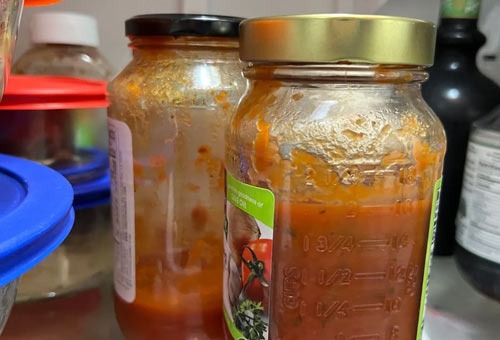
The shelf life of opened store-bought pasta sauce is '4 days.' Just because it looks fine means nothing.
On weekday evenings, when I get home and need to feed the kids, pasta is the easiest option.
Boil the noodles, pour in a jar of sauce from the store, and it's done. The problem is that there's always half a jar left over.
That half jar gets tucked away in the corner of the fridge with the thought, "I'll use it for next week's pasta night." I've done that too.
However, listening to food safety experts, I learned that this is quite a dangerous habit.
Let's start with the numbers: 4 days
According to Dr. Detweiler, a professor at Northeastern University, the guideline is to consume opened store-bought pasta sauce within about 4 days when stored in the fridge at or below 40°F (about 4°C).
The reason is simple. Once you open the lid, it is no longer a sealed room-temperature product.
Every time a spoon, hand, air, or food touches it, microorganisms can enter.
Refrigeration slows down bacterial growth but does not stop it.
Tomato sauce has a higher acidity, so it lasts a bit longer than creamy sauces.
But "a bit longer" does not mean "indefinitely." Whether it's Alfredo or Marinara, once opened, it should be refrigerated and consumed within 4 days.
"It looks fine, right?" — That's the trap.
Signs of spoiled sauce include mold, bubbles, a lid that has puffed up due to gas pressure, and a sour or fermented smell.
If it smells off and the liquids inside have separated into layers, it's almost certain it's bad.
But the real problem is the opposite case. Some harmful bacteria do not change the taste, smell, or appearance at all.
Just because it passed a test doesn't mean it's bug-free.
And please, don't taste it to check if it's spoiled. If you're unsure, throw it away.
To keep it longer, manage it this way:
1. After using it, put it back in the fridge immediately and close the lid tightly.
2. Always use a clean spoon when serving. Do not dip cooked noodles directly into the jar.
3. Write the opening date on the jar. Relying on memory is like running a server without logs.
4. Store it in the back of the fridge, in the coldest spot, not in the door. The door has significant temperature fluctuations.
So here's my thought:
A jar of sauce from an American grocery store costs only a few dollars at most. Risking your family's health for that savings is a problem.
If stored properly, you can reduce the risk of contamination. But there is no way to keep opened sauce forever.
After 4 days, don't think about how wasteful it is; just throw it away. Or buy a smaller jar from the start.
 ShortyKicker
 CalorieGhost
 OmuriceCopter







 choi family |

 What can make money? |

 road98 |

 Baguette Blog |

 Khan Film Blog Production |

 Gorama Round |

 U.S. Weather Bureau News |

 There Are Such Things in the World |

 ultron78 |

 Texas Migration Story |
 Giant Squid and Sweet Potato Soup |
 Valley Hong |
 The Gelaton |
 Twist Kim |
 berlon93 |
 Physical Laws and Science |
 good thinking |
 Solo Yolo |
 Mr Oh |
 laro90 |
 San Diego TOP Idol |
 Round and Round Children's Song Kingdom |
 American Golf Course Travelogue |
 MEDBIO American Doctor Blog |
 Hot Seat Driver |
 bryvexi |
 koala organic farm |
 riverstone |
 My Antonio |
 California Information News |