

Is a Serious Crisis Coming to the AI Industry? Insights from Anthropic's IPO Filing
I live in San Jose and work in the IT field.
Over the past 20 years, I've experienced everything from the dot-com bubble to the smartphone revolution and the growth of cloud business, but the scale of money flowing into AI these days is staggering.
However, after reviewing the IPO documents released today by Anthropic, I began to wonder if the AI industry might be facing significant problems in the financial sector.
To start with the facts, Anthropic, the company behind Claude, submitted its IPO filing to the U.S. Securities and Exchange Commission today, October 26, 2026.
They are pursuing a Nasdaq listing, with an estimated company value being discussed at up to $2 trillion.
For ordinary people like us, $2 trillion is an amount that's hard to grasp. But what's even more surprising is the company's financial statements.
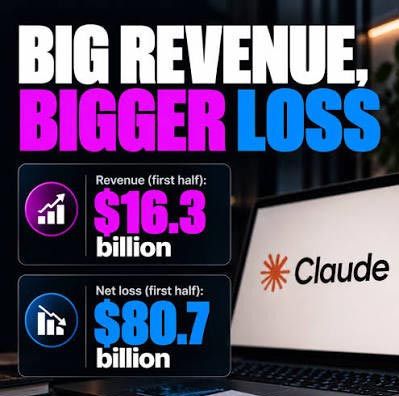
Anthropic reported approximately $16.3 billion in revenue for the first half of this year. This is a dramatic increase compared to the same period last year.
At this point, it looks like a tremendous success. The problem lies in the losses. The net loss for the first half of this year reached a staggering $80.7 billion.
However, about $72.4 billion of that loss is an accounting loss due to the increase in the value of convertible bonds and other securities.
This does not mean that $80.7 billion in cash has actually flowed out.
In fact, the operating loss was about $693 million, which is a decrease compared to the same period last year.
Nonetheless, there are concerning aspects. The computing costs necessary to maintain and grow the AI business are significant.
Anthropic will have to bear computing infrastructure costs amounting to hundreds of billions of dollars under contracts with Amazon, Google, Microsoft, and others.
Developing AI models costs money, but providing services to countless users also requires enormous servers and power.
The business structure is quite different from that of typical software companies.
In the past, if you developed a good piece of software, profits often increased as the customer base grew.
However, with generative AI, as the customer base grows, computing costs also increase.
Of course, as technology advances, processing costs may decrease. But to create a model that outperforms competitors, more investment is needed.
How long can this competition continue? This is what I am most curious about.
Currently, AI companies are receiving massive investments based on the expectation that they will generate enormous profits in the future.
Investors expect AI to transform nearly every industry, including search, programming, healthcare, law, and finance.
I also agree that AI will bring significant changes across industries.
However, the fact that a technology is innovative and the fact that the company developing that technology will necessarily generate high profits are entirely different issues.
In short, if you invest 100 trillion won, but can't even break even? Investors will be left with nothing.

Thinking back to the internet boom of the late 1990s makes this easy to understand.
At that time, the prediction that the internet would change the world was accurate. Indeed, the internet did change the world.
However, many internet companies that received investments back then did not survive. The enormous money turned out to be a bubble and vanished in an instant.
We cannot rule out the possibility that a similar situation could occur in the AI industry today.
Especially as various AI companies compete, they are investing massive amounts of money in data centers and semiconductors.
But what happens if the prices of AI services continue to drop due to competition?
Users may enjoy good services at lower prices, but companies may find it difficult to recoup their invested costs.
Ultimately, it is possible that the technology succeeds, but investors suffer significant losses.
For those living in Silicon Valley, this issue does not end as just a stock market story.
If AI companies start to reduce their investment scale, it could impact not only semiconductors, cloud services, and data centers but also related startups and the job market.
There could be implications for the housing market, commercial real estate, and local consumption in the San Jose and Santa Clara areas.
Of course, there is no basis to conclude that the AI industry will collapse right now.
Anthropic's revenue growth rate is very high, and actual corporate clients are increasing rapidly.
However, given the enormous scale of investment needed in the coming years, it is difficult to believe that revenue growth alone will solve all problems.
I believe this IPO filing could be a significant turning point for the AI industry.
Until now, the focus has been on how smart AI has become and how many tasks it can take over.
Now, we have entered a stage where it must be proven how much money can be made with that technology and whether it can cover the enormous operating costs.
I have no doubt that AI is the future.
However, since the current value of AI companies has not been recognized, the survival ability of AI companies may become more important news than the technology itself in the coming years.
Even if the technological revolution continues, we must remain vigilant about the possibility of serious financial shocks occurring in the process.
We need to observe whether Anthropic's IPO will mark the beginning of a new success in the AI industry or serve as a moment to reflect on excessive investment enthusiasm.
 CORMA
 RubyDreamer







 Coastal city |

 novapixel |

 Victory 1988 |

 washington mom |


 Tarzan's Joyful Imagination |

 Living Economy Information Blog |

 Rushing Youngest Rabbit Toto |

 Western US Medical Student Association |

 good thinking |
 See It |
 Con Cheese |
 softmoony |
 Breaking Bad Drama |
 New York Queens Native Blog |
 Shinbaram Dr. Blog |
 vivavida |
 Way to easy |
 limestone |
 oster |
 daddyyo |
 neapolis |
 seadoll |
 ansdal |
 Vivid U.S. Regional Information |
 Vasila's Newlywed Blog |
 Arizona Cowboy |
 merry merry |
 Hoorah Ooorah |
 Fragile Me |