
Recently, I had coffee with an acquaintance who mentioned that after over 20 years of living here, he has no one to contact on weekends.
At first, I thought he was just making conversation. But as I listened, I realized this isn't just his problem.
So, I did some research. To cut to the chase, the difficulty of making friends in your 50s is more about the structure of society than personality.
First, let's look at the numbers. A survey by AARP published in December 2025 found that 40% of American adults over 45 reported feeling lonely.
In 2010 and 2018, that number was 35%. So, it has increased by 5 percentage points in just a few years.
This survey was conducted online by Ipsos in August 2025, involving 3,276 American adults over 45. Given the large sample size, I think these numbers are significant.
What's even more surprising is the difference by age group. Among those aged 45 to 59, 46% reported feeling lonely, while only 35% of those over 60 felt the same.
Honestly, I thought older people would feel lonelier. But it turns out that the busy middle-aged, who are in the thick of their careers, are the loneliest.
By gender, 42% of men and 37% of women reported feeling lonely. In 2018, there was almost no difference between the sexes, but this time, men reported higher loneliness.
So, why is it so difficult? A 2018 study by Professor Jeffrey Hall from the University of Kansas provides a clear answer.
According to this study, it takes about 50 hours for an acquaintance to become a casual friend. A true friend requires 90 hours, and a close friend needs over 200 hours.
200 hours means that even if you meet for two hours each week, it would take nearly two years. For someone in their 50s, balancing work and household responsibilities, this is not easy at all.
Moreover, Professor Hall noted that time spent working together doesn't count much toward building friendships. It's the time spent socializing and chatting that really matters.
When we were in school, this time happened naturally. We were in the same classroom and clubs every day.
But as we age, these automatic meeting opportunities start to disappear. School events for kids come to an end, and workplace relationships often end when the workday does.
This is also a broader societal trend. A study cited in the 2023 Surgeon General's advisory found that between 2003 and 2020, the time spent with friends decreased by 20 hours per month.
A similar 2021 survey by the Survey Center on American Life found that the percentage of Americans with no close friends increased from 3% in 1990 to 12% in 2021, with 15% of men reporting this.
Adding the immigrant experience makes it even more challenging. Friends made in Korea are far away, and in America, there are few connections outside of church or work.
Many people find it easy to make small talk in English but struggle with deeper conversations. This isn't a lack of effort; it's just the reality.
I believe this shouldn't be seen as just an individual problem. Communities need spaces and programs where people can naturally gather, and it's worthwhile for cities to support this.
So, what can be done? Here are some practical methods I've found.
First, choose a recurring meeting. Seeing the same people at the same time each week is much more effective than attending a one-time event.
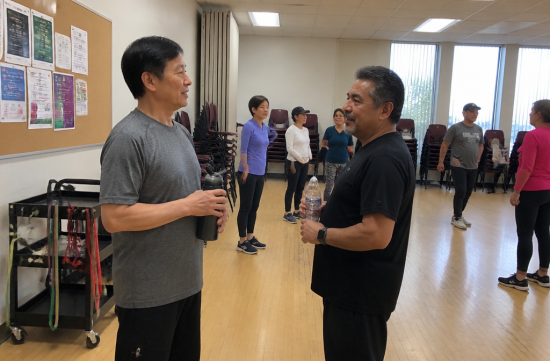
Groups that involve doing something together, like exercise classes, dance, or volunteering, are especially good. It's much less intimidating than just sitting down and talking with someone you don't know.
If you're in Downey, the Barbara J. Riley Community and Senior Center is a great starting point. According to the city website, they offer leisure, self-development, and social activities for those over 50.
They have programs like senior clubs, health workshops, and computer labs, and they also offer paid classes for all ages. The address is 7810 Quill Drive, and since schedules and fees change each season, be sure to check the Parks and Recreation guide or call 562-904-7223.
Second, invite others first. Professor Hall also mentioned that while you can't force someone to spend time with you, you can extend an invitation.
A cup of coffee or a walk is enough. If someone declines, it doesn't mean they dislike you, so try not to take it too personally.
Third, reconnect with someone you already know. Often, rebuilding a relationship with an old acquaintance is much quicker than trying to make a new friend.
I shared this with that uncle, and he said he would sign up for a class at the center starting next month.
If it were me, I would start with a simple weekly commitment of one hour rather than a grand goal. Friends are ultimately built over time, so start that first hour today.
 SunnyFox








 road98 |
 Baguette Blog |
 Khan Film Blog Production |
 dermoon |
 hoosierdaddy |
 UNI Lover |
 American Food Information & Calories |

 What can make money? |
 Dragon Lee |
  productionblog |
  Oklahoma Hoya OK |
  prixon74 |
  Roman Pan |
  USALATU BLOG |
  Sunshine Blog |
  Minnesota Small Business |
  Strawberry Pancake Warrior |
  amolayo |
  korvon |
  Que Buena |
  virexo |
  silverpath |
  Komet Park |
  reliable |
  vexo90 |
  As Always Today |
  veltar87 |