
To rent out a home in Denver for more than 30 days, you need a rental license issued by the city. This applies whether it's a single room or an entire apartment.
This system has been in place for several years, but many first-time landlords still overlook it. Therefore, I have compiled the official guidelines from the City of Denver as of October 2026.
First, let's look at the timeline. For multi-family buildings, applications were mandated to start by January 1, 2023, and for single units, by January 1, 2024.
Currently, all grace periods have ended. Renting without a license is considered a violation.
The scope is broader than expected. According to the city's FAQ, if a landlord receives any form of benefit, it is considered rental.
For example, if a tenant pays part of the mortgage, property tax, or HOA fees instead of rent, a license is required. However, sharing utility costs is considered an exception.
Basement apartments or ADUs with separate entrances, kitchens, and bathrooms are also included. Conversely, if a landlord rents out a single room without a separate kitchen and bathroom while living in the property, it is excluded.
Short-term rentals of less than 30 days fall under a different short-term rental license, which often confuses many people.
Now, regarding costs. The application fee is $50, and the license fee varies depending on the number of units.
A single unit costs $50, 2-10 units cost $100, and 11-50 units cost $250. For 51-250 units, the fee is $350, and for more than 251 units, it is $500.
If you have a single-family home, the total amount payable to the city is $100. Looking at the numbers, it doesn't seem too burdensome.
In reality, the higher costs come from inspections. The city does not conduct inspections directly; instead, landlords must hire qualified private inspectors.
The inspection fee is not set by the city but determined by each inspector. Local reports mention a range of $200-$300 depending on the size of the building, but since prices vary by company, it's advisable to get estimates from two or three places.
Inspector qualifications are also stringent. Inspectors must have certifications from organizations like ASHI or InterNACHI, along with ICC building inspector qualifications.
While the city provides a list of inspectors, it is stated that the responsibility for verifying qualifications lies with the landlord. It's safer not to just trust the list but to obtain proof of certification.
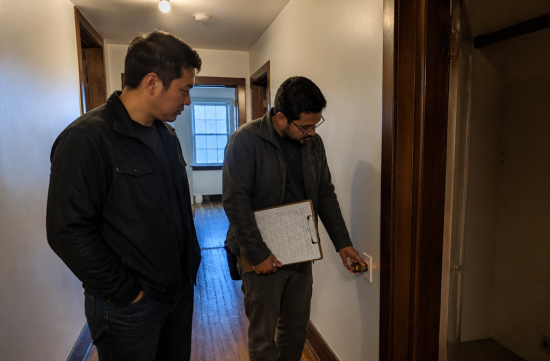
The inspection covers minimum occupancy standards. Items such as plumbing, ventilation, lighting, electrical systems, stairs, and pest control are checked for compliance.
For multi-family buildings, it is not necessary to inspect all units. A minimum of 10 percent must be inspected, and if there are fewer than 10 units, one unit is selected at random for inspection.
If you pass the inspection, you must submit your application within 90 days. If you miss this deadline, you may have to undergo the inspection again, so managing your schedule is important.
The license is valid for four years. However, if ownership changes, it does not transfer, and a new license must be obtained.
Therefore, if you are buying a home with tenants, you should prepare to apply immediately after closing. Don't assume that the previous owner's license will cover you.
The city recommends applying for renewal 90 days before expiration. During renewal, inspections must be conducted again under the same criteria as the initial application.
If you miss the expiration date, there is a 90-day grace period. The first 30 days incur a 20 percent penalty, and from 31 to 90 days, a 50 percent penalty applies. After 90 days, you must apply anew.
If you received your license in early 2023, it will expire in 2027. If you own a multi-family building, it's a good idea to mark next year's schedule on your calendar now.
Fines can be quite steep. According to the city's FAQ, unlicensed rentals can incur fines ranging from $150 to $5,000.
Reports indicate that the first violation incurs a $150 fine, the second $500, and the third $999. The city initially started with warning notices but has since implemented software to identify unlicensed properties.
There is one more document to keep in mind. The city requires landlords to provide tenants with a tenant rights notice at the time of lease signing and when issuing a rent demand notice.
If you fail to provide this, it can also result in penalties, so it's advisable to keep a record of having delivered it. An email attachment or a signed copy should suffice.
In summary, while the costs payable to the city are low, the system requires attention to inspection preparation and scheduling. Older homes are more likely to have issues that need fixing before inspections, which can be a concern.
On the other hand, having a license signals to tenants that the home meets basic safety standards. Personally, I would check smoke detectors and electrical outlets myself before the inspection.
You can check if your home is already registered through the Denver City Online Permit Center by searching with your address. If the specific conditions are unclear, contacting 311 or the city's business license department directly is the most accurate approach.
 sunsetroadbuilder1941






 neapolis |

 moo moo |

 ultron78 |

 garlic bread |

 Sugar Cream Door Bulletproof Noodles |

 Your Curiosity Resolved |

 LIZ Legal Information Blog |

 coloradoman |

 COLO COLO |
 Chichiki Chicago Train |
 Univ Student |
 See It |
 Con Cheese |
 softmoony |
 Breaking Bad Drama |
 New York Queens Native Blog |
 Shinbaram Dr. Blog |
 vivavida |
 Way to easy |
 limestone |
 oster |
 daddyyo |
 seadoll |
 ansdal |
 Vivid U.S. Regional Information |
 Vasila's Newlywed Blog |
 Arizona Cowboy |
 merry merry |