

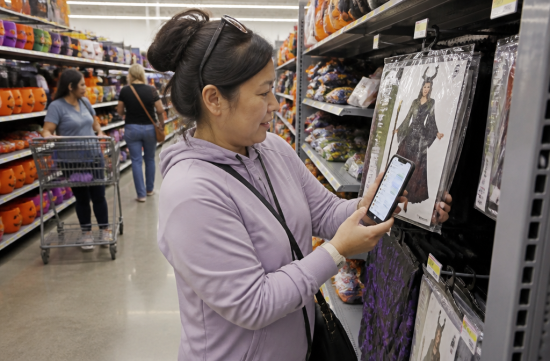
Last week during lunch at work, a colleague next to me showed me their phone. They asked an AI for Halloween costume ideas, and it gave them ten suggestions.
I just laughed it off, but when I got home and looked it up, I found out this wasn't just a rare occurrence. A lot more people were already using it than I expected.
According to a Halloween survey released by the National Retail Federation (NRF) on September 22, 47% of respondents said they are using AI platforms or tools for Halloween shopping. That's nearly one in two people.
It also shows how they are using it. 34% said they use it for brainstorming ideas in the planning stage, while 32% said they get recommendations when choosing products.
This survey was conducted by Prosper Insights & Analytics from September 1 to 9, involving 7,889 consumers, with a margin of error of plus or minus 1.1%. Given the large sample size, I don't think these numbers should be taken lightly.
However, there's something to note. Saying that someone used AI is different from saying that AI influenced their purchasing decisions. This survey doesn't show whether AI actually affected buying choices.
Let's take a look at the overall picture. This year's Halloween spending is projected to be $13.5 billion, which is a 3.82% increase from last year's record of $13.1 billion. Of course, this figure does not account for inflation.
The average expected spending per person is $115.14, which is almost the same as last year's $114.45.
Breaking it down by category, costumes account for $4.4 billion, decorations for $4.3 billion, and candy for about $4.1 billion. The most common item people plan to buy is candy at 96%, followed by decorations at 78%, and costumes at 71%.
74% of people plan to celebrate Halloween, which is similar to last year's 73%. Considering it was 68% in 2019, it's clear that the trend has grown.
Interestingly, the timing of preparations is changing. 49% of people said they would start shopping in September or earlier, compared to 34% in 2016. It seems everyone is starting earlier.
When asked where they get costume inspiration, online searches still ranked first at 32%. However, this is down from 37% last year. It appears that AI is gradually filling that gap.
So, I decided to try it out myself over the weekend. To cut to the chase, there are definitely useful aspects, but also some things to be cautious about.
The easiest part was generating ideas. I listed the clothes and props I had at home and asked what costumes I could make with them, and it came up with some pretty decent combinations without needing to buy anything new.
It also helped with party planning. If you provide the number of guests and your budget, it organizes a list of snacks and shopping items for you. For those who find dealing with Excel tedious, this is a surprisingly big help.
On the flip side, you shouldn't take the price information at face value. There's no guarantee that the prices the AI provides reflect today's store prices. You need to verify this yourself.
The same goes for local event information. Sometimes it mixes last year's details with this year's, so it's best to double-check the dates and times with the official announcements.
For example, Disneyland Resort's Halloween Time has been officially announced to run from August 21 to October 31 this year. This is certain, but local free trick-or-treat events change dates every year, so it's safer to check with the city or shopping center announcements.
This year's Halloween falls on a Saturday, so there will likely be many daytime events, and more kids will be out in the evening compared to weekdays. It would be wise to stock up on candy.
Of course, there are valid counterarguments. Halloween is originally about the fun of creating and thinking things through by hand, so what does it mean to leave that to a machine?
I understand that sentiment. However, receiving ideas and actually creating them are two different things, so in the end, it's still up to us to take action.
Privacy is also something to consider. There's no need to input personal information like your child's name, school, or home address. Just providing your age range and preferences is enough to get useful responses.
The NRF also noted that consumers are being quite cautious this year. About one-third said they would compare prices to find the lowest, and 26% are looking for coupons or sales.
So, I think the most realistic approach is to divide the roles: use AI for ideas and do the price comparisons yourself. It's a division of labor.
In summary, here's what I recommend: let AI handle the ideas and list organization. Check prices and stock directly on store apps or websites.
Verify event dates with official announcements. Do not input personal information.
If you follow these four guidelines, you can save time and reduce mistakes.
Personally, I plan to continue using AI, but more as an assistant. I'll make the decisions and just delegate the tedious organization tasks.
If you haven't tried it yet, ask for a costume idea this weekend. You might get a surprisingly fun response, and if not, you can just close it.
How are you preparing for Halloween this year? I'm curious about the experiences of those who have used AI.
 ShortLegKick







 Giant Squid and Sweet Potato Soup |

 choi family |

 What can make money? |

 road98 |

 Baguette Blog |

 Round and Round Children's Song Kingdom |

 Anna Life |



 My Love DS |
 bayaa |
 loveyom |
 Coastal city |
 Spaghetti Flying Religion |
 My Town My Way Blog |
 holy cow |
 endone |
 starline |
 Where is a really nice neighborhood? |
 Real Estate |
 Forest Gump |
 Real Estate Investment Korean American |
 Dollydori, Lover of Movies |
 dmzline |
 travelo |
 American Food Information & Calories |
 Splendid Mission |
 sparklingo |
 Watch Walker |
 Soy Angelino |