

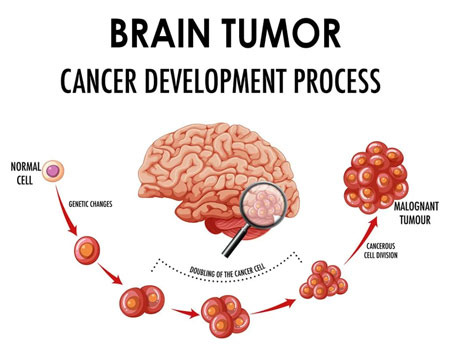
Brain cancer is one of the types of cancer that is difficult to detect early compared to others.
Even people who regularly undergo health checkups may fail to detect a brain tumor in its early stages. So, why is that?
The biggest reason is that the initial symptoms are very vague.
When we think of brain tumors, we might expect sudden collapse or severe headaches, but in reality, that may not be the case in the early stages.
It can start with symptoms like headaches, dizziness, fatigue, nausea, and decreased concentration, which can occur in anyone at some point.
Headaches, in particular, are more ambiguous. You can have a headache from lack of sleep or from stress.
Additionally, drinking too much coffee or suddenly stopping caffeine can also lead to headaches.
Therefore, very few people would rush to get a brain MRI just because they have a slight headache.
The second reason is due to the nature of the brain as an organ.
Different areas of the brain are responsible for different functions. Depending on where the tumor grows, the symptoms can vary significantly.
If there is an issue in the area responsible for movement, one side of the arm or leg may feel weak, and if it's in the area related to language, there may be problems with speaking or finding words.
Conversely, there are locations where a tumor can grow to a certain size without causing any noticeable functional impairment.
Thus, even with tumors of the same size, some people may show symptoms relatively early while others may not be diagnosed until much later.
The third reason is that routine health checkups do not typically involve a detailed examination of the brain.
Even if we undergo annual health checkups, they mostly focus on blood tests, blood pressure, cholesterol, and diabetes.
Cancer screenings are also primarily conducted for cancers with proven effectiveness, such as colonoscopies, mammograms, and cervical exams.
Annual brain MRIs or CT scans for asymptomatic individuals are generally not recommended.
This is because brain tumors are rare, and the benefits of screening everyone must be weighed against the costs and the potential issues arising from incidental findings that require further testing.
Another challenge is that there is currently no standard screening test that can detect early brain cancer through a simple blood test.
There is no universal test that can raise suspicion based on specific values, like the PSA for prostate cancer.
So, what symptoms should not be overlooked?
If you experience new headaches that are different from usual and become progressively worse, repetitive vomiting, unexplained seizures, changes in vision or speech, weakness in one side of the body, or difficulty maintaining balance, it is important to seek medical attention. Changes in personality, memory, or judgment that are noticeably different from before can also be signals that require evaluation.
Of course, having these symptoms does not necessarily mean you have brain cancer. More often, they are caused by much more common and benign issues. The key is to pay attention to persistent neurological changes that differ from your usual state and not to dismiss them as just age or fatigue.
Ultimately, the difficulty in early detection of brain cancer is not just because it is hidden, but because the signals it sends out in the early stages are too diverse and overlap with other common symptoms.
While regular checkups are important, being aware of changes in your body that differ from your norm is also crucial.
 mintroadbuilder1971
 popculturemaker1967







 neroyo |
 nivex85 |
 Old English |
 nixxon |
 LIZ Legal Information Blog |
 Tesla X |
 Next Year, Let's Become Rich |

 Kondae Garusong Blog |
 Korean Mom |
  My NYC |
  moo moo |
  Mr Oh |
  forevergee |
  festival |
  manchester |
  constant |
  Leapfrog Move |
  vibranto |
  Tora Tora |
  yellowbutter |
  Dolly |
  US Embassy |
  NYC saladbar |
  Finding Superfoods |
  lightyear |
  song bang |
  vexomo |
  Indiana Jones |