
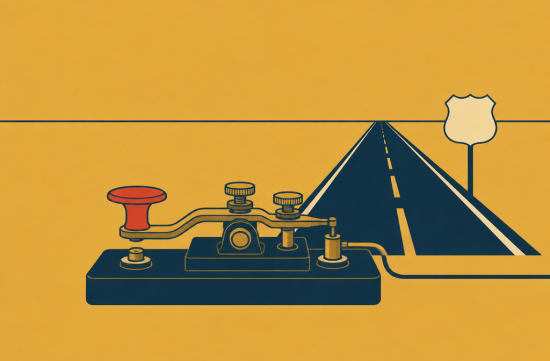
How many roads in the United States have names that became song titles? When you think of Route 66, the melody that everyone hums comes to mind.
However, not many people know that there is a specific place associated with the number 66 on this road. It's not Chicago or LA, but Springfield in the Ozarks of Missouri.
This year, 2026, marks the 100th anniversary of the name being established. So today, I want to gradually explore how a single number became a symbol of an era.
The story goes back to the fall of 1925. At that time, a federal initiative was underway to assign numbers to highways, and the route from Chicago to LA was originally slated to be designated as Route 60.
In the American numbering system, a route ending in 0 signifies a major east-west highway. In other words, it was a sort of premium number.
The person who put a stop to this was Kentucky Governor William J. Fields. He strongly insisted that a Route 0 should also pass through his state.
As a result, Route 60 was reassigned to a route that went through Virginia and Kentucky. Instead, Route 62 was proposed for the road from Chicago to LA.
One person who was unhappy with this decision was Cyrus Avery, the chairman of the Oklahoma Highway Commission. After months of back-and-forth, on April 30, 1926, he found himself in Springfield.
Present at the meeting were Missouri highway engineer B. H. Pfeiffer and Springfield businessman John T. Woodruff. The location was the Colonial Hotel at the corner of St. Louis Street and Jefferson Avenue.
Woodruff was a prominent local figure who worked as a lawyer for the Frisco Railroad. He understood better than anyone that roads attract people and money.
The three men were looking over a list of numbers that had not yet been assigned and discovered that 66 was available. It is said that everyone agreed it was easy to say and remember.
That day, a telegram was sent from the Colonial Hotel to Washington. The key message was, "We prefer Sixty-Six to Sixty-Two," meaning that 66 was better than 62.
The telegram included a condition that other states like Illinois, California, Arizona, and New Mexico would also support 66 if it was accepted. This was not a unilateral push; they sought the agreement of stakeholders.
This aspect feels very American to me. It's not a name imposed from above by the government, but one that was negotiated and obtained by the local people.
On November 11 of that year, the U.S. highway numbering system was officially approved, and the name Route 66 became official. The basis for Springfield being called the birthplace of Route 66 is this telegram.
Unfortunately, the Colonial Hotel building that sent the telegram no longer exists. It was demolished long ago.
Instead, this year, a new place called Bus Place Plaza, literally the birthplace plaza, has been established at that location. A dedication ceremony was held on April 30, 2026, exactly 100 years later.
During that week, Springfield hosted a nationwide kickoff event for the 100th anniversary. NBC's Today Show broadcast live from the site, and a large concert took place at the Great Southern Bank Arena.
The Federal Highway Administrator and the Missouri Lieutenant Governor spoke at the dedication ceremony. What began as an event at a city corner has now become a national holiday.
However, this road was not officially eternal. As interstate highways began to emerge, Route 66 was gradually pushed aside.
In 1984, Williams, Arizona, became the last town bypassed by I-40. And on June 27, 1985, the American Association of State Highway and Transportation Officials officially removed Route 66 from the federal highway system.
Isn't it interesting that a road erased from the map is still so beloved? I find it impressive that after its name disappeared, people rallied to preserve that name.
I remember the first time I drove long distances after immigrating. I recall stopping my car on purpose to take a picture of the brown Historic Route 66 sign.
At that time, I thought it was just a tourist sign. I didn't realize until much later that behind that number lay the stubbornness of a governor and the negotiations of local businessmen.
I believe there's a lesson to be learned from this story. A large system ultimately moves when the persistent voices of small-town people are heard.
I think the same applies to our Korean community. Whether at city council meetings or school boards, those who voice their opinions leave their mark.
If you have plans to drive toward the Ozarks this fall, I encourage you to stop by the downtown birthplace plaza. Just standing where that telegram began 100 years ago will be meaningful.
If it were me, I would choose the old Route 66 instead of I-44 and take my time. After all, the road with a name tends to stay in memory longer than the faster route.
 LiveBold

 novapixel |
 Peter Pan Pet |
 horse |
 Sunset Oregon |
 daisypat |
 meonetoo |
 ramen |
 calvor |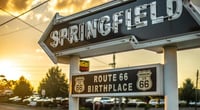
 nameone |
 lightyear |
  song bang |
  vexomo |
  Indiana Jones |
  meloncat |
  mortrix |
  Esther 1983 |
  fortbliss |
  Moscow Kim |
  My Two Way |
  toastyfox |
  FLORIDA Acus |
  tracker |
  TONTON COFFEE |
  sunrise |
  ultron78 |
  uplifted |
  Folding Instructions |
  same same life |