
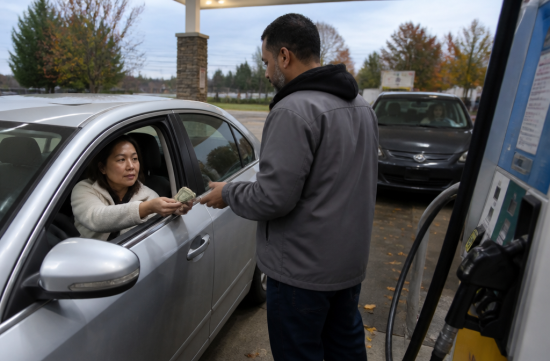
Last week, I went to a gas station, rolled down my window, and handed over my card, but the attendant pointed to the numbers on the machine. It indicated that cash was 10 cents cheaper per gallon.
Even though I've been driving in New Jersey for quite some time, that 10 cents really stuck in my mind that day. I thought about how it might add up over a year, even if it was just a little over a dollar at a time.
So, I went home and looked it up and did the math. I was a bit surprised that the numbers weren't as small as I expected.
First, let's clarify the rules. New Jersey allows gas stations to charge different prices for cash and card payments.
According to state regulations, the price displayed on the pump and meter must be the card price, and the cash discount must be clearly indicated on the pump or at the island. So, if you miss the cash discount sign, you end up paying the card price.
In 2011, a law was passed requiring both cash and card prices to be posted. Still, it's not easy to keep an eye on those small signs while driving.
I was also curious about why there's a difference. The reason is the card processing fees.
The representative of a New Jersey gas station industry group mentioned in a local broadcast interview that the average card processing fee for gas stations is about 3%. Some places go as high as 4%, depending on the contract.
Since the fee is proportional to the price, as gas prices rise, the burden on gas stations increases. In the same interview, it was explained that at $5 per gallon, a 3% fee would amount to 15 cents.
Looking at this year's gas prices, this is not just someone else's problem. According to AAA data, as of September 16, the average price for regular gasoline in New Jersey was $4.425 per gallon.
A month ago, it was around $3.97, so it has risen quite a bit in a short time. At this price, a 3% fee would exceed 13 cents per gallon.
So, how much is the actual difference between cash and card prices? According to the same report, many gas stations set a 10-cent difference, while some vary between 5 cents, 7 cents, and even 20 cents.
When gas prices soared in 2022, one chain even set its card price 20 cents higher than the cash price. What used to be a 10-cent difference doubled.
And there's one more thing to note. Unless a state of emergency is declared, there's no cap on how much more they can charge for card prices.
Ultimately, it's a matter of who pays the card processing fees, and the cash discount structure shifts that cost onto customers who use cards. I understand it, but from a customer's perspective, it can feel a bit unfair.
Now, I calculated it my way. If I fill up 12 gallons once a week, that's 624 gallons a year.
If the difference is 10 cents, that's $62.40 a year. If the gas station has a 20-cent difference, it would be $124.80.
If you have a larger tank and fill up 15 gallons at a time, you would save even more. At a 10-cent difference, that's $78, and at a 20-cent difference, it's $156.
If you have two cars, you'd have to double that, meaning you could be losing the equivalent of a month's grocery bill just in fees. That's not an insignificant amount.
Of course, carrying cash can be a hassle. It's annoying to get change, and these days, there are often days when I hardly have any cash in my wallet.
However, it's not easy to say that cash is always better. You have to consider card rewards.
If you're using a card that gives you a percentage back in the gas category, you need to compare that earning rate with the cash discount. A 10-cent discount on a $4.40 gallon price corresponds to about 2.3%, so if your rewards are lower than that, cash is better, and if they're higher, the card might be the way to go.
Some gas stations charge the same price for cash and card. Wawa has promoted that they offer the same price in New Jersey, whether you pay with cash or card.
However, industry groups say that just because the prices are the same doesn't mean it's the cheapest option. Sometimes, they set the cash price a bit higher to offset the fees.
So, I believe it's best not to just look at the numbers but to compare based on the routes I frequently take. If you go out of your way to save a few cents, you might end up spending more on gas.
How debit cards are treated also varies by gas station. Some places will give you the cash price, so if you're at a new station, it's best to roll down your window and ask.
New Jersey is the only state where you can't pump your own gas, so you have the opportunity to ask every time. This rule has been in place since 1949, so it's actually convenient in this case.
My conclusion is this: Just jot down the cash and card prices at two or three gas stations you frequently visit.
If the difference is more than 10 cents and my card rewards are lower than that, I'll try to keep cash for gas in my wallet. Saving a few dozen dollars a year can mean a lot in an immigrant household.
Not overlooking small amounts is one of the habits I've learned while living here. Next time you stop at a gas station, take a look at the small print under the sign.
 SilverMoon


 mortrix |
 cherrydino |
 victoria 68 |
 American Man in a Mask |
 kuku 100 |
 Reeno |
 Living in New Jersey blog |
 gardener 007 |
 Delicious Food Finder |

 Mr Oh |
  forevergee |
  festival |
  manchester |
  constant |
  Leapfrog Move |
  vibranto |
  Tora Tora |
  yellowbutter |
  Dolly |
  US Embassy |
  NYC saladbar |
  Finding Superfoods |
  lightyear |
  song bang |
  vexomo |
  Indiana Jones |
  meloncat |
  novapixel |