
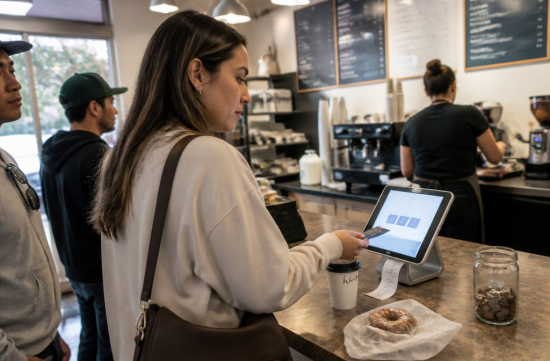
Recently, I bought a cup of coffee and a bagel at a local bagel shop. As soon as I inserted my card, the screen flipped around and the 15%, 20%, and 25% buttons were staring at me.
The employee was turned around preparing my coffee, and there was a line behind me. For those few seconds, I felt like I was taking a test for no reason.
In the end, I pressed the smallest button instead of No Tip. But it wasn't until I got into my car that I thought, what am I paying extra for?
This experience isn't unique to me. According to a survey by the Pew Research Center in August 2023, 72% of 11,945 American adults reported that the number of places expecting tips has increased compared to five years ago.
What's even more interesting is the next number. Only 34% of respondents said it was easy to know whether to tip, and just 33% said it was easy to know how much to tip.
This means that Americans are confused too. When I first immigrated, I thought I was the only one who didn't know, but in reality, everyone was nervously pressing buttons.
In the same survey, 92% of people said they always or often tip at sit-down restaurants. In contrast, only 25% do so when buying coffee, and just 12% at fast-casual restaurants.
This indicates that people's mental standards remain unchanged. If you receive service, you tip; if you pick up at the counter, it's optional. However, the screen keeps erasing that boundary.
So why has the screen become so prevalent? The biggest factor was the pandemic. As takeout and pickup orders increased, tablet payment systems spread to small shops.
These systems can activate the tip screen with just a button. Payment companies like Square explain that the store owner can turn the tip option on and off or change it.
According to NBC reports, the frequency of tips at quick-service restaurants increased by 16% in the fourth quarter of 2022 compared to the previous year, based on Square data. From the customer's perspective, when the screen pops up, they just end up pressing a button.
Interestingly, the actual tip percentages haven't increased significantly. What has increased is the number of times tips are requested, which seems to be the source of fatigue.
Let's take a moment to discuss history. The tipping culture in America wasn't always taken for granted. In the early 20th century, there was a strong movement to abolish tipping.
In 1904, the Anti-Tipping Society of America was formed in Georgia, and Washington state even passed a law in 1909 that made tipping a misdemeanor.
However, that law was hardly enforced and was repealed in 1913. Other states that enacted similar laws also abolished them by the mid-1920s.
The structure of tipping as a substitute for wages is said to have been heavily influenced by the Pullman railroad company. They primarily employed Black men as porters in sleeping cars, and the base pay was set at a level that couldn't sustain a living without tips.
This structure has continued to this day with the federal tip credit system. Under federal law, employees who receive tips can be paid a cash wage of just $2.13 per hour, with the remainder made up by tips to reach the minimum wage of $7.25.
However, California is different. The state minimum wage is $16.90 per hour as of 2026, and it does not recognize tip credits at all. Tips are considered additional income on top of the minimum wage.
So living here adds another layer of consideration. Knowing that employees receive the minimum wage, is it right to add 20% on top of a cup of coffee?
Of course, we need to hear the other side. California has such high housing costs and living expenses that many employees struggle to get by on minimum wage alone, and for small businesses, having a tip screen might be less burdensome than raising prices.
Another variable has emerged. Starting from 2025 through the 2028 tax year, the federal government is implementing a program called No Tax on Tips, which allows tip income to be deducted up to $25,000 per year.
This is good news for employees, but honestly, it raises questions about whether this will reduce the frequency of tip screens. It could actually make tips an even more significant source of income.
Customer fatigue continues to build. A 2025 survey by Bankrate also found that the number of people with negative views on tipping has increased compared to the previous year, and many believe that businesses should raise wages more.
In summary, both sides have their reasons. Businesses want to pass costs onto customers without it being too obvious, employees need to cover living expenses, and customers are unsure about what is considered polite.
The problem is that all this pressure is concentrated in those three seconds in front of the payment screen. For Koreans, who are used to a culture of reading the room, this can be particularly stressful.
My personal standard is this: I tip generously for services where people are directly involved, like table service, delivery, or hair salons, and I only tip for coffee when I feel like it.
And I've decided not to feel guilty about pressing the No Tip button. Just looking at the Pew numbers shows that those who consistently tip when buying coffee are actually in the minority.
I would prefer to see more places that include everything in the price without a tip screen. Even if the menu prices are a bit higher, it's much better not to feel anxious at the register.
 330iforever







 novapixel |
 Peter Pan Pet |
 horse |
 Sunset Oregon |
 daisypat |
 Old English |
 US Home Buying Information Home Insurance |
 U.S. Military Recruitment Information |
 K-POP TV News |
 Archaic Kim |
  Dolly |
  US Embassy |
  NYC saladbar |
  Finding Superfoods |
  lightyear |
  song bang |
  vexomo |
  Indiana Jones |
  meloncat |
  mortrix |
  Esther 1983 |
  fortbliss |
  Moscow Kim |
  My Two Way |
  toastyfox |
  FLORIDA Acus |
  tracker |
  TONTON COFFEE |
  sunrise |