
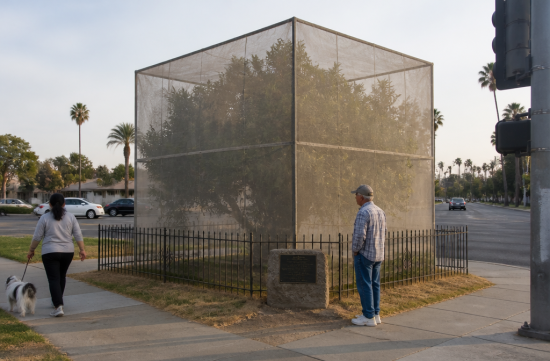
As you drive down Magnolia Avenue and hit the signal at the Arlington Avenue intersection, you'll see a tree surrounded by a fence at the corner. At first, I thought it was just a small landscaping tree in a park.
But it turns out this tree is known as the Parent Washington Navel Orange Tree, which is considered the starting point of California's navel orange industry. To be honest, when I first heard about it, I thought it might be a bit of an exaggeration.
The story begins in Bahia, Brazil. It is said that in the early 19th century, a mutation occurred in an orange tree in a monastery orchard in Bahia.
The fruit had a small bump on the opposite end of the stem, resembling a navel, and most importantly, it had no seeds. That's how it got the name navel orange.
Having no seeds is a blessing for those who eat the fruit, but it's quite fatal for the tree. Since it can't reproduce by seeds, the only way to propagate it is by cutting branches and grafting them onto other trees.
In 1870, the U.S. Department of Agriculture (USDA) brought 12 of these trees from Bahia. William Saunders, who was the head gardener at the USDA at the time, grafted the buds of these trees onto other orange seedlings in a greenhouse in Washington, D.C.
Here, we meet Eliza Tibbetts, a woman who moved to Riverside, a newly established settlement, with her husband, Luther Tibbetts.
In 1873, two grafted seedlings grown by Saunders were sent to the Tibbetts couple. It was a long journey from Washington to the western edge, involving trains and stagecoaches.
Local historian Esther Clotz cited records indicating that the trees arrived on December 10, 1873. However, there are some sources that note slightly different planting times, making it hard to pinpoint the exact date.
According to the story, Eliza even collected dishwater to give to these trees. Considering how precious water must have been in this dry area, that shows real dedication.
Years later, the fruit produced was large, sweet, and seedless. Neighboring farmers flocked to get grafting branches, and orange orchards quickly spread throughout Riverside.
This led to the term Citrus Belt being coined in Southern California, indicating the growth of citrus cultivation. Many of the navel oranges you pick up at the grocery store today are descendants of these two trees.
Of course, we should be cautious about claiming that all navel oranges originated from this one tree. There were other routes through which navel oranges came, and some researchers view the origins differently.
So, what happened to the two trees? One of them was transplanted to the front yard of the Mission Inn when President Theodore Roosevelt visited Riverside in May 1903.
The fact that even the president participated in the tree transplanting shows how serious this community was about oranges. However, that tree didn't last long and died in the early 1920s.
There are conflicting records regarding the date of death, with some stating 1921 and others 1922. In any case, only one tree remains today.
The surviving tree was moved around 1902 to the corner of Magnolia and Arlington. In 1920, a plaque was also erected in honor of Eliza Tibbetts.
On June 1, 1932, it was designated as California Historical Landmark No. 20. It's one of the earlier landmarks in the state, which is evident from its number.
This tree didn't just survive on its own. During a time when its trunk was deteriorating due to disease, UC scientists saved it by using a grafting method called inarching to attach nearby seedlings to its trunk.
Today, the care of the tree is jointly managed by UC Riverside and the city's parks department. The establishment of the Citrus Experiment Station at UC Riverside in 1907 was also a result of this industry.
In recent years, this tree has been covered with a white cloth, and in 2019, it was replaced with a tent structure with insect barriers. This is to protect it from pests that spread citrus greening.
When I first saw the tent, I thought it looked a bit funny, like a VIP patient isolation ward.
But thinking about it, this is the right response. Since the tree can only be propagated through grafting, its symbolic value is significant, and one disease could shake the entire industry.
What resonates with me most in this story is Eliza Tibbetts. She wasn't a great landowner, but she was a woman who managed to keep those two trees alive in a new settlement.
History books usually prioritize railroads, large farms, and presidents. But the first thread of this community's economy was woven by someone who went out to the yard with dishwater.
It's also interesting that this structure of public institutions bringing in the trees, individuals nurturing them, and universities conducting research has preserved this legacy. If any one of those elements were missing, we wouldn't have the citrus landscape we see today.
If you happen to pass by, feel free to stop and take a look. It may not be a grand sight, but knowing that it's a tree that has stood for over 150 years changes the feeling.
If it were me, I would buy a bag of navel oranges in winter and enjoy one in front of the fence. Tasting the descendants of this tree in front of the original is quite a nice experience, don't you think?
 StarlitCloud




 novapixel |
 Peter Pan Pet |
 horse |
 Sunset Oregon |
 daisypat |
 Purple Moons, |
 Kathy's Blog |
 What can make money? |
 Korean Mom |
  My NYC |
  moo moo |
  Mr Oh |
  forevergee |
  festival |
  manchester |
  constant |
  Leapfrog Move |
  vibranto |
  Tora Tora |
  yellowbutter |
  Dolly |
  US Embassy |
  NYC saladbar |
  Finding Superfoods |
  lightyear |
  song bang |
  vexomo |
  Indiana Jones |