
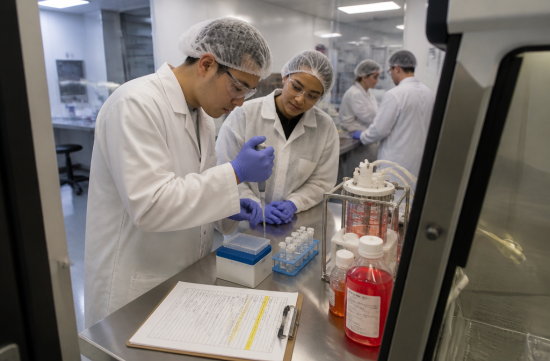
Recently, I received a DM from a friend. They are majoring in business and asked if there are any job openings for someone like them at the bio companies lined up along I-270.
Honestly, I used to think that bio companies were only for PhDs. But if you dig a little deeper, there are more opportunities than you might expect.
First, let's talk about the local atmosphere. In November 2025, AstraZeneca announced a $2 billion investment in Maryland, which includes a new clinical drug manufacturing facility in Gaithersburg.
According to the governor's office announcement, this Gaithersburg facility aims to be operational by 2029 and will create 100 new jobs while maintaining 400 existing positions.
In the same announcement, AstraZeneca revealed that they have already employed over 5,500 people in Maryland. I was a bit surprised by that number.
There's also a counter trend. Novavax signed a contract in October 2025 to transfer the lease rights of the building at 700 Quince Orchard Road, along with adjacent land and equipment, to AstraZeneca.
According to Novavax's announcement, this deal was finalized in the first quarter of 2026, and the headquarters moved to a smaller building within Gaithersburg. One side is downsizing while the other is expanding.
This means that job postings are not concentrated in one company but are continuously shifting. Therefore, it's important to look at multiple companies.
So, what positions should non-majors consider? The first one that comes to mind is manufacturing technician.
According to Maryland Department of Labor data, bio manufacturing technical positions require special skills beyond a high school diploma, but a two-year or four-year degree is not always necessary.
However, the requirements can vary by posting. One manufacturing technician job in Gaithersburg required a bachelor's degree in biology and experience in cell culture.
So, it's better to understand it as "you can knock on the door with a training certificate instead of a degree" rather than "a degree is not required."
The second area is quality control, such as QC analyst or validation technician. This involves recording experimental results and ensuring that equipment operates according to regulations, which can be a good fit for detail-oriented individuals.
The third area is outside the lab. Departments like supply chain, warehouse management, facility maintenance, HR, finance, and IT are all present in bio companies.
In these positions, experience in your previous field is often more important than bio knowledge. However, having a basic understanding of GMP (Good Manufacturing Practice) can definitely make you stand out in interviews.
So where can you get that training? A nearby option is the BioHub Maryland training center in Rockville.
This center is operated by the Maryland Tech Council and uses the curriculum from Ireland's NIBRT. The facility is 8,200 square feet.
The courses are divided by job roles, such as upstream manufacturing, downstream manufacturing, fill finish, QC, and validation, with durations ranging from 24 to 64 hours depending on the course.
Eligibility requirements include being a resident of Maryland, DC, or Virginia, having a high school diploma, English proficiency, and legal work authorization in the U.S. Costs vary by course, so be sure to check directly.
If you want to earn credits, Montgomery College offers a Biomanufacturing Certificate. It's a total of 19 credits, and you need to get approval from the program coordinator before registering.
Here, you'll learn basics like pipetting, buffer preparation, aseptic techniques, filtration, and protein chromatography. These are exactly what beginners in the field need.
However, since this is a career-oriented program, the school has noted that credits may not transfer well to a four-year college. If you're considering transferring later, keep this in mind.
There's also a realistic downside to mention. The manufacturing positions may have a schedule that runs seven days a week with 10-12 hour shifts, according to the state labor department data.
This can be quite a barrier for those with children or those working multiple jobs. Personally, I wish there were more support for childcare in these shift jobs.
Still, I think it's a great opportunity to enter an industry where you can start without a degree and build your career, especially for those who have immigrated and need to start anew.
The advice I gave my friend was this: first, take a short introductory course to get a grasp of GMP, then apply for positions that overlap with their previous experience.
And I told them not to check the career pages of companies like AstraZeneca, Novavax, and Emergent all at once, but to set alerts and keep an eye on them regularly.
If I were in their shoes, I would take a short course at BioHub first and then apply right away. The 19-credit program can be considered later, as it's not too late to think about it.
 AnchovyDive


 coloradoman |
 Living Economy Information Blog |
 Tomato Health Club blog |
 Banana Style Life |
 crystalo |
 tartbear |

 Thersburg Mrs |
 monkey |
 lightyear |
  song bang |
  vexomo |
  Indiana Jones |
  meloncat |
  novapixel |
  mortrix |
  Esther 1983 |
  fortbliss |
  Moscow Kim |
  My Two Way |
  toastyfox |
  FLORIDA Acus |
  tracker |
  TONTON COFFEE |
  sunrise |
  ultron78 |
  uplifted |
  Folding Instructions |
  same same life |