
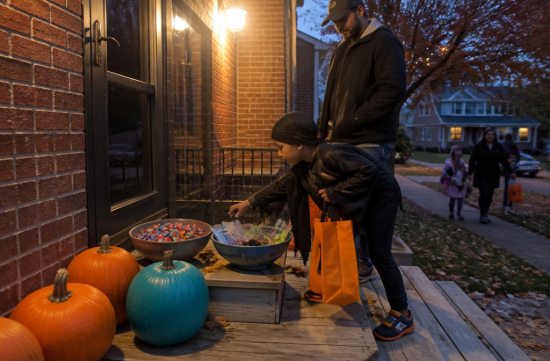
Last week, I stopped in front of a house on my evening walk. There was a teal-painted pumpkin among the orange ones.
At first, I thought it was just a unique decoration. But it turned out to be a clear signal with a specific meaning, and since then, I've been looking for this color whenever I walk around the neighborhood.
This teal pumpkin is a sign of the 'Teal Pumpkin Project.' It means that this house has non-food treats available in addition to candy.
The color teal symbolizes food allergy awareness. Just as the pink ribbon is associated with breast cancer, this color serves as a promise of sorts.
It didn't start out grand. In the fall of 2012, a mother in East Tennessee placed a teal pumpkin in front of her house, and that was the beginning.
The person behind it is Becky Basalone. She was leading a local food allergy group called FACET (Food Allergy Community of East Tennessee).
Her youngest son had severe allergies to peanuts, milk, and nuts. On Halloween, he had to either refuse candy at every door or explain his condition.
So, this family prepared small toys along with candy, allowing kids to choose what they wanted. They placed a teal-painted pumpkin at their door as a sign of this.
The nonprofit organization FARE (Food Allergy Research & Education) helped expand this idea nationwide. FARE began promoting this campaign across the country starting from Halloween 2014.
The response was swift. It spread through social media, and in the first year alone, over 5 million people learned about it on FARE's Facebook page.
Now, it operates by registering participating households on a map. According to FARE, over 12,500 locations will be listed on the map in 2024, including all 50 states and Washington, D.C.
Honestly, I was a bit surprised by the numbers. What started with a single pumpkin in front of a house has grown to this scale in just over a decade.
When I think about why it spread so much, the answer is simple: there are more kids affected than you might think.
FARE explains that 1 in 13 children in the U.S. has a food allergy. This means there could be two or three kids in a classroom, and it's a significant number among neighborhood children as well.
The target isn't just kids with allergies. Children with diabetes or celiac disease, or those who are tube-fed, also find candy baskets to be out of reach.
For those kids, Halloween is a fun day but also a day filled with refusals. The feeling of coming home with candy that they can't eat is something even adults can understand.
Participating is not difficult. Just place a teal pumpkin or a printed sign in front of your house and prepare non-food treats.
FARE emphasizes one point: do not mix candy and non-food treats in the same bowl; keep them separate.
The reason is understandable. If they are mixed, candy ingredients could get on the toys, and kids should be able to choose without having to explain their situation.
The treats don't need to be extravagant. Small items like stickers, glow bracelets, chalk, pencils, or spider rings are sufficient. Just avoid toys with very small parts that could be a choking hazard for younger kids.
This campaign doesn't call for completely cutting out candy. It simply adds another option alongside the existing candy, making it less burdensome.
These days, there are several other Halloween color signals emerging. Some people interpret seeing a child with a blue basket as a sign to wait, as they may have difficulty communicating.
Observing this trend, I've realized something from a business perspective: the strength of community culture in America comes from these voluntary commitments rather than government policies.
No one mandated it, and it wasn't established by law, but neighbors voluntarily set and follow these signals. The rules are simple and the costs are low, making participation easy. I believe this approach will last longer.
Our Korean families can also participate. Small stationery or character stickers sold at Korean markets surprisingly get a good reaction from kids. It also serves as a great opportunity to naturally greet neighbors.
If it were up to me, I would place a small bowl next to the candy bowl this year. It might cost a few more dollars, but if it brings a smile to just one hesitant child at the door, it's worth it.
There are just about three weeks left until Halloween. If you see a teal pumpkin while walking, take a moment to think about who that house is waiting for.
 BusanYeocha


 Anjollinya Blog |
 Anova US Beauty Information |
 anchor |
 Korea Tiger News |
 Alpha and Omega World |
 American Hardcore Band |

 tervox95 |
 Kondae Garusong Blog |
 Virginia Butterfly Mom |
 Fairfax Fox |
  Gold Bar |
  Banana Style Life |
  Tesla X |
  Old English |
  urbanmint |
  forestcloud |
  forever young |
  Arlington house |
  liquid asset |
  Who's watching? |
  eclipse |
  quietwave |
  Hajiwon Blog Hair Salon |
  hoosierdaddy |
  saffronroute |
  korvex93 |
  Mini Mee |
  Darnignac |
  vanilla |
  selvon |