

Last week, I paused for a moment while lifting a bag of rice at the local Korean market. It used to be a weight I could lift without a second thought, but that day, my arms and legs felt heavier than my back. I tried to brush it off as just aging, but it lingered in my mind, prompting me to quietly gather my thoughts on the topic today.
As we age, the loss of muscle mass and strength is referred to as sarcopenia. While the term may be unfamiliar, the changes it describes are something we all experience.
According to data from the U.S. Department of Health and Human Services' Office on Women's Health, the body naturally loses 3-5% of muscle mass every ten years starting around age 30. This change becomes noticeable around age 60 and continues to progress with age.
While the numbers may seem small, the story changes when accumulated over decades. You might notice that stairs feel a bit higher, or you find yourself using your hands to push off your knees when getting up from a chair—these can be signals of that change.
The same data explains that people who move less are more likely to experience these changes. Conversely, this means there is potential to slow down the process through movement and diet.
So, how much should we move? The CDC recommends three types of exercise for those over 65: aerobic exercise, strength training, and balance exercises.
Aerobic exercise should include at least 150 minutes of moderate-intensity activities like brisk walking each week. Alternatively, high-intensity activities like hiking or jogging can be done for 75 minutes a week.
Breaking it down, that's about 30 minutes a day for five days. A leisurely walk around the neighborhood after dinner can easily fulfill that requirement.
The second type of exercise directly related to sarcopenia is strength training. The CDC advises engaging in exercises that work major muscle groups—legs, hips, back, abdomen, chest, shoulders, and arms—at least two days a week.
You don't need fancy gym equipment to do this. Pulling resistance bands, lifting water bottles, or doing push-ups against a wall all count as strength training.
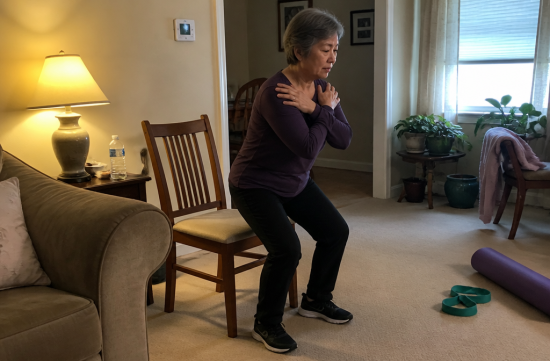
The easiest exercise I started with was standing up and sitting down from a chair. Crossing my arms, I would slowly stand up and then slowly sit back down, and even doing this ten times made my thighs feel heavy.
The third type is balance exercises. The CDC provides examples like standing on one foot or walking in a straight line with your heels and toes touching.
Balance is not separate from muscle strength. When leg strength decreases, the risk of falling increases, and fear of falling can lead to less movement, creating a cycle.
Now, let's talk about nutrition. If you exercise but don't get enough protein, your body lacks the materials needed to build new muscle.
The recommended dietary allowance (RDA) for protein in the U.S. is 0.8g per kg of body weight, regardless of age. For someone weighing 60kg, that means a daily intake of 48g.
However, in 2013, the PROT-AGE study group, an international panel of experts, suggested a higher intake of 1.0-1.2g for those over 65. For the same 60kg individual, that would increase to 60-72g per day.
This group also recommended more than 1.2g for those who exercise regularly. When I first saw this number, I was surprised to realize that my intake was significantly lower than I thought.
Another important point is to spread out protein intake. Researchers believe that older adults should consume about 25-30g of protein per meal for optimal muscle synthesis.
Many of us skip breakfast and load up on meat at dinner. It's better to distribute protein evenly across three meals.
Using Korean ingredients makes this easy. You can add eggs or tofu for breakfast, grilled fish for lunch, and a side of beans or lean meat for dinner.
Having a cup of Greek yogurt or milk as a snack is also a good idea. Just getting into the habit of checking the nutrition labels for protein content at the store can help you stay informed.
However, there's an important caveat. For those with reduced kidney function, a high-protein diet can be burdensome, so the National Kidney Foundation (NKF) recommends protein management for chronic kidney disease patients.
If you have diabetes, kidney disease, heart disease, or are on medication, consult with your doctor or pharmacist before determining exercise intensity and protein intake. The same goes for choosing protein supplements.
Starting exercise too aggressively can lead to burnout. The CDC advises that if you find it difficult to meet the guidelines, start with what you can manage.
These days, I'm doing just that. On Tuesdays and Fridays, I do chair exercises and band workouts, and on the other days, I take evening walks.
While brushing my teeth, I stand on one foot, and I always make sure to include two eggs on my breakfast plate. These are small habits I've incorporated into my day rather than grand plans.
Muscle loss doesn't happen overnight, and neither does recovery. Still, I believe that consistency can take you further than you might expect, just like a river slowly flowing to the sea.
The next time I lift a bag of rice at the store, I hope to hesitate a little less. How about you try standing up slowly from your chair ten times tonight?
 HamCheeseDrop




 Old English |
 nixxon |
 LIZ Legal Information Blog |
 Karina's Blog |
 Jimbeam 88 |
 dorex |
 parlon |
 Virginia Butterfly Mom |

 garlic bread |
  middlekick |
  Moscow Kim |
  nivex85 |
  quanta7 |
  Tomato Health Club blog |
  horse |
  Egg Steamed Pot |
  Helpful Life Stories |
  UNI Lover |
  zen zeng |
  oh my salami |
  wendra |
  coloradoman |
  business life |
  candytip |
  churrotop |
  swiftlane |
  allstar realty |
  mystery |