
To be honest, saying that ragweed is the sole culprit for autumn nasal itch is only half true.
These days, I start my mornings with three sneezes. I thought it might be a cold, but I have no fever and my throat feels fine. I just keep having a runny nose and itchy eyes, so I eventually started looking into it.
The first name that pops up in a search is ragweed. But I'm not one to just believe what everyone says, so I dug a little deeper.
There's definitely a reason ragweed has a bad reputation. According to the American Academy of Allergy, Asthma & Immunology (AAAAI), a single ragweed plant can release up to a billion pollen grains in a season.
A billion. From one plant. I had to pause for a moment after seeing that number.
However, there's quite a bit of variation in studies. Some research shows that the average for a single plant is much lower, so it's best to read that billion as a "maximum."
The distance ragweed pollen can travel is also frightening. The Asthma and Allergy Foundation of America (AAFA) explains that ragweed pollen has been detected 400 miles out over the ocean and at heights of 2 miles in the air.
Still, most of it falls close to where it grows. So, a more accurate expression would be "it hits harder if it's nearby" rather than "it comes from far away."
The season usually starts in August and continues until the first frost. Ragweed needs frost to stop producing pollen.
This is where my question began. When does the season end in Southern California, where frost rarely occurs?
I couldn't find any official data on this. However, it's confirmed by federal data that if frost is late or absent, the season is extended.
According to EPA climate indicators, ragweed season has lengthened in 10 out of 11 survey sites since 1995. Minneapolis has seen an increase of 18 days, and Winnipeg, Canada, has seen an increase of 25 days.
The EPA believes that the delay in the first autumn frost has also extended the season. However, this data is from the Midwest and Canada, so it shouldn't be directly applied to our area.
And here's the real twist. There are too many other suspects to explain autumn allergies in Southern California with just ragweed.
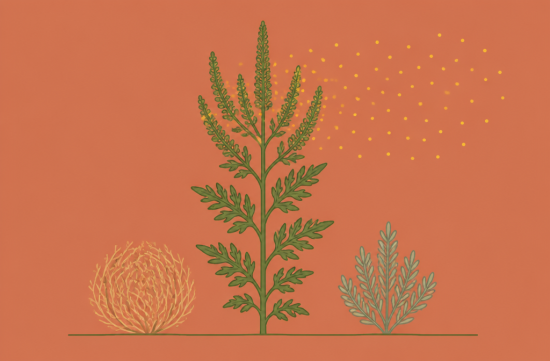
Local allergy data often point to sagebrush, Russian thistle (the tumbleweed), and various types of amaranth as the main culprits in Southern California. Ragweed does grow in this area, but it's the western ragweed.
The tumbleweed is indeed the plant that rolls across the road in Western movies. I learned for the first time that it can cause pollen allergies.
Different sources rank these allergens slightly differently, but sagebrush and ragweed appear in almost all data. So, I think it's more accurate to say, "the ragweed family of weeds is the culprit" rather than just "ragweed is the culprit."
And one more thing that nobody really tells you: if you have a ragweed allergy, you might experience an itchy mouth when eating certain fruits.
This is known as oral allergy syndrome, and the Stanford Healthcare guide lists bananas, watermelon, cantaloupe, honeydew melon, zucchini, and cucumbers. The pollen proteins are similar in structure, which confuses the body.
Chamomile tea is also on the caution list. If you drank chamomile in the fall for a sore throat and your mouth itched more, that might not be a coincidence.
Fortunately, for most people, the symptoms are mild and only last briefly, and cooking the fruits often reduces the reaction. However, if you feel swelling in your throat, don't ignore it.
So, what can you actually do? It starts with the basics. On days with high pollen counts, keeping your windows closed at home and in the car is the first step.
After being outside, take a shower before bed to wash off any pollen that may have stuck to your hair. Otherwise, it will end up on your pillow.
Pollen counts are usually high in the early morning, and the air tends to be cleaner right after it rains. It's best to avoid jogging in warm, windy mornings during this season.
You can also find over-the-counter nasal steroid sprays at the pharmacy. The FDA approved fluticasone, triamcinolone, and budesonide, and in 2022, mometasone was also approved as an OTC medication.
Many explanations suggest that these sprays are more effective when used consistently rather than just when symptoms occur. However, if you're taking other medications or have pre-existing conditions, be sure to consult with a doctor or pharmacist first.
And don't confuse it with a cold. If you have a fever or body aches, it's more likely to be something other than allergies.
In summary, ragweed is definitely a major cause. But in Southern California, it's not alone.
If I were you, I would check the local pollen forecast daily instead of just toughing it out this year. Knowing which weeds are high on certain days will help you respond more accurately.
 HoldSongHae







 neroyo |
 nivex85 |
 Old English |
 nixxon |
 LIZ Legal Information Blog |
 Fun Flex Life |
 Experiences Living in America |

 MacMorningBlog |
 vibranto |
  Tora Tora |
  yellowbutter |
  Dolly |
  US Embassy |
  NYC saladbar |
  Finding Superfoods |
  lightyear |
  song bang |
  vexomo |
  Indiana Jones |
  meloncat |
  novapixel |
  mortrix |
  Esther 1983 |
  fortbliss |
  Moscow Kim |
  My Two Way |
  toastyfox |
  FLORIDA Acus |