
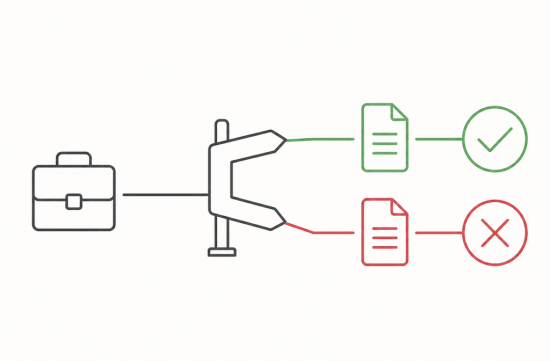
When you suddenly receive a termination notice from your company, the first thought that comes to mind is often relief, thinking that unemployment benefits will surely follow.
However, this thought is only half correct. Just because you were fired does not automatically mean you will receive benefits.
The sole criterion that determines whether you will receive unemployment benefits is the reason for your termination.
Let's start with cases where employees are laid off due to company circumstances. If the position was eliminated due to restructuring, budget cuts, or department consolidation, it is not the employee's fault, and they will almost always qualify for benefits.
The problem arises when the company claims that you were fired because of your actions. At this point, the issue of misconduct, or serious fault, comes into play.
Misconduct has a higher standard than you might think. It refers to intentional and deliberate violations of company rules, not just simple mistakes or negligence.
Examples of misconduct include theft, repeated disregard for company policies, or knowingly violating important safety regulations. It means that the behavior must have clearly harmed the company's interests.
On the other hand, being let go for not meeting performance targets does not constitute misconduct. If you worked hard but did not achieve results, that is not a fault; it simply means it was not a good fit.
Similarly, being fired due to a mismatch with your supervisor or company culture generally meets the criteria for benefits.
One important point to note is that the burden of proof for misconduct lies with the employer, not the employee.
The company cannot simply claim that you were the problem. They must provide concrete evidence, and if they fail to do so, the benefit claim will be granted. Just because something is written in the termination notice does not automatically confirm misconduct.
Many people are also curious about being fired during a probationary period. To put it simply, being on probation does not automatically disqualify you from benefits.
The key factors are twofold: what the reason for termination was and whether you met the minimum income requirements when combined with your previous employment.
If you have recently changed jobs and lack sufficient income history, you may run into issues in that area. There are cases where you do not meet this requirement regardless of the reason for termination.
The type of employment is also an important variable. Regular W2 employees are generally eligible because their employers have been paying unemployment insurance premiums.
In contrast, 1099 contractors or freelancers often fall outside of this insurance premium system. Therefore, it is common for them not to qualify for regular unemployment benefits even after their contracts end, so it is advisable to check this when signing the contract.
What about cases where the employee voluntarily resigns? In principle, voluntary resignations are excluded from eligibility for benefits.
However, there are exceptions. If you quit due to clear issues on the company's part, such as wage theft, unsafe working conditions, or sexual harassment, those reasons can be recognized as valid.
Let's discuss the actual payment amounts based on California standards. Weekly payments are set between $40 and $450, and this cap has remained unchanged since 2005.
It is somewhat disappointing that while the cost of living has continued to rise, this cap has not changed in over 20 years. The maximum duration for receiving benefits is 26 weeks.
There are also conditions during the benefit period. You must be able to work and continuously prove that you are actively seeking employment.
Receiving severance pay can also be a confusing aspect. In some states, the payment of severance can delay the start of unemployment benefits until the severance period ends.
The application process itself is simpler than you might think. You need to file a claim with the state labor department, after which your former employer will be notified.
If you prepare your most recent pay stubs and termination documents before applying, the processing speed can noticeably improve. Accurately providing basic information such as your employment duration and last working day can smooth the review process.
At this point, your former employer may also contest the claim. Since the unemployment insurance rate is tied to the company, it is common for them to file disputes, which can lead to a denial of the claim.
However, it is crucial to understand that this is not the end of the road. If you receive a denial notice, you have the right to appeal.
In California, you must submit your appeal within 30 days of the notice date. An administrative judge will then hold a hearing where evidence and testimony will be presented.
There are many cases where the company fails to prove misconduct, and the appeal is overturned. Therefore, there is no need to give up just because you were initially denied.
Personally, I would encourage you to actively utilize this appeal process. There are preparations you can make in advance, such as documenting the reasons for your termination and saving relevant emails or conversation records.
It is especially helpful to take notes during the termination meeting. If the company's claims later differ from the actual circumstances, this record can serve as crucial evidence.
Ultimately, the key point is this: it is not just the fact that you were fired, but the reason behind it that determines your eligibility for benefits.
Understanding this structure can reduce the likelihood of unjustly giving up. I have seen people who feel embarrassed about being fired and do not apply for benefits, but that is unfortunate because it means they are giving up on a system funded by their own taxes.
 CloudLink







 Always Dreaming of Big Success |
 happy 9 |
 coloradoman |
 pintos |
 mapsina |
 Living Economy Information Blog |
 Haha and Bomi Blog |
 Time is GOLD |
 TONTON COFFEE |
 Augusta 90 |
  Project Tomorrow |
  DOCTOR MED |
  Say IT Now |
  Alpha and Omega World |
  NEXT ROUND |
  Helpful Life Stories |
  Healthy Local Fresh Information |
  molten |
  Way to easy |
  intact |
  Park M.Y. |
  tredon |
  Poppin News |
  metsoo |
  dewyo |
  Casa Mia |
  Asparagus Blog |