
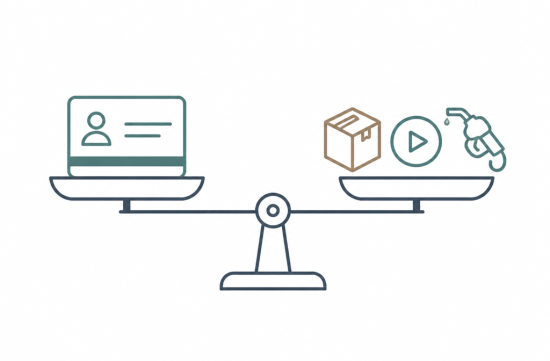
Not long ago, I received a message about the automatic renewal of my Prime membership and found myself staring at the screen for a while. The amount that was charged every year without much thought suddenly caught my attention this time.
If I pay the annual fee, it's $139, and if I pay monthly, it's $14.99. At first glance, these numbers don't seem too high, but when I looked at the total for the year, it was a different story.
In fact, this $139 fee hasn't always been the same. In February 2022, the annual fee increased from $119 to $139, which was a 17 percent hike. It was the first increase since 2018.
This time, I decided not to rely on my gut feeling and to review my order history from the past year from start to finish. I organized how much I spent each month and what benefits I actually used.
The first thing I checked was shipping costs. If you order without Prime, you need to spend $35 to qualify for free shipping.
I also confirmed that books are an exception, with free shipping starting at $25. Since I don't buy books often, this condition didn't mean much to me.
The issue wasn't just the amount. If you choose standard shipping without Prime, it usually takes about 5 to 8 days for delivery.
The longer wait can be frustrating, especially for items needed urgently. In contrast, Prime members can receive most essentials within a day or two.
Counting my orders, I found that I ordered about four times a month on average. Wondering if that was unusually high, I looked it up and found that the median for Prime members is exactly four times a month, or about 48 times a year.
Data also showed that 42 percent of members order two to four times a month, while 36 percent order between five and ten times. It turns out my spending pattern isn't as unusual as I thought.
Another striking figure was that the average annual spending for Prime members on Amazon is about $1,170. That breaks down to around $100 a month.
My spending was not much different from that average. So, just considering the savings on shipping, the annual fee was easily covered.
Besides shipping costs, I also checked the discounts on subscriptions and the Subscribe & Save program. Individual items get at least a 5 percent discount, and if you receive five or more items at the same address, you can get up to a 15 percent discount.
Next, I looked into streaming. I checked my actual viewing history for Prime Video.
I was surprised to see how often I had it on. If I subscribed to video separately without Prime, it would cost $8.99 a month.
If I wanted ad-free quality, it would add another $4.99. So, just for video alone, it accounted for more than half of the Prime membership fee.
After calculating all this, I started to lean towards one side. However, there were definitely benefits I wasn't using at all.
Gas discounts are a prime example. You can get a 10-cent discount per gallon at bp, Amoco, and ampm gas stations, but since I hardly use those brands, it didn't apply to me.
The delivery app subscription benefit was similar. I knew it existed, but I hadn't used it even once throughout the year.
Calculating the total benefits, including those I don't use, felt a bit forced. It seemed no different from trying to justify a gym membership that I never use.
To be honest, I should only consider the items I actually use. Just from shipping and video viewing, I was already surpassing the annual fee.
So, the conclusion became clear. At least for me, the Prime membership was a worthwhile expense.
However, this calculation can vary greatly from person to person. If someone only orders once or twice a month and hardly watches streaming, the situation would be the opposite.
In that case, it would be more rational to spend $35 to qualify for free shipping and accept the longer delivery times for non-urgent items. I don't think there's a need to force justification for the Prime fee.
For those eligible for government assistance programs, the situation is different. If you qualify for EBT, Medicaid, or SNAP, you can access Prime for $6.99 a month.
If you meet those conditions, I believe it's best to sign up without hesitation. A few dollars a month can feel significant when looking at overall living expenses.
One thing I've learned from years of consumer experience is that relying on gut feelings about subscription fees often leaves you feeling like you're losing out.
It becomes clear where you stand only when you lay out the actual numbers. Maintaining a subscription just because everyone else does is different from calculating it directly.
I plan to make it a habit to review my order history like this once a year when it's time to renew.
Numbers don't lie, so I'm prepared to accept whatever conclusions arise, even if they change over time.
 ChocoBuddy





 Silent Sea |
 Pointy |
 Idaho's Sumi's House |
 holy cheese |
 Michigan Enthusiast |
 Tomex Train Uncle |
 An ant castle |
 Que Buena |
  tredon |
 clarion |
  Park M.Y. |
  Poppin News |
  metsoo |
  dewyo |
  Casa Mia |
  Asparagus Blog |
  dorange |
  hiddenkong |
  some fame |
  Godory Life |
  Lime Juice |
  French fries |
  Rynex |
  Caribbean |
  Let's Be Like a Salt-like City Person |
  Belgray Miscellany |
  sweetvan |
  Augusta Univ |
  Round and Round Children's Song Kingdom |