
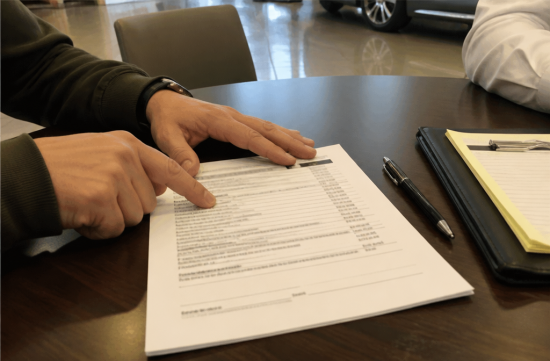
A friend of mine recently went to buy a used car and was shocked when he received the contract. The final amount presented by the dealer was several hundred dollars different from the price he saw online.
In such cases, the items that sneak in are what are commonly referred to as dealer fees. Today, I want to break down the money you really need to pay versus what you can negotiate away.
The first item that comes up is the doc fee, which is the fee for processing paperwork. This is the money charged under the pretext that the dealer is handling the registration or title application for you.
A report from CarEdge analyzing over 96,000 contracts in 2025 found that the national average doc fee was $400. Just looking at the number, it seems quite hefty.
However, there is a significant variation by state. In states without a cap, doc fees can be charged anywhere from $700 to $999.
Fortunately, New York has it a bit better. Since August 2021, New York has capped the dealer doc fee at $175.
There is one more condition attached. The dealer can only charge this fee if they actually handle the registration or title application; if they don't do it and still charge, that's a violation of the regulations.
In neighboring New Jersey, the situation is different. The average doc fee for dealers in New Jersey is $712, which is four times that of New York.
It's also good to know that in regulated states like California, the average is around $107. It's fascinating how the fee structure changes just by crossing state lines.
So the first thing to do is simple. If the doc fee listed on the estimate exceeds $175, ask for the justification right there.
The second thing to watch out for is the so-called add-on items. These include paint protection coatings, nitrogen tire fills, and lost key protection packages.
According to a 2025 survey, 91% of dealers included such add-ons in their estimates. When bundled together, the average cost per item was around $2,084.
In Southern California, Florida, and Texas, it's not uncommon for this amount to exceed $3,500 to $5,000, which is quite surprising, isn't it?
In fact, these items often have very low costs but can be inflated to several hundred dollars. This is also where there is the most room for negotiation.
Just saying "please remove this item before signing" will often lead to most of them being taken off. They are not legally required items.
The third item is the markup on the used car itself. This refers to the profit margin that the dealer adds to the purchase price.
Typically, the markup ranges from 10% to 35% of the purchase price, with the most common range being 15% to 25%. In dollar terms, that means an additional $1,500 to $4,000.
Of course, this also includes legitimate costs like maintenance, warranties, and store overhead, so it's not entirely negative. Still, knowing this as a negotiation point can't hurt.
The fourth item is financing. The loans that dealers connect you with are often more expensive than those from banks or credit unions.
The pre-approved rates from credit unions start around 4.74% to 4.99%, while the average dealer rate is between 6% and 8%. The difference is quite significant.
Dealers typically add 1 to 2 percentage points to the rate they receive from banks and pocket the difference. This is known in the industry as buy rate markup.
So, it's best to get pre-approved from a credit union or bank before going to the dealership. This way, you can immediately compare whether the rate the dealer offers is reasonable.
These four items—doc fees, add-ons, markups, and financing—should be negotiated separately. If you only ask about the total price, the dealer may shuffle the items around and easily bring you back to square one.
That's why experts unanimously advise negotiating the out-the-door price. This means asking for the final amount that includes all items except taxes and registration fees.
Having just this one number allows you to neatly compare estimates from various dealers. Hidden items will naturally come to light.
There's also the option of buying directly between individuals without going through a dealer. In this case, there are no doc fees or add-ons at all.
However, you must get a pre-purchase inspection, commonly known as PPI. The cost usually ranges from $150 to $250, and can go up to $300 to $500 depending on the type of vehicle.
Buying from a private seller means there's no warranty and you have to handle the paperwork yourself, which can be a hassle. Still, considering the fees saved, it's worth it even if you have to get inspected twice.
If it were me, I would first get pre-approved from a credit union, then gather out-the-door price estimates from several dealers, and start negotiating from the lowest one. It's a method that allows for clear numerical comparisons.
In New York, since the doc fee cap is legally set, if you can properly filter out the add-ons and financing, the amount you save can be quite substantial. Ultimately, developing the habit of carefully reviewing each document is the biggest savings, isn't it?
 MagicOcean







 Silent Sea |
 Pointy |
 Idaho's Sumi's House |
 holy cheese |
 Michigan Enthusiast |
 newyorker 101 |
 International Court |
 Living with a Consistent Heart |
 Things to Do to Buy a House |
 Encyclopedia of New York and Surrounding Areas |
  tredon |
  Poppin News |
  metsoo |
  dewyo |
  Casa Mia |
  Asparagus Blog |
  dorange |
  hiddenkong |
  some fame |
  Godory Life |
  Lime Juice |
  French fries |
  Rynex |
  Caribbean |
  Let's Be Like a Salt-like City Person |
  Belgray Miscellany |
  sweetvan |
  Augusta Univ |
  Round and Round Children's Song Kingdom |
  butter 90 |