
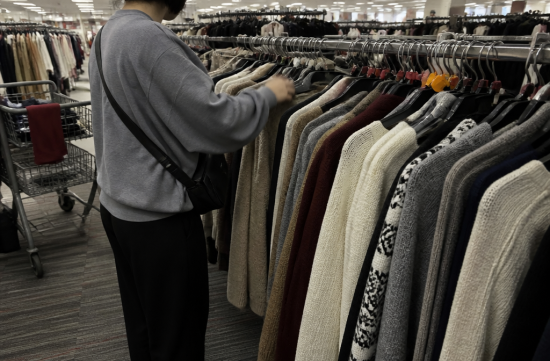
Last week, I heard from a junior colleague that they bought a winter coat at full price. They couldn't resist when the perfect color showed up in the store.
Hearing that made me think that if they had just waited a few months, it wouldn't have even cost half that much.
Among those who shop for clothes in the U.S., there is a group that never pays full price. They hold out until the season is completely over and only open their wallets when the 70% off sale hits.
It's not that these people have extraordinary patience. Once they understand how prices actually drop in stores, waiting starts to look much more reasonable.
Just looking at Target, the structure is quite clear. Clearance usually starts at a 30% discount and continues to drop over a couple of weeks.
After going through several rounds, products eventually reach a 70% discount. Compared to the original price tag, it becomes a completely different price point.
Interestingly, there seems to be a pattern to the days of the week. Women's clothing markdowns tend to cluster on Tuesdays, so targeting specific days is better than aimlessly wandering the store.
Macy's operates a bit differently. They have clearance events for out-of-season items about four times a year.
During these events, discounts range from 40% to 60% by department. And if you enter the section called Last Act, you can find shoes and clothing marked down by 60% to 80%.
JC Penney has set dates for markdowns. New markdowns are released on the first and third Fridays of each month.
Seeing prices that initially didn't feel significant drop to 80% over several Fridays makes me think that those who aren't in a rush ultimately win.
Gap also has its own rhythm. About four weeks after new products hit the store, markdown stickers start appearing.
These markdowns usually happen mid-week, and in April and August, they run online clearance events that add an extra 50% discount.
Looking at the seasons, the flow becomes even clearer. Winter clothes tend to drop in price between January and February, when it's still cold, but stores need to bring in spring items.
Summer clothes, on the other hand, are cleared out between August and September. They need to make room for fall's new arrivals, so summer dresses and short sleeves tend to drop significantly during this time.
Fall clothing markdowns start a bit later, around late October to early November. Prices for fall items drop just before winter coats and knits fill the stores.
Since each store has different markdown days and cycles, relying on just one store can lead to missed opportunities. Some people check multiple places, like Target on Tuesdays and JC Penney on the first and third Fridays.
I also set up email alerts for a few brands I'm interested in. I get notifications whenever markdowns happen, so I don't have to visit the store every time, reducing unnecessary trips.
Once you understand this flow, it makes sense why some people only target end-of-season sales. They watch both the timing of new product releases and the timing of inventory clearances.
Those who buy at full price prioritize wanting to wear something right away, while those who wait for sales seem to think about the fact that they will wear the clothes in the next season anyway.
Of course, this method isn't without its weaknesses. Popular sizes and colors often sell out long before sales begin.
Among the items that remain at 70% off, it's not uncommon to find only extremely small or large sizes, or colors that no one chose.
So, shopping during end-of-season sales is more about the calculation that buying at this price isn't a loss rather than a necessity for that specific item.
Personally, I think this method works well for expensive outerwear like coats or jackets. Similar designs come out every year, and the price differences can be significant.
On the other hand, for lower-priced items like t-shirts or basic pants, I don't see much reason to wait several months. Even with a big discount, the savings might only be a few dollars, which isn't worth the time and effort.
There's a common saying among those who wait for sales: since they'll wear it next season anyway, there's no reason to pay more now.
I can relate to this sentiment to some extent. Especially for winter coats, which are worn for several years, there seems to be little reason to rush.
However, I also want to point out that this strategy isn't for everyone. It requires time and flexibility to check stores multiple times or regularly visit online clearance pages.
For busy people, the process of waiting weeks or months can itself become stressful.
Ultimately, whether to buy at full price or wait for a sale seems to depend more on individual lifestyles than on right or wrong. If I didn't need something urgently, I would choose to wait at least a season.
If you're planning to buy a winter coat next year, it might not be a bad idea to check the markdown schedule around the end of January instead of rushing into the store right now.
 MacaronTroupe


 Silent Sea |
 Pointy |
 Idaho's Sumi's House |
 holy cheese |
 Michigan Enthusiast |
 breezem |

 silverleaf |
 eatontown blog |

 metsoo |
  dewyo |
  Casa Mia |
  Asparagus Blog |
  dorange |
  hiddenkong |
  some fame |
  Godory Life |
  Lime Juice |
  French fries |
  Rynex |
  Caribbean |
  Let's Be Like a Salt-like City Person |
  Belgray Miscellany |
  sweetvan |
  Augusta Univ |
  Round and Round Children's Song Kingdom |
  butter 90 |
  Lando Mao |
  Washington Denzel DJ |