
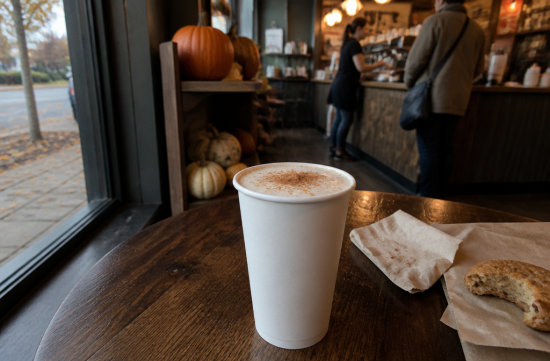
As soon as you open the door to the store, there's a strong smell that hits you. It's a warm scent of cinnamon and nutmeg. Ah, it feels like this season has returned once again.
The same goes for cafes. The menu prominently features pumpkin, and the display is lined with fall-scented candles.
At this point, you might wonder. When did this pumpkin scent take over the entire United States, and why?
In fact, the history of this spice combination is much older than you might think. The first American cookbook, published in 1796, included a recipe for pumpkin pie flavored with ginger, mace, nutmeg, and allspice. The first company to package these spices together was McCormick, which established the standard we know today by introducing a blend of pie spices around the time canned pumpkin puree was first released in 1934.
What elevated this long-standing scent to a global trend was something else. In 2003, the pumpkin spice latte was born in a Starbucks experimental space.
Initially, it was quietly test-marketed in 100 stores in Vancouver and Washington D.C. The response was extraordinary. It quickly surpassed the sales records of the already established peppermint mocha and eggnog latte, spreading to stores across the U.S. the following year.
In the following decade, 200 million cups were sold. It even earned the title of the best-selling beverage in Starbucks history.
However, here's the twist. This latte actually contains very little pumpkin. The actual pumpkin content is minimal, and most of the flavor comes from the spices.
The essence of the scent is a blend of cinnamon, nutmeg, clove, and ginger. It's essentially borrowing the name pumpkin.
In movie terms, it's like putting the lead actor's name in the title while the screen is filled with supporting characters.
So why does this particular spice combination resonate so deeply with people?
Research shows that our sense of smell holds memories more firmly than other senses. A single scent can evoke an entire season or scene.
When you smell cinnamon and ginger, memories of autumn landscapes from childhood, school days, and family gatherings come rushing back.
With seasonal contexts like fall foliage, back-to-school, and Halloween preparations overlapping, this scent has become a symbol of autumn.
Moreover, spices like cinnamon and ginger are known to have warming properties. This combination aligns perfectly with the drop in temperatures.
With both psychological nostalgia and physical warmth combined in one scent, it's no wonder people respond to it every year.
The problem is that this scent doesn't stop at just one latte. Every fall, the variety of products infused with this scent noticeably increases.
Cereals, snacks, air fresheners, and candles all switch to pumpkin flavor as soon as fall arrives. You can even find this scent in pet treats and hand sanitizers.
Social media also plays a role. Every year around this time, posts showcasing the first cup of pumpkin spice become a trend, reigniting interest.
Among them, the presence of the candle industry is particularly significant. Brands like Yankee Candle release limited-edition scents every fall, creating a near-fandom among consumers.
In 2021, Americans spent $5.8 billion on scented candles alone. That's a sum that makes the production budget of a typical blockbuster movie seem trivial.
Just the value of the Yankee Candle brand alone exceeds $1.2 billion, showcasing how much market growth can come from a single scent.
From a marketing perspective, the answer is surprisingly simple. The limited-edition strategy that can only be purchased at this time of year effectively taps into consumer urgency.
Since these products appear and disappear at set times, people open their wallets to avoid missing out on that short window.
This is similar to how audiences flock to seasonal films. People tend to line up for works they can only see now rather than those available at any time.
Interestingly, this craze is particularly strong in the United States. It's rare to find a culture that so deeply associates an entire season with a single scent.
You don't necessarily have to buy store-bought candles to create a similar warmth. Just simmering cinnamon sticks and a few cloves in a pot can fill your home with that autumn scent.
Personally, I sometimes find this scent a bit overwhelming. When every place from the local grocery store to the hair salon and bank has the same scent, it feels less like a seasonal vibe and more like a flood of spices.
Still, every year around this time, I find myself sniffing the air and welcoming that scent. Despite saying I dislike it, I inevitably return to it, like a familiar comfort film.
Ultimately, this pumpkin spice craze is less about the power of the scent itself and more about the intricate interplay of memory, season, and marketing. It's surprising to realize that just a few spices can drive such a large industry.
The way this country uses a single scent to herald the arrival of autumn is surprisingly clever. It's essentially branding an entire season.
This fall, if you catch a whiff of that scent, it might not be a bad idea to enjoy it a little instead of dismissing it as mere marketing.
 HangoverGuy




 Florida King |
 AH LALA |
 Victory 1988 |
 Panorama Kstar |
 Giant Squid and Sweet Potato Soup |
 Purple Moons, |



 dewyo |
  Casa Mia |
  Asparagus Blog |
  dorange |
  hiddenkong |
  some fame |
  Godory Life |
  Lime Juice |
  French fries |
  Rynex |
  Caribbean |
  Let's Be Like a Salt-like City Person |
  Belgray Miscellany |
  sweetvan |
  Augusta Univ |
  Round and Round Children's Song Kingdom |
  butter 90 |
  Lando Mao |
  Washington Denzel DJ |
  LIZ Legal Information Blog |