

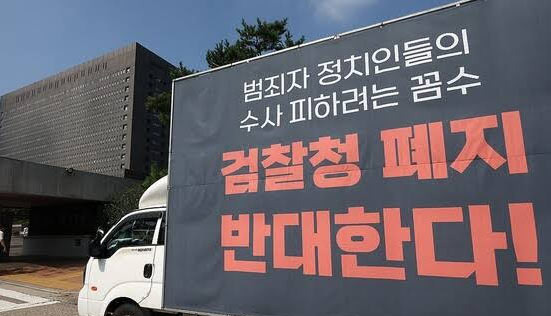
According to South Korean news, starting October 2, 2026, the Prosecutor's Office law will be abolished, and the organization known as the Prosecutor's Office will disappear into history.
The Prosecutor's Office has been a national institution for 78 years since the establishment of the government in 1948.
Of course, just because it has existed for 78 years doesn't mean it must be preserved without question. As times change, government organizations can also be reformed.
However, witnessing such a large-scale overhaul of the national criminal justice system makes me wonder if sufficient preparation and verification have been completed.
If we ask whether the abolition of the Prosecutor's Office was a decision made directly by the people, the answer is no.
There has never been a national referendum on the abolition of the Prosecutor's Office in South Korea.
The legally designated decision-making body is the National Assembly.
The National Assembly passed the law, and the President announced it, leading to the abolition of the Prosecutor's Office law and the implementation of the Public Prosecution Office system starting October 2, 2026.
The Public Prosecution Office law explicitly states, "The Public Prosecution Office law passed by the National Assembly is hereby announced."
However, this does not mean that the President and the government's intentions are irrelevant.
It is more accurate to view this system as a combination of the current government's push for prosecutorial reform and the legislative actions of the majority in the National Assembly.
So what will happen in the future? According to the news, the status and system of prosecutors will not disappear.
Instead, a new organization called the Public Prosecution Office will be created, where prosecutors will handle indictments and maintaining prosecutions, while investigative functions will be separated into the police and the Serious Crimes Investigation Agency.
The intention is to separate investigative and prosecutorial powers to distribute the authority that has been concentrated in the Prosecutor's Office.
I understand this part.
But does simply transferring power from one entity to another automatically resolve the issues of power?
If the authority of the Serious Crimes Investigation Agency or the police increases, who will properly oversee those agencies?
What happens if there is a conflict of opinion between the agency responsible for investigations and the one making prosecutorial decisions?
If a prosecutor believes that an investigation is lacking but the investigative agency does not take action, what will happen?
From the public's perspective, if an incident occurs, and the police say it's a Public Prosecution Office issue, the Public Prosecution Office claims there's a lack of investigation, and the Serious Crimes Investigation Agency says it's not under their jurisdiction, where exactly should one go to seek resolution?
Changing a government organization is not as simple as moving a few boxes like in a company.
Transferring a task to another department involves a tremendous amount of work, including IT systems, personnel, budgets, accountability, internal regulations, training, and record transfers.
Let alone the national criminal justice system that involves arresting individuals, conducting searches, prosecuting, and bringing cases to trial.
That's why I feel even more frustrated.
This is not to say that the Prosecutor's Office has never had issues in the past.
There has been long-standing criticism that prosecutorial power was excessively strong, and controversies over political neutrality have been repeated.
Therefore, it is natural to have intense discussions about how to address those issues.
However, recognizing that the existing system has significant problems and ensuring that the new system functions properly are entirely different matters.
Moreover, the fact that such a large-scale organizational restructuring is being done through legislation is also something to consider.
If this government and the National Assembly can change the law to abolish the Prosecutor's Office, future governments and assemblies can also change the law again.
What will happen if, at that time, they say, "The Public Prosecution Office system has failed," and propose to create an organization similar to the Prosecutor's Office?
I worry that we might become a country where the organizational structure of the core investigative agency changes with each change of administration.
I have no particular interest in whether the name of the agency is the Prosecutor's Office or the Public Prosecution Office.
It is not a matter of viewing the abolition of the Prosecutor's Office as reform and its retention as anti-reform.
Changing the signboard on October 2, 2026, can be done in a day.
However, it will take years to verify whether the results of changing a criminal justice system that has been in operation for 78 years are truly effective.
Ultimately, the question will not be why the Prosecutor's Office was abolished, but whether investigations have become fairer, whether power agencies have become more independent, and whether the public is better protected.
If that answer cannot be adequately demonstrated, no matter how grandly it is labeled as reform, it will ultimately be just another organizational restructuring, and it seems likely that it will be restored in the next administration.
 MintJoy
 VelvetValley97







 Florida King |
 AH LALA |
 Victory 1988 |
 Panorama Kstar |
 Giant Squid and Sweet Potato Soup |
 Yellow Snowman |
  Alpha and Omega World |
 holy cheese |
 Say IT Now |
  Always Dreaming of Big Success |
  NEXT ROUND |
  Helpful Life Stories |
  Healthy Local Fresh Information |
  molten |
  Way to easy |
  intact |
  happy 9 |
  Park M.Y. |
  tredon |
  Poppin News |
  metsoo |
  dewyo |
  Casa Mia |
  Asparagus Blog |
  dorange |
  hiddenkong |
  some fame |