

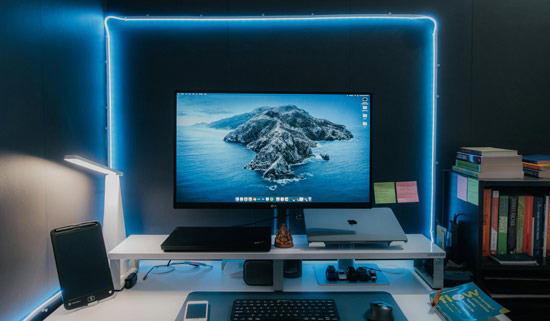
Sometimes I imagine. Will there really be a day in the near future when my computer says, "It's 128-bit"?
Right now, 64-bit is taken for granted, and no one thinks about it, but in the past, 16-bit and 32-bit were also considered future technologies.
This naturally raises the question of when 128-bit will arrive.
However, I found out that the possibility of a 128-bit computer era is almost nonexistent, haha.
The reason is that while the number of bits looks impressive when doubled, there is actually very little benefit.
Even with a 64-bit address space, theoretically, it could allocate memory for every grain of sand on Earth and still have plenty left over.
In this situation, there is no reason to double it. Moreover, increasing the number of bits complicates hardware design, increases power consumption and heat generation, and the actual perceived performance hardly improves. So, from an engineer's perspective, the first question is, "Why do this?"
If it's for encryption or prime number calculations, it's even less likely. People might think that since they deal with large numbers, the CPU bit width should also increase, but the reality is the opposite. Encryption calculations already break down hundreds or thousands of bit numbers into smaller parts for repeated calculations, so whether the CPU is 64-bit or 128-bit, the essence does not change.
Therefore, the evolution of future computers is flowing towards core count, parallel processing, power efficiency, and AI acceleration, rather than the number of bits. However, it cannot be definitively stated that a 126-bit computer will never come out. If it does, it is likely to be more about marketing or symbolism than technical necessity.
For example, in the era of quantum computers, there may come a day when someone uses a completely different unit and says, "This corresponds to 126 bits." Or game companies or movies might use terms like "126-bit superintelligent computer" to exaggerate the future.
Ultimately, a 126-bit computer is more of a device to show how big we can imagine technology rather than a solution to real-world problems. Looking at history, true innovation has come not when numbers get larger, but when directions change.
So, one day we might say instead of boasting about the number of bits, "This computer thinks differently." By then, the number 126 bits will likely just be a joke we recall with a smile.
To put it metaphorically, the reason most cars have four wheels is that "it's the optimal point," not because of a lack of technology.
Making six wheels might slightly increase traction, but it complicates the structure and significantly increases weight and cost. The steering structure also becomes more difficult, and the points of failure increase. The losses outweigh the gains. Of course, trucks that carry a lot of cargo benefit from having more wheels.
The same goes for the bits in computers. A 64-bit structure already sufficiently covers memory addresses, operational ranges, and operating system structures. Increasing to 128-bit or 126-bit theoretically offers advantages, but the actual changes perceived by users are minimal. In contrast, the difficulty of hardware design, power consumption, and compatibility issues noticeably increase.
Thus, in everyday passenger cars and personal computers, four wheels and a 64-bit structure are already in a balanced state. Therefore, it is not that they are not made, but rather that there is little reason to make them.







 Korean Mom |
 novapixel |
 Peter Pan Pet |
 horse |
 Sunset Oregon |
 Living Economy Information Blog |
 Shining Our Own World |

 California Kangaroo |
 Tonky |
  viroma |
  cookie |
  Live and that's it |
  Alright Twain |
  eatontown blog |
  HAWAII Korean Church News |
  Amore |
  linex |
  Balancework |
  laro90 |
  MEDBIO American Doctor Blog |
  SWAT TEAM BLK |
  DREAM BIG |
  frostbite |
  330 Forever My Love |
  El Dorado |
  dralix58 |
  Gorama Round |
  Skydiving |