
Recently, while visiting a friend's house in America, I found myself staring at a piece of paper stuck to the refrigerator door.
Next to the children's names were items like washing dishes, folding laundry, sweeping the yard, and walking the dog, with each task carefully listed alongside the amount they would earn. It looked like a mini payroll sheet, and I couldn't help but laugh.
There was a small note below stating that if there were no check marks, there would be no allowance that week, and that firmness was oddly impressive.
For someone like me, who grew up in Korea, allowance was more like an unconditional expression of love from parents, given without any strings attached.
While I had seen bonuses for good grades, the idea of pricing each household chore was a foreign concept. The thought of calculating how much to pay for a few errands was unimaginable in my home.
However, I was even more surprised to learn that this wasn't just a quirky practice in a few American households, but rather a fairly common cultural norm.
In the summer, it's typical to see neighborhood teenagers mowing lawns for extra cash or selling lemonade from a stand as they embark on their first business ventures.
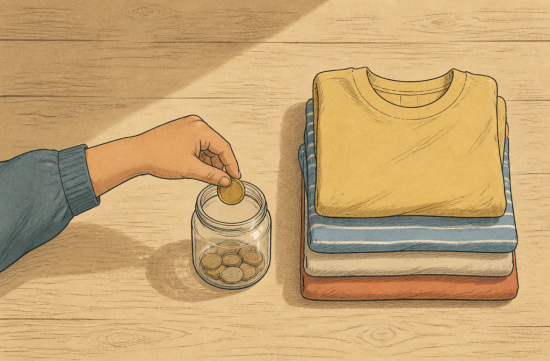
Younger children are said to naturally accept the idea of filling their allowance envelopes based on the work they do, rather than just collecting coins in a piggy bank.
Curious to see the numbers, I did some research and found that there are actually quite a few detailed studies on this topic.
A survey conducted by Harris Poll for the American Institute of CPAs found that 52 percent of respondents believe that allowance should be directly tied to household chores. This means that more than half support the idea of compensating children based on the work they do, rather than just giving them a set amount each month.
Moreover, 86 percent of people believe that children should receive some form of allowance.
In the same survey, the average weekly allowance for children was reported to be $30, and the chores they performed to earn that money averaged about 5.1 hours per week.
Another survey by T. Rowe Price showed similar trends.
Seventy-nine percent of parents reported giving their children an allowance, and among them, 64 percent required that chores be completed in order to receive it.
Seeing such overlapping results from two different organizations made me confident that this is not just a personal preference for a few families, but a cultural norm that permeates society.
This raises the question: why is there such a strong emphasis on teaching the connection between work and money?
Looking back, the answer seems to have deep historical roots.
In 18th century agrarian America, even five-year-old children were expected to help out on the farm. Tasks like planting seeds, caring for livestock, and fetching water were shared responsibilities among all family members, regardless of age.
At that time, a child's labor was seen as a natural contribution to the family community, not something to be compensated separately.
As time passed and society industrialized, the role of labor was replaced by the new educational tool of allowance. The skills necessary for survival that were once learned through physical work have now shifted to teaching the concept of money.
Interestingly, not everyone agrees with this approach.
Author Ron Lieber argues that allowance should remain a teaching tool rather than a wage.
Psychologist Wendy Mogul also emphasizes that chores are a natural responsibility of family members and should not be treated as something to be bought and sold. She expresses concern that if children are paid every time they do the dishes, the sense of helping each other as family members may diminish.
On the other hand, there are strong opinions suggesting that children who learn the relationship between work and reward from a young age are more likely to maintain a diligent attitude as adults.
Both sides have valid points, making it difficult to declare one as the definitive answer.
Personally, observing this debate has made me realize how much American society values self-sufficiency. It subtly teaches children from a young age that parents are not always there to take care of everything for them.
This method instills a sense of earning something based on one's own efforts from an early age.
However, it's also important to acknowledge that not every family has the luxury to adopt this approach.
In financially strained households, a child's labor can become a part of survival rather than education, so this method isn't always as beautiful as it seems. We must remember that good intentions can carry very different weights depending on circumstances.
Nonetheless, I believe there are valuable lessons to be learned from this culture.
Rather than becoming accustomed to receiving things without effort, the experience of accomplishing even small tasks and seeing the results can become a significant asset for children. That asset will likely last much longer than the amount of their allowance.
The piece of paper stuck to the refrigerator door was, in fact, a small map showing how a society wants to raise its children into responsible adults.
 SunnyDay





 Florida King |
 AH LALA |
 Victory 1988 |
 Panorama Kstar |
 Giant Squid and Sweet Potato Soup |
 seouljung |

 Jimbeam 88 |
 Vision XT |
  Way to easy |
 US Home Buying Information Home Insurance |
  molten |
  intact |
  Always Dreaming of Big Success |
  happy 9 |
  Park M.Y. |
  tredon |
  Poppin News |
  metsoo |
  dewyo |
  Casa Mia |
  Asparagus Blog |
  dorange |
  hiddenkong |
  some fame |
  Godory Life |
  Lime Juice |
  French fries |
  Rynex |
  Caribbean |