
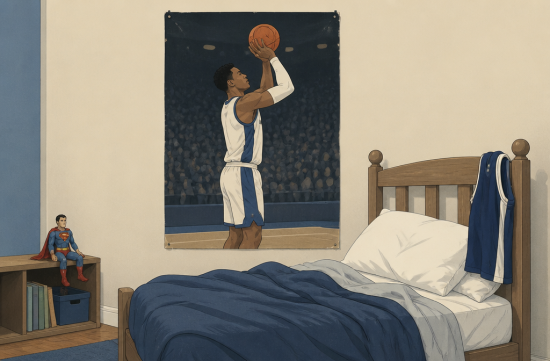
When my friend's child was five years old, the only conversations were about Spider-Man. Whether it was during meals, before bed, or while bathing, it was all about Spider-Man.
But by third grade, suddenly, all he talked about was Stephen Curry. Superheroes quietly disappeared from the conversation.
I wondered if this was just a unique case for that family, so I did some research. I was curious if American parents felt similarly. I vaguely remembered going through a similar transition myself.
Then I came across a survey released this year. It was conducted with 2,000 children aged 4 to 12 and their parents.
The number one hero chosen by the kids was their parents. A whopping 71 percent answered that way.
Teachers followed with 40 percent, and siblings were at 37 percent. It turns out the people they see every day were their top choices.
Relatives were at 33 percent, and friends at 31 percent. Most of the top spots were filled by people close to them.
Interestingly, the next spot was taken by superhero characters, which accounted for 29 percent.
Celebrities and cartoon characters each followed with 22 percent. While characters may have dropped in rank, they certainly weren't gone.
Spider-Man, Batman, and Black Panther still made the list. Newer trends like Sonic, Bluey, and K-Pop Demon Hunters' Lumi also appeared.
However, it was notable that names of real athletes like Michael Jordan and LeBron James were also listed right alongside them.
What caught my attention was the change by age group. While characters dominate in preschool, the focus shifts toward real athletes as kids reach upper elementary school.
This shift coincides perfectly with the age when children start participating in sports. The timing is too coincidental to be just a coincidence.
Last year, the sports participation rate among American kids rose to 58 percent. It peaks between the ages of 9 and 12.
Children who have thrown a ball and made a shot will definitely see the athletes on screen differently.
In psychology, this is referred to as observational learning. It's the theory that we learn by watching those we feel resemble us.
Characters that fly and shoot webs are cool, but they are beings I can never become.
On the other hand, basketball players jump with the same legs I have and throw the ball with the same hands. The key is that their bodies are not different from mine.
That one difference subtly shifts the pedestal of admiration. The experience of having tried it yourself completely changes the direction of respect.
Moreover, cartoons have predetermined endings. No matter how many times you watch, Spider-Man always wins in the end. That safety may be comforting in childhood, but as one grows up, it can feel a bit dull.
In sports, no one knows what will happen next. An athlete who was doing well yesterday might be sidelined by an injury today.
This unscripted uncertainty seems to draw kids in even more. As someone who loves music, I think it's similar to the thrill of live performances, where mistakes and recoveries feel more exhilarating than recorded tracks.
This trend isn't something that just started recently. If you trace back, it goes all the way to the trading cards sold by tobacco companies in the 1880s.
The reason they put athletes' faces on those cards was obvious. It was marketing aimed at getting kids to pester their parents to collect the cards.
The explosive growth really began in the 1950s when TVs entered homes.
Names like Mickey Mantle, Willie Mays, Johnny Unitas, and Bill Russell appeared on screens every week. On school playgrounds, cards with those faces were passed around.
For that generation of kids, athletes were tangible idols they could collect. Nowadays, highlights and social media accounts serve that role instead, but the essence hasn't changed much.
However, it's not all positive. Especially for younger children, the line between admiration and blind faith can easily blur.
Researchers warn that when a child believes an athlete is perfect, the disappointment is much greater when that athlete shows flaws.
Participation in sports also varies by income. The participation rate for children from low-income families hovers around 36 percent, which means the opportunity to choose idols isn't equal.
Ultimately, who a child idolizes is closely tied to what they have experienced and tried themselves.
Personally, I don't mind this trend. I find stories of people who make mistakes and rise again to be much more rhythmic than those of perfect heroes.
 JellyPower


 Florida King |
 AH LALA |
 Victory 1988 |
 Panorama Kstar |
 Giant Squid and Sweet Potato Soup |
 Misstic M |

 Yoyma |

 Round and Round Children's Song Kingdom |
 Vasila's Newlywed Blog |
  Healthy Local Fresh Information |
  molten |
  Way to easy |
  intact |
  Always Dreaming of Big Success |
  happy 9 |
  Park M.Y. |
  tredon |
  Poppin News |
  metsoo |
  dewyo |
  Casa Mia |
  Asparagus Blog |
  dorange |
  hiddenkong |
  some fame |
  Godory Life |
  Lime Juice |
  French fries |
  Rynex |