

Many people come in with headaches during consultations.
Everyone asks, "Is this just because I'm tired, or is it something serious?"
Headaches can generally be divided into those with clear causes and those that occur due to body conditions.
First, headaches with clear causes have relatively obvious reasons.
These can be due to a sudden spike in blood pressure, a tendency for migraines, dental issues, jaw problems, or in severe cases, structural issues like cerebrovascular problems. These headaches often have a repetitive pattern, with specific areas consistently hurting, and they may not respond well to medication.
On the other hand, headaches that occur with the flu or a cold have a different nature. They are characterized by a general heaviness and dull pain in the head, accompanied by fever and body aches. Most of the time, there is a feeling of tightness in the head, dry eyes, and overall body soreness. These headaches typically disappear naturally as the fever subsides and the condition improves.
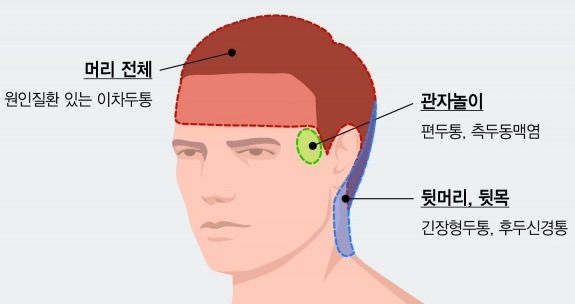
Headaches that cause pain around the temples should be considered separately. They often occur when there is significant stress, a habit of clenching teeth, or lack of sleep, leading to muscle tension in the temple area. Migraines often start in the temple area as well, so if the pain feels like a throbbing pulse, it may be worth considering a migraine.
Conversely, headaches that cause stiffness in the back of the neck and pain in the back of the head are often related to issues with neck and shoulder muscles.
Spending long hours sitting in front of a computer or looking down at a smartphone can cause neck muscles to tighten, leading to pain that radiates to the back of the head.
This is often more related to posture than the head itself, so stretching or correcting posture can be more effective than painkillers in many cases. I always say in the consultation room that if headaches become increasingly severe or are accompanied by neurological symptoms, it is essential to get them checked.
However, headaches that come and go with systemic symptoms like a cold, or those related to stress or posture, usually improve with lifestyle adjustments.
In fact, many people experience a dull headache that feels like a cold after a night of poor sleep.
In the consultation room, I often hear expressions like, "I don't have a fever, but I feel like I have body aches and my head feels heavy." This is closer to a headache caused by a lack of sleep disrupting the balance of the autonomic nervous system and immune system than a cold.
When sleep is insufficient, the brain does not recover adequately, and stress hormones remain elevated. This leads to symptoms like a tightening sensation in the head, dry eyes, and stiffness in the neck and shoulders.
As the condition worsens, the body can feel heavy like during a cold, leading to confusion with cold symptoms. The characteristic of this headache is that there are almost no respiratory symptoms like a runny nose or cough, and it tends to improve relatively quickly after a day or two of good rest.
The key to treatment is to restore sleep. Going to bed early for a day or two and cutting out smartphones or caffeine before sleep can make a difference. Staying hydrated to prevent dehydration and stretching the neck and shoulders can significantly reduce stiffness in the back of the neck.
Painkillers can be helpful once or twice when needed, but I do not recommend relying on them continuously.
If these headaches occur frequently, it is best to check not only sleep duration but also sleep quality and stress management.







 Tora Tora |
 neroyo |
 nivex85 |
 Old English |
 nixxon |
 Peter Pan Pet |
 Nuchuhan Exploration BLOG |
 Moscow Kim |

 Sugar Cream Door Bulletproof Noodles |
  road98 |
  Churros Train Conductor |
  gleeful |
  Burbank Lee |
  Olivia's Blog |
  Bushing Around Life |
  Active |
  Cherokee Rose |
  Kor. Master |
  Holey Moley |
  Conflite Teacher |
  Hodong Prince Over Flex |
  Mist inn |
  citrus pop |
  Onion Ring |
  phoenixia |
  viewtop |
  loverun |
  Kim Do Sun |
  SEVEN SEVEN |