
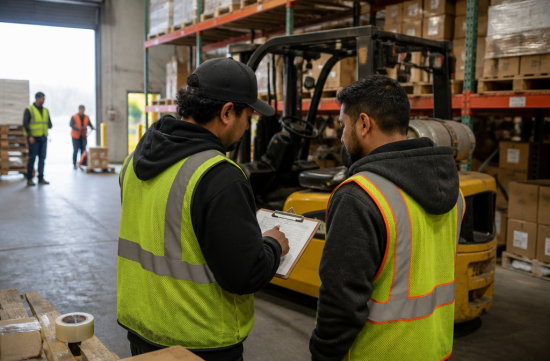
Recently, I heard a story from an acquaintance who started working on the packing line in a warehouse and, after four years, was promoted to shift manager. Hearing that made me curious about whether there is a real path to becoming a manager in warehouse operations.
Upon researching, I found that the answer isn't straightforward because this question actually mixes two different job roles. The U.S. Bureau of Labor Statistics categorizes the first management position just above warehouse operations as a different job code from the true managerial role above it.
First, looking at the first supervisor level that leads the shift, as of May 2025, the median annual salary is $62,890, which translates to an hourly wage of $30.23.
If you move up to the manager level responsible for the entire warehouse or distribution center, the median annual salary jumps to $107,230 at the same time.
The gap between these two positions exceeds $40,000, and it's not just because of a higher job title; the nature of the responsibilities changes completely. Since this role involves managing people, budgets, and overall safety regulations, it's not surprising that the wage difference is this significant.
Interestingly, the typical educational requirement for this managerial position, according to federal statistics, is a high school diploma. Since a college degree is not a mandatory requirement, it means that the door is open for those who start from the ground up.
Instead of a degree, the requirement is over five years of relevant work experience. Ultimately, the ticket in is not a diploma but time and experience, making it one of the few job categories where tenure outweighs educational pedigree on the resume.
The actual path generally flows like this.
You start in field positions like picking, packing, or forklift operation, then move up to team lead or shift lead, and from there, you progress to supervisor and then manager.
The first promotion to team lead or shift lead typically takes about one to one and a half years. The conditions are not grand; consistent attendance and noticeable performance are essentially all that is required.
At this point, you will first be responsible for scheduling others and writing simple reports. As your responsibilities expand to include safety management and inventory systems, you will then be classified as a supervisor.
The total time from supervisor to manager is usually estimated to be around five to ten years.
However, if you have an associate degree or a supply chain-related certification, this period can be reduced to three to five years, and while a degree is not mandatory, having one certainly acts as a shortcut.
If it were me, I would recommend obtaining at least one relevant certification during nights or weekends rather than just extending the time spent in the field. According to feedback from practitioners, the difference in perception between having a certification listed on the promotion application and not having one is more significant than expected.
That said, having field experience is definitely not a disadvantage for qualifying as a manager. In fact, those who do not understand the field and try to create schedules or safety regulations often end up with superficial knowledge, so it is common to see those who have risen from the ground up become more solid managers.
Practical skills, such as having a forklift license or experience with warehouse management systems, also subtly contribute to scoring points in promotion evaluations.
Conversely, during manager promotion interviews, Excel and report writing skills are often scrutinized more closely, so it's not just about excelling in hands-on work.
The job outlook is also fairly positive. From 2024 to 2034, employment in this managerial role is expected to grow by 6 percent, which is faster than the average for all occupations.
It is estimated that about 18,300 new positions will open nationwide each year. While this number includes positions that become available due to retirements or job changes, it is clear that this is a field that continues to need people.
Surprisingly, the first thing that often affects promotion evaluations is attendance rather than skill. I have heard from managers that if you frequently miss work, no matter how fast you are, you will likely be removed from the list of leadership candidates.
The second most common issue is English proficiency in meetings and document work. While fieldwork is hands-on, from the supervisor level onward, meetings and reports take up half of the job, so I have often seen candidates fall behind in this area.
Therefore, for those preparing for this stage, it is practical to familiarize yourself with documentation and reporting methods in advance.
If your company offers leadership training or safety training programs, it's a good idea not to decline and to volunteer for them.
During the company evaluation season, it's also good to know that attendance records and safety violations are the first things to be filtered out. Conversely, if your attendance and safety records are clean, you can at least get your name on the promotion candidate list, which means that basic skills take precedence over flashy qualifications.
Some may feel that this path is blocked due to gender or age, but statistically, the educational and experience requirements apply equally to everyone.
Ultimately, the dividing line is how long you have been with the company, your reputation within the company, and how well you have prepared the necessary qualifications in advance.
This is not a glamorous path. However, it is certainly worth noting that it is one of the few routes to reach a salary in the $100,000 range within ten years without student loans.
Therefore, I tend to view this path as a solid investment rather than a waste of time.
 Brighto








 Always Dreaming of Big Success |
 happy 9 |
 coloradoman |
 pintos |
 mapsina |
 nero kim |

 VVV 80 |

 DOCTOR MED |
  Say IT Now |
  Alpha and Omega World |
  NEXT ROUND |
  Helpful Life Stories |
  Healthy Local Fresh Information |
  molten |
  Way to easy |
  intact |
  Park M.Y. |
  tredon |
  Poppin News |
  metsoo |
  dewyo |
  Casa Mia |
  Asparagus Blog |
  dorange |
  hiddenkong |