
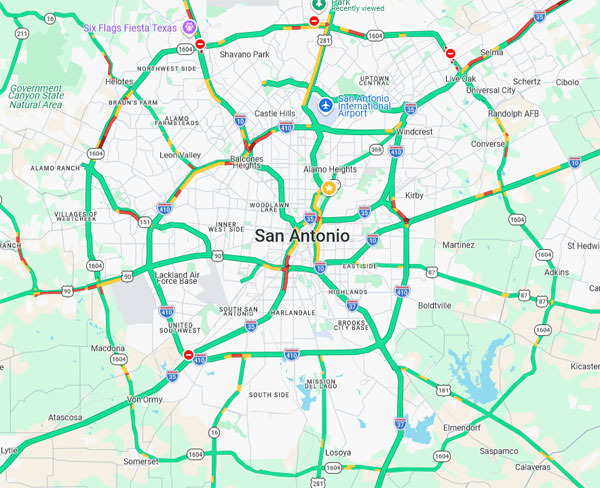
If you've been driving in San Antonio for a while, you might have noticed that traffic has definitely increased lately.
Especially during rush hour on 281, I-10, and Loop 1604, the atmosphere feels quite different compared to ten years ago.
In the past, driving north on 281 didn't really give the impression of congestion, but nowadays, just after 4 PM on weekdays, cars are lined up.
The same goes for 1604, which connects to I-10. The area where I-10 and 1604 meet can get pretty congested if you hit it at the wrong time.
Interestingly, after living in San Antonio for a few years, visiting LA or Houston can completely change your perspective.
"Oh, San Antonio is still a city that doesn't have bad traffic yet."
And once you get on California's 405 or I-10 freeway in the afternoon, the congestion in San Antonio can feel quite mild.
In Houston, if there's an accident around I-10, I-45, or 610, traffic can pile up incredibly fast.
New York has the added bottlenecks of bridges and tunnels contributing to road congestion.
San Antonio is the seventh largest city in the U.S., so how does it manage to hold up this well?
There are several reasons, but the most noticeable while driving is definitely the Loop structure.
If you look at a map of San Antonio, you'll see Loop 410 wrapping around the city, with the massive Loop 1604 surrounding it.
Roads like I-10, I-35, I-37, and US-281 extend outward from the city center. It looks like a spider web with overlapping circles.
The advantage of this structure is that there are relatively few cases where there's only one way to reach a destination.
If 281 is congested, you can take 1604 toward I-10, or depending on your destination, you might use 410.
Vehicles that don't need to pass through the city center can completely bypass it using 1604.
Especially the existence of Loop 1604 is significant. Even as San Antonio's northern areas expand toward Stone Oak, La Cantera, and UTSA, not all vehicles need to head downtown.
Loop 1604 accommodates traffic moving between northern areas. Of course, just having a Loop doesn't eliminate traffic congestion.
In fact, as San Antonio continues to grow, housing, shopping centers, and businesses have sprung up around 1604, making it a commuter road.
The ongoing large-scale expansion projects can be seen as a result of this. Still, looking at the city as a whole, there is still some breathing room.
Even when someone says, "Today the roads were really congested in San Antonio," it's often the case that after about 10 minutes, you can be back to driving at 60-70 mph.
In LA, that 20 minutes can stretch to an hour. So while driving on 281 or 1604, you might think, "San Antonio has become a traffic hell too," but after a trip to LA, your perspective changes.
San Antonio is definitely more congested than it was ten years ago. If the population continues to grow, it will likely get worse.
However, the two massive loops, 410 and 1604, along with the radial highway network connecting them, have played a significant role in dispersing traffic as the city has grown.
Ultimately, San Antonio's Loop can be considered a hidden hero of its road network, preventing it from experiencing the daily traffic jams seen in cities like LA or Houston.
 CocoPastaHelp







 Casa Mia |
 TEXAS Fishing Boat |
 Study Abroad Life Know-How Tips |
 pravix22 |
 American Hardcore Band |
 solvix18 |
 Coding Elf |
 alamo |
 Alpha and Omega World |
  Always Dreaming of Big Success |
  NEXT ROUND |
  Helpful Life Stories |
  Healthy Local Fresh Information |
  molten |
  Way to easy |
  intact |
  happy 9 |
  Park M.Y. |
  tredon |
  Poppin News |
  metsoo |
  dewyo |
  Asparagus Blog |
  dorange |
  hiddenkong |
  some fame |
  Godory Life |